Hand and Wrist Protection for Karate: Wraps, Guards, and When to Use Them
Most competitors I’ve worked with treat hand and wrist protection as an afterthought. They’ll spend serious money on a gi, agonise over which belt to buy, then grab whatever foam guards are sitting in the club’s lost property box and call it done. I’ve seen students tape their wrists with electrical tape because they forgot their wraps. I’ve seen competitors show up to a regional tournament with guards that don’t meet the association’s specifications and have to borrow a pair from a stranger. The result, in almost every case, is that they perform worse than they trained - not because they lacked skill, but because their hands didn’t feel right.
This matters more than most people admit. Your hands are your primary tools. If your wrist feels unstable on impact, you’ll unconsciously pull your punches. If your guards are too thick, you lose proprioceptive feedback and your timing drifts. If you’ve trained without wraps and then suddenly put them on for a grading, your hands feel foreign to you at exactly the wrong moment.
Here’s what I’ve learned about getting this right - after years of making most of these mistakes myself.
Why Wraps Are Not Optional for Serious Training
I used to think wraps were for people with weak wrists. That was a white belt opinion, and I held it embarrassingly long. My first instructor kept telling me to wrap before bag work. I kept skipping it. Then I jammed my wrist badly on a heavy bag during a session where I was rushing, tired, and not thinking about alignment. Three weeks off serious training. Lesson learned the hard way.
What wraps actually do is create a stable platform for your wrist joint under load. When you’re throwing a committed gyaku-zuki into a heavy bag or makiwara, the force travels up through your hand and into your wrist. Without support, that joint has to manage the impact entirely through its own ligament and tendon structure. That’s fine at low intensity. At high repetition or high force, it’s a slow accumulation of stress that eventually becomes an injury.
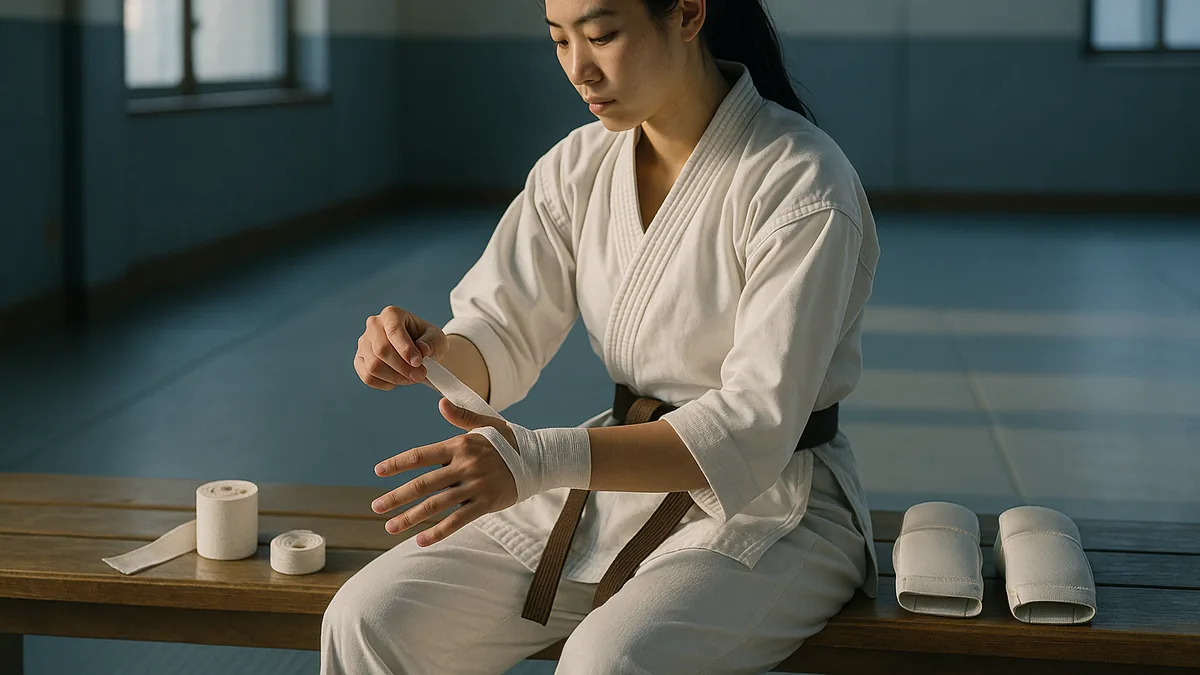
The physical sensation of a properly wrapped wrist is distinctive once you know it. It should feel secure without feeling rigid. You want to be able to make a full fist comfortably, feel the thumb tucked safely, and sense a slight compression around the wrist joint itself. If your fingers are going numb or your grip feels compromised, the wrap is too tight. If you can feel the wrap shifting during movement, it’s too loose or the technique is wrong.
How to Wrap for Karate Specifically
Karate wrapping is not the same as boxing wrapping, and I think this is worth being clear about. Boxing wraps are designed for repeated heavy impact with a glove over the top. Karate wraps need to allow more hand mobility because you’re not wearing a glove in most training contexts. What I tell students is: wrap for wrist stability first, knuckle protection second.
A simple approach that works:
- Start at the wrist, two or three passes around the joint
- Come across the back of the hand and loop around the thumb base
- Pass back across the knuckles, one or two passes
- Return to the wrist and secure
You want the wrist passes to be firm. The knuckle passes should be snug but not compressive. The whole wrap should take about 90 seconds once you’ve done it a few hundred times. If it’s taking you five minutes, you’re overthinking it.
One mistake I see constantly with newer students is wrapping too high up the forearm. They think they’re giving themselves more support. What they’re actually doing is restricting the wrist’s natural range of motion, which changes how the punch lands and creates a different kind of stress. Keep the wrap focused on the wrist joint itself.
Guards: What They’re Actually For
Guards protect your training partner as much as they protect you. This is something I didn’t fully internalise until I started grading students and watching their sparring. A beginner without guards is a liability to everyone around them, not just themselves. An experienced practitioner without guards is still a liability - they just know it and control their technique accordingly.
For competition specifically, guards serve a second function: they standardise the contact surface so that judges can assess technique quality rather than trying to account for wildly different impact variables. This is why your association’s specifications matter. WKF-approved guards have specific density and coverage requirements for a reason.
I prefer open-finger guards for most sparring contexts. The feedback you get through your fingertips matters for gripping, redirecting, and sensing your opponent’s movement. Full-coverage mitts feel safer but they deaden your awareness. The correction that makes the biggest difference when students switch from full mitts to open guards is usually in their distance management - suddenly they can feel when they’re too close, and they adjust naturally.
Guard Selection for Competition
This is where I’ll take a firm position: don’t buy cheap guards for competition. I know that sounds obvious, but I’ve watched students show up to competitions with guards that are either non-compliant or so poorly made that they compress unevenly under contact. The second problem is worse than the first. Uneven compression means the force distribution on impact is unpredictable, which affects your scoring and your opponent’s safety.
What to look for:
- Association compliance marking (WKF, national federation, etc.)
- Even foam density across the striking surface - press it in different spots, it should feel consistent
- Secure wrist strap that doesn’t shift during movement
- Thumb protection that doesn’t restrict your hand position in kamae
The fit around the wrist is the thing most people ignore. Your guard should sit snug enough that it doesn’t rotate when you throw a technique. If it’s spinning on your wrist mid-combination, your alignment is compromised and you’ll know it - it feels like throwing with a loose wheel on a car.
Wraps for Training, Guards for Competition - But It’s Not That Simple
The general rule holds: wraps in training, guards in competition sparring. But the actual picture has more nuance, and I’ve changed my thinking on this over the years.
I now recommend that competitors train with their competition guards regularly - not exclusively, but regularly enough that the guards feel normal. The weight, the slight change in hand position, the way the foam affects your feedback on contact - all of these are variables that your nervous system needs to adapt to. If you train exclusively without guards and then put them on for competition, you’re introducing an unfamiliar variable at the worst possible moment.
What I tell students preparing for their first competition: spend at least four weeks doing some portion of your sparring in your actual competition guards. Not training guards, not borrowed guards - the specific pair you’ll wear on the day. Your hands need to know those guards.
The reverse is also true. Don’t wear guards for all your training. Bare-hand or wrapped training develops sensitivity and control that guards can mask. The best competitors I’ve trained with can move fluidly between both because they’ve built their technique on a foundation that doesn’t depend on equipment feedback.
If you’re thinking about your overall equipment setup, it’s worth being as deliberate about your gi as you are about your protection - I’d point you toward the Best Karate Gi for Beginners and the honest breakdown of budget versus premium gi options as a starting point for thinking about where to invest.
Common Mistakes I’ve Actually Seen
Training through wrist pain without wraps. This one is common and the reasoning is usually “it’s not that bad.” I’ve seen students develop chronic wrist issues from exactly this approach. Pain during bag work or makiwara training is information. Wraps won’t fix a technique problem, but they’ll protect the joint while you work on it. If you’re curious about makiwara training specifically, there’s a useful honest assessment at Do You Need a Makiwara? that’s worth reading before you commit to that training tool.
Wearing guards that are too large. The instinct is that bigger means more protection. In practice, oversized guards shift during movement, change your hand position in ways you don’t notice until you’re under pressure, and give you a false sense of security. Fit matters more than size.
Removing wraps between rounds and not replacing them. I’ve watched students take their wraps off during a water break and not bother putting them back on. The rationale is usually that it takes too long. The wrap is doing structural work. The moment you remove it, your wrist is unsupported again. Either stay wrapped or don’t bother - the on-off approach gives you the worst of both.
Assuming guards replace wraps. They don’t. Guards protect the striking surface and your training partner. Wraps stabilise the wrist joint. These are different functions. Wearing guards without wraps underneath in a heavy contact session is like wearing shin guards without proper footwear - you’ve protected one thing and left another exposed. Speaking of which, if you haven’t thought about footwear for your training context, Do Karate Shoes Actually Help? covers that ground well.
Community Perspective
There’s genuine disagreement in the karate community about how much protection is appropriate in training, and I think it’s worth being honest about that rather than pretending there’s one right answer.
Traditional practitioners - particularly those from Shotokan and Goju-Ryu backgrounds - often resist guards in regular training on the grounds that they change technique and create dependency. The argument is that bare-hand training forces you to develop control, and that control is the point. I have some sympathy for this view. I’ve trained in dojos where guards were rarely used outside of competition preparation, and the standard of control in those dojos was noticeably high.
Sport karate competitors, particularly those training for WKF-style competition, tend toward more regular guard use because the rules require them and because the training environment is higher contact. This is also a legitimate approach.
What I’ve noticed is that the disagreement is often less about the equipment itself and more about training philosophy. The practitioners who are most opposed to guard use are usually also the ones most focused on precision and control. The practitioners who use guards regularly are often working in higher-contact environments where the guards are genuinely necessary for safety.
My honest position: use both, understand what each one is for, and don’t let either become a crutch. If you only ever train with guards, put them aside for some sessions and see what your technique actually feels like. If you never use them, you’re not preparing properly for competition. The equipment should serve your training, not define it.
And if you’re thinking about the broader picture of how you treat and present your training equipment - including your belt - the piece on karate belt display and storage is a good reflection on how we relate to what we train with.
Key Takeaways
- Wrap your wrists before bag work, pad work, and makiwara training - not because you’re weak, but because the joint deserves support under repeated load
- Train in your actual competition guards regularly in the weeks before competition - your hands need to know that equipment before the day
- Guard fit matters more than guard size - a well-fitted smaller guard outperforms an oversized one that shifts during movement
- Wraps and guards serve different functions and neither replaces the other - you need both in your kit
- If your technique changes noticeably when you put guards on or take them off, that’s feedback about what your technique is actually built on
- Don’t make equipment decisions in the car park before training - know what you’re wearing, why you’re wearing it, and have it ready before you step on the floor
The weekly digest
New karate articles, once a week
One email every week with everything new on Karate Lifestyle. No spam; unsubscribe in one click.
We'll email you to confirm. See our privacy policy.