Karate Belt Display and Storage: How to Respect Your Rank
I’ve watched students earn their black belts and then stuff them into a gym bag alongside sweaty sparring gear. I’ve seen belts faded to grey, fraying at the edges, tied in knots that took ten minutes to undo before grading. And every single time, I think the same thing: this person worked for years to earn that rank, and they’re treating the symbol of it like a spare shoelace.
This isn’t about being precious. It’s about understanding what the belt actually represents and acting accordingly.
Why the Belt Deserves More Than a Gym Bag
The belt records your journey in a way nothing else does. In some traditional dojos, you never wash your belt at all - the idea being that the sweat and wear of training is literally embedded in it. I don’t fully subscribe to that view (more on that later), but I understand the principle behind it. The belt is not decoration. It marks where you’ve been.
I used to think the belt was just a ranking system - a way to organise students by ability. By brown belt, I’d started to understand it differently. The belt is a physical reminder of obligation. When you put it on, you’re committing to train at the level it represents. When you take it off, you’re responsible for how you treat that commitment.
That shift in thinking changed how I handled mine. I stopped leaving it in the bag. I started folding it properly. Small thing, but the mindset behind it matters.
How to Store Your Belt Properly
The most common storage mistake I see is leaving the belt loosely coiled or shoved into a bag. It seems harmless. Over time, it isn’t. The fabric creases permanently, the stiffness breaks down unevenly, and the embroidery (if you have it) starts to fray at the folds.
What I tell students is this: fold it flat, or hang it. Those are your two real options.
Flat folding works well for students who don’t have a dedicated display space. Fold the belt in thirds lengthwise first, then fold it in half, then in half again. You end up with a compact, flat rectangle that sits cleanly in a drawer or shelf. No tight bends at the embroidered sections. No coiling that stresses the fabric.
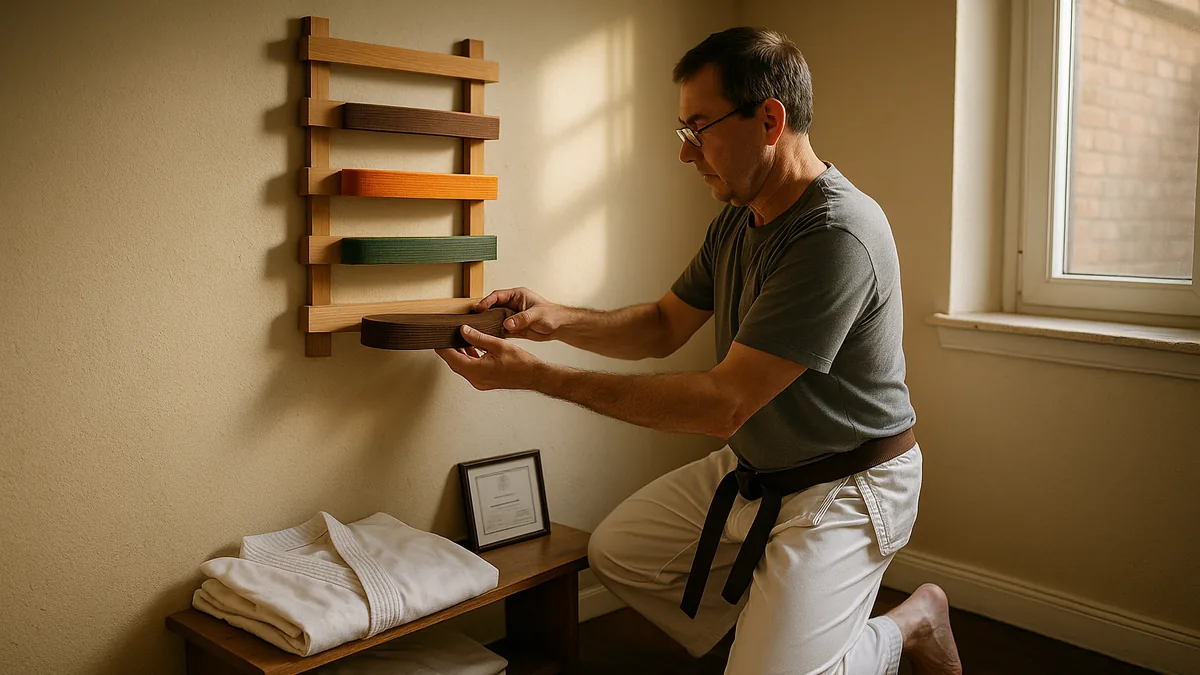
Hanging is better if you have the space. A simple belt hanger - either a dedicated karate rack or even a smooth wooden dowel - keeps the belt at full length without any pressure points. You’ll feel the difference when you tie it: a belt that’s been hung stays cooperative. A belt that’s been crammed into a bag fights you every time.
I’d recommend against plastic storage boxes unless you’re archiving old belts. The lack of airflow traps moisture, especially if the belt was worn recently. Mould is rarer than people think, but musty fabric is not.
If you’re serious about your kit in general - and you should be - the same care principles apply to your gi. The How to Care for Your Karate Gi guide covers the fabric side of things in detail and is worth reading alongside this.
Displaying Your Belt: The Right Way to Show Respect for Rank
There’s a version of belt display that’s pure ego - a wall of belts arranged to impress visitors. I’ve been in homes like that. The belts are dusty, the display is about status, and the owner usually hasn’t trained in years.
That’s not what I’m talking about.
Displaying your current belt - or your complete progression - done thoughtfully, is something different. It keeps your training present in your daily life. I have my belts on a rack in the room where I do my home practice. I look at them before I train. It’s a small ritual, but it grounds the session.
Dedicated Belt Racks
A proper belt rack holds multiple belts horizontally, usually on wooden dowels or pegs. You can display your full progression, or just your current belt. I prefer the full progression because it’s honest - it shows the whole path, not just where you are now. That white belt at the bottom is as much a part of the story as the black belt at the top.
What I’ve noticed with students who display their progression is that they tend to talk about their training differently. There’s less posturing about rank and more acknowledgement of how long the road has been. That’s the psychological value of the display done right.
Shadow Boxes and Framed Displays
Some practitioners frame a belt with their grading certificate or a photo from their grading day. I think this works well for significant milestones - shodan especially. It marks the occasion without making the belt inaccessible for training.
One thing to watch: UV exposure. Direct sunlight will fade a black belt to a washed-out brown faster than you’d expect, especially if it’s a cotton belt rather than a synthetic one. If you’re framing behind glass, use UV-filtering glass. If you’re using a rack near a window, keep it out of direct sun.
Placement in the Home
I’ve noticed that where people put their display matters more than they realise. A belt rack in a high-traffic area - a hallway, a living room - becomes background noise quickly. You stop seeing it. Putting it in the space where you actually train keeps it meaningful. It stays connected to the practice rather than becoming furniture.
Cleaning Your Belt Without Destroying It
Here’s where the community genuinely disagrees, and I’ll tell you where I land.
The traditional position is that you never wash your belt. The sweat is part of it. Some instructors say this with real conviction, and I respect the principle. But I’ve also watched a student’s white belt turn a shade of grey-yellow that was genuinely unhygienic, and I’ve smelled belts that had no business being near other people. There’s a point where tradition becomes an excuse for not washing your kit.
My position: wash your belt when it needs it. Not after every session. Not on a schedule. When it actually needs cleaning.
For cotton belts, a gentle hand wash in cool water with mild detergent is enough. No machine washing - the agitation breaks down the fabric structure faster than you’d think, and the embroidery suffers badly. Rinse thoroughly, reshape while damp, and lay it flat to dry away from direct heat. Do not tumble dry. The shrinkage is unpredictable and the stiffness never comes back the same way.
For synthetic or competition belts, the same principle applies but they’re more forgiving. Still hand wash. Still lay flat to dry.
The one thing I’ve seen go wrong repeatedly is students wringing out their belt to dry it faster. You’ll feel the twist damage the fabric - it doesn’t bounce back the way a towel does. Lay it flat, let gravity do the work, and give it 24 hours before you fold or hang it.
If your belt has embroidery or a printed name, turn it inside out before washing. The embroidery thread is more fragile than the belt fabric and the colour will run if you’re not careful.
Community Perspective
The “never wash your belt” tradition is one of those topics that generates real disagreement between dojos, and I’ve trained in places that held both positions firmly.
The traditional argument is genuinely about more than hygiene - it’s about the idea that washing removes something earned. The belt darkens and stiffens with training, and that physical change is seen as meaningful. I trained under one instructor for three years who held this view absolutely, and I respected it in his dojo.
The counter-argument, which I now hold, is that treating your belt with respect includes keeping it in a condition that honours what it represents. A belt that smells of months of accumulated sweat is not a mark of dedication - it’s just an unwashed piece of fabric. The commitment is in your training, not in avoiding the sink.
What I’ve noticed is that this debate often tracks with how long someone has been training and what kind of dojo culture they grew up in. Traditional Shotokan dojos tend toward the no-wash position. Sports karate environments tend to be more pragmatic. Neither is wrong about the underlying value - they just express it differently.
If you trained under an instructor who told you never to wash it, I’m not saying ignore that. I’m saying understand why they said it, and make a considered choice rather than a lazy one.
Mistakes I See Constantly
Tying the belt loosely out of habit. This one isn’t about storage, but it belongs here. The belt should sit firmly at the waist, both ends equal length, the knot flat and tight. I’ve corrected this in students at every grade. When the belt is tied sloppily, the whole presentation suffers - and more importantly, it tells me something about how focused the student was when they got dressed. What I tell students is: the way you tie your belt before training sets the tone for the session.
Keeping all belts in the same bag as sparring gear. The contact with hard plastic guards, velcro straps, and damp gloves destroys belt fabric faster than anything else. Keep your sparring gear separate from your training belts. This is basic kit management.
Displaying the wrong belt. I’ve seen students put up their previous belt on the rack because it looks more impressive - a darker, more worn black belt versus a newer one. Display the belt you actually earned. The worn one goes in the archive box.
Folding embroidery against itself. The embroidered section of a belt - usually the end with your name or grade - needs to be folded so the embroidery faces outward, not pressed flat against another embroidered section. The thread catches and pulls. I’ve seen belts with embroidery half-detached because of this, and it’s entirely avoidable.
Key Takeaways
- Fold your belt flat in thirds or hang it on a smooth rack - never coil it tightly or leave it in a bag with hard equipment
- Display your full belt progression if you have the space; it keeps the whole journey visible, not just your current rank
- Wash your belt when it genuinely needs it, by hand in cool water, and lay it flat to dry - tradition is worth respecting, but not at the cost of basic hygiene
- Keep belts out of direct sunlight whether displayed or stored; UV fading is faster than you expect, especially on cotton black belts
- Tie your belt properly every single time - the physical act of tying it correctly is part of how you prepare to train
- Store your current training belt separately from your archive belts and completely separately from your sparring kit
If you’re building out your training kit more broadly, the Karate Training Equipment for Home guide is a good place to think about how your belt display fits into a proper training space rather than just a corner of the bedroom.
The weekly digest
New karate articles, once a week
One email every week with everything new on Karate Lifestyle. No spam; unsubscribe in one click.
We'll email you to confirm. See our privacy policy.