Groin Guards for Karate: What Men and Women Actually Need and What Most Clubs Get Wrong
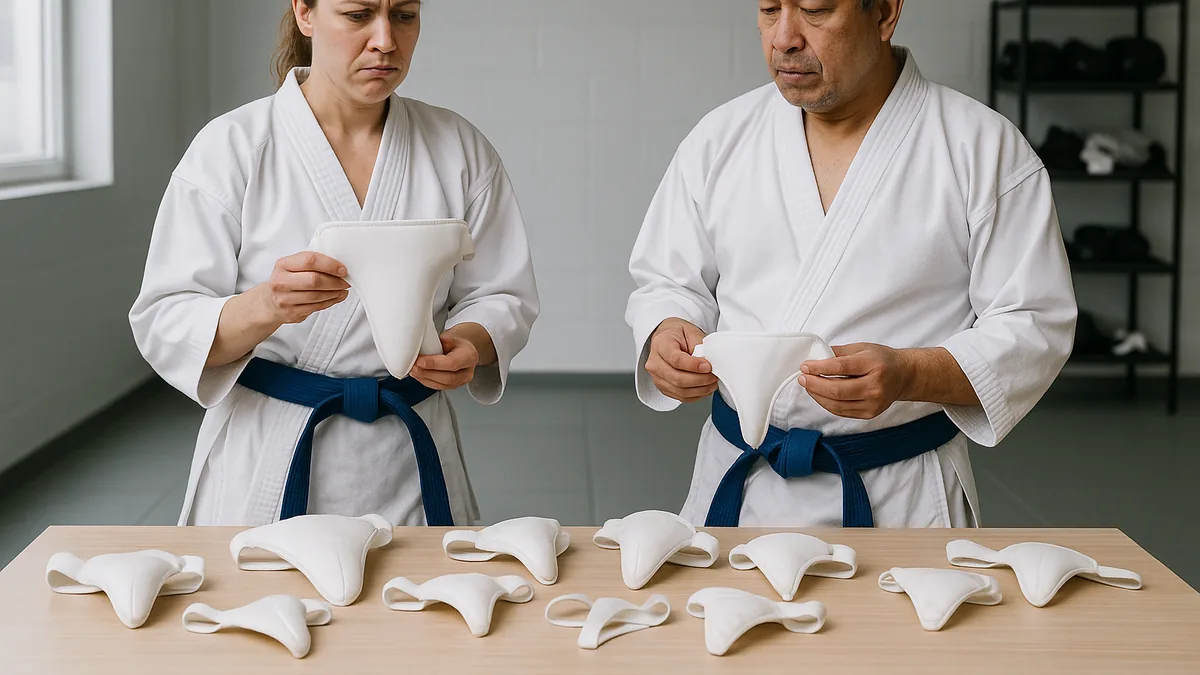
Most clubs hand out a groin guard to new students like it’s a formality - tick the box, move on. I’ve watched instructors spend twenty minutes explaining the correct way to tie an obi and then hand a brand new female student a hard cup designed for a man and tell her “that’ll do.” It won’t do. It hasn’t done for years, and the fact that we’re still doing it says more about how little serious thought goes into equipment education than it does about the equipment itself.
This matters more than most people think. A groin guard that fits badly doesn’t just fail to protect you - it actively interferes with your movement, your stances, your kicks. I’ve had students training with guards so ill-fitting that they were subconsciously shortening their mae-geri to avoid the discomfort. They didn’t know that’s what they were doing. I only spotted it because I’ve seen the same compensation pattern dozens of times.
Men and Women Are Not the Same - And the Equipment Shouldn’t Be Either
I know that sounds obvious. It isn’t, apparently, because the default assumption in a huge number of clubs is that groin protection is a men’s issue and women either don’t need it or can make do with something designed for male anatomy.
Women absolutely need groin protection. The pubic bone, the labia, and the surrounding soft tissue are all vulnerable to a low kick or a knee that comes in during clinch work. I’ve seen women take hits in that area during sparring that stopped training dead. The idea that women are somehow exempt from this kind of injury is one of those quiet assumptions that nobody ever said out loud but that shapes how clubs buy and distribute equipment.
What women need is different in shape and coverage. Male guards are designed around the cup - a hard or semi-rigid shell that protects the testes and penis. Female guards are flatter, wider, and designed to sit flush against the pubic area without the protruding cup shape. They’re often made with more padding across a broader surface area. When a female student is handed a male guard, it doesn’t sit correctly, it shifts during movement, and it leaves the areas that actually need protecting partially exposed.
What I tell students when we cover this in equipment sessions is simple: if your guard moves when you throw a roundhouse, it’s either the wrong size or the wrong type. A guard that shifts isn’t protecting you - it’s just giving you a false sense of security, which is arguably worse.
For Men: Hard Cup vs. Compression Shorts with Integrated Guard
This is where I’ve changed my mind over the years. When I started training, the hard plastic cup in a jockstrap was the only option most clubs offered, and I wore one for about eight years without questioning it. The thing that changed my understanding was actually grading a group of senior students and watching how their movement was affected by what they were wearing underneath.
One student - a solid second dan - moved noticeably better in his lower body than two others at the same grade. I asked him about it afterwards. He’d switched to a compression short with a semi-rigid integrated guard about six months earlier. His hip rotation in ushiro-geri was cleaner. His transitions between stances felt more fluid to him, he said. Less bulk, better positioning, nothing shifting around.
I tried it myself. The difference in comfort during extended training sessions is significant. The traditional hard cup sits further from the body, can rotate out of position, and creates a gap between the cup and the body that can actually worsen impact in some scenarios - the cup moves instead of distributing force. A well-fitted integrated guard sits closer, moves with you, and doesn’t require a separate jockstrap that can bunch or shift.
I’d recommend the compression short format for most regular training. Hard cups have their place - full contact competition, heavy bag work with partners who aren’t controlling their kicks yet, or any session where the impact risk is genuinely elevated. But for standard dojo training, the integrated option wins on comfort, fit, and practicality.
The Fit Problem - What Actually Goes Wrong
One mistake I see constantly is students buying on size alone. They look at the size chart, pick medium because they’re a medium in everything else, and that’s the end of the decision-making process. Groin guards don’t work like gi jackets. The fit needs to account for hip width, waist position, and how the guard sits relative to your stance.
I’ve noticed that students with a lower, wider fighting stance - more common in Goju-Ryu and some Kyokushin-influenced clubs - often need to size up in the waist band even if the guard shell itself fits correctly. The reason is that in a deeper stance, the guard pulls forward and down slightly. If the waistband is too tight, it creates pressure that becomes genuinely distracting after about twenty minutes. If it’s too loose, the guard drops.
The test I use with students is this: put the guard on, drop into your deepest zenkutsu-dachi, and then throw three mae-geri at full extension. If the guard has moved when you check it, it’s not fitted correctly. If you felt it pulling or shifting during the kicks, same problem. A correctly fitted guard should feel almost like it isn’t there - not because it’s doing nothing, but because it’s moving with you rather than against you.
For women specifically, the fit test should include lateral movement - yoko-geri and ashi-barai - because the wider coverage area on female guards can catch on the inner thigh if the guard is too large. You’ll feel it as a slight drag or pinch during side kicks. That’s the guard, not your technique.
What Most Clubs Get Wrong in How They Teach This
The education gap is the real problem. Equipment lists get handed out, guards get bought, and then nobody says another word about it until someone takes a hit and the guard fails.
I’ve seen three specific situations where this plays out badly:
The “just wear it” briefing. New student gets told to wear a groin guard. No guidance on type, fit, or how to check it’s working. Student buys whatever is cheapest on Amazon, wears it incorrectly, and either gets hurt or trains for months with compromised movement they don’t know about.
The female student who gets ignored. I’ve watched this happen more times than I want to admit. A new female student joins, the equipment list mentions groin guard, she either asks about it and gets a vague answer or doesn’t ask and assumes it doesn’t apply to her. Nobody takes the time to explain that yes, she needs one, and here’s what type. This isn’t malicious - it’s a gap in how clubs think about the conversation.
The student who wears it wrong. This one surprised me the first time I saw it. A teenage male student had been training for four months wearing his cup guard positioned too high - covering his lower abdomen but leaving the actual target area partially unprotected. He’d never been shown how to position it. He’d just put it on and trained. The correction that made the biggest difference wasn’t technical - it was just showing him where the guard should actually sit and having him check it in the mirror before putting his gi on.
If you’re running sessions or helping new students with equipment - and if you’re a senior student, you should be doing this - treat groin guard fitting like you’d treat any other part of equipment education. It deserves the same attention you’d give to hand and wrist protection or shin guards. The stakes are at least as high.
Material and Construction - What to Actually Look For
The market has improved a lot in the last decade. When I started training, your options were basically a hard plastic cup or a harder plastic cup. Now there’s a reasonable range of materials, and it’s worth understanding what you’re choosing between.
Hard shell (polycarbonate or ABS plastic): Maximum protection, least comfortable for extended training. Good for competition or heavy contact work. Tends to be bulkier and more prone to shifting.
Semi-rigid (EVA foam with a harder core): The middle ground I prefer for most training. Enough rigidity to distribute impact properly, enough flex to move with you. These tend to fit better across a range of stances and don’t create the same pressure points as a full hard shell.
Soft foam only: I wouldn’t recommend these for anything beyond very light contact kata training. They compress under impact rather than distributing it, which means the force still reaches the target - just slightly slower. That’s not protection, it’s delay.
For women, most of the better options on the market are in the semi-rigid category by default, which is appropriate. The key thing to look for is coverage area - you want a guard that extends wide enough to cover the full pelvic floor area, not just the centre.
Community Perspective
There’s a genuine split in how different styles and clubs approach this topic, and I think it’s worth being honest about it.
Traditional clubs - particularly those with a strong JKA or WKFA lineage - often have a fairly minimal approach to protective equipment in general. The philosophy is that you learn to control your technique, and over-reliance on padding creates sloppy habits. I have some sympathy for this view. I’ve trained in dojos where the lack of padding forced everyone to be more precise, and the standard of controlled sparring was genuinely higher.
But groin protection is different from shin guards or chest protectors. The consequences of getting it wrong aren’t a bruise or a sore shin - they’re significantly more serious, and they’re largely unrelated to technique control. Even a well-controlled kick can cause serious injury if it lands in the wrong place. I think the “toughen up and control your technique” argument doesn’t hold here the way it might for other equipment debates.
The other split I’ve noticed is between clubs that train primarily for competition under WKF rules and those that don’t. WKF competition has specific approved equipment lists, which means some clubs default entirely to WKF-approved guards even in regular training. That’s not necessarily wrong, but WKF-approved doesn’t automatically mean best-fitting or most appropriate for your training context. Worth knowing the difference.
Key Takeaways
- If your guard moves during kicks or stance transitions, it is not protecting you correctly - fit it properly before your next session, not after an incident
- Women need guards designed for female anatomy, not adapted male equipment - this is a basic provision issue that clubs need to take seriously
- For regular dojo training, a compression short with integrated semi-rigid guard outperforms a traditional hard cup on comfort and movement - reserve the hard cup for high-contact scenarios
- The fit test is three full-extension mae-geri after putting the guard on - if it’s moved, it needs adjusting
- New students need actual guidance on this, not just an entry on an equipment list - if you’re a senior student running a beginner class, make this part of your first equipment session
- The education gap is the real problem, not the equipment itself - clubs that take five minutes to explain correct use and fit will have far fewer issues than clubs that hand out guards and say nothing
If you’re thinking about your overall equipment setup, it’s worth looking at the same level of care for shin guards and hand and wrist protection - the principle is the same across all of it. Wrong fit, wrong type, or no education means the equipment isn’t doing its job regardless of what you paid for it.
The weekly digest
New karate articles, once a week
One email every week with everything new on Karate Lifestyle. No spam; unsubscribe in one click.
We'll email you to confirm. See our privacy policy.