Shin Guards for Karate: When You Need Them, When You Don't, and How to Choose
Most people buying shin guards for karate are solving the wrong problem. They’re either buying too much protection because they’re nervous about contact, or buying nothing because their instructor told them traditional karate doesn’t need padding. Both camps end up regretting it eventually.
I’ve been through four dojos over fifteen years, trained under instructors who ranged from “full contact or go home” to “we don’t spar, we practise kata,” and I’ve seen the full spectrum of how shin guard decisions play out. What I’ve learned is that the right answer depends almost entirely on what you’re actually doing on the mat - not what style you train, not what your budget is, and not what looks good in the gear bag.
Who Actually Needs Shin Guards
Here’s the honest version: if your sparring involves any leg contact at all, you need some form of shin protection. That sounds obvious, but I’ve watched students train for months in light-contact freestyle without them, taking repeated low kicks to the shin because the contact was “controlled,” and then wonder why their shins feel like they’ve been worked over with a cricket bat after class.
The shin has almost no muscle covering the bone in the lower third. When you catch a kick there - even a pulled kick - you feel it through your whole leg. It doesn’t fade quickly. The bruising compounds over sessions. I’ve noticed that students who train through this without guards develop an unconscious flinch when kicks come low, which then wrecks their guard positioning. They’re not protecting their shin anymore - they’re protecting their mind’s memory of the last time it hurt. That’s a harder thing to fix than just buying the right gear.
The question isn’t whether you spar. It’s what kind of sparring you do:
- Light-contact point sparring (ippon kumite style): You can probably get away with minimal protection, but a thin slip-on guard is worth having
- Continuous light freestyle: You want proper coverage - kicks land more frequently and with less control than point sparring
- Semi-contact competition: Check your association’s rules, but most require guards that meet specific standards
- Full-contact or knockdown: You need heavily padded guards, full stop, and likely ankle protection too
- Kata only: You don’t need shin guards. Save the money for something else
What I tell students who are new to sparring is this: buy the guards before you think you need them, not after. The first session you take a hard low kick without them is the session you’ll wish you’d listened.
The Lightweight vs. Heavily Padded Question
This is where I have a strong opinion, and I’ll own it: most karateka training in a standard dojo context are better served by a lightweight instep-and-shin guard than by the thick foam blocks you see in full-contact kickboxing gyms.
The reason is simple. Karate sparring, even when it involves leg contact, is built around mobility and distance management. Heavy padded guards change how you move. They add weight to the lower leg, which affects your kick mechanics, your footwork, and - this one surprises people - your chamber position on roundhouse kicks. When you’re used to training without anything on your legs, strapping on thick foam changes the timing of your technique in ways you don’t notice until you take them off and spar again.
I used to train at a dojo that required full kickboxing-style shin guards for all sparring. When I moved to a different club and went back to lightweight slip-ons, my first few sessions felt strange - my kicks felt faster but less controlled, like I’d been compensating for the weight without knowing it. That adaptation period was a useful reminder that gear shapes your movement whether you want it to or not.
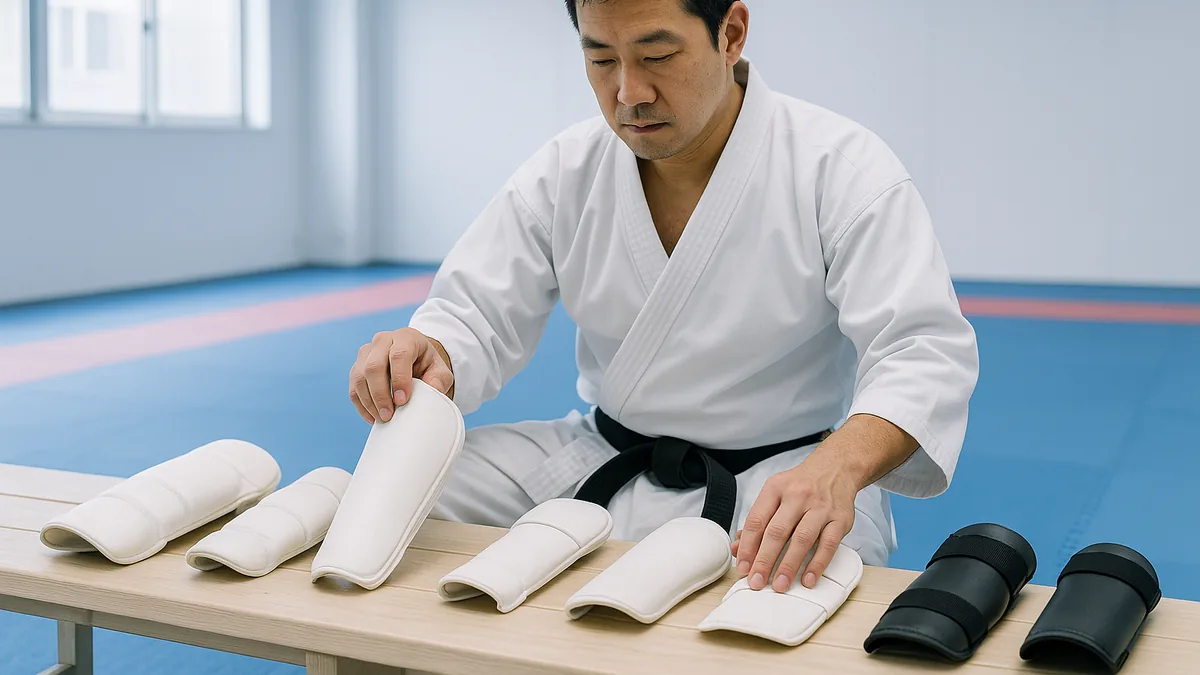
Lightweight guards - the slip-on foam and elastic type, or the thin moulded shell versions - give you enough protection for the kinds of contact that happen in most karate sparring. They cover the shin and instep without adding meaningful weight or bulk. You’ll feel the difference between wearing them and not wearing them if someone catches you with a hard kick, but they won’t interfere with your technique the way thick guards do.
Heavily padded guards are the right call when:
- You’re training in a knockdown or full-contact format
- Your sparring regularly involves hard leg kicks without significant pulling
- You’re recovering from a shin injury and need extra protection during the healing period
- Your competition rules specifically require a higher level of padding
For everything else, I’d recommend starting with something lightweight and only moving up if your training demands it.
Reading Your Dojo’s Culture Before You Buy
One mistake I see often is students buying gear based on what they find in online reviews without understanding what their own dojo actually uses. You show up with expensive full-contact shin guards to a light-contact club and you’re both over-equipped and slightly out of place. You show up to a hard-contact dojo with thin slip-ons and you’ll find out quickly that they’re not enough.
The correction that works here is simple: ask before you buy. Watch a sparring class if you can before your first one. Look at what the senior students are wearing. If your dojo has a gear list, that’s your starting point - not the internet’s opinion of what’s best.
Competition adds another layer. If you’re training toward a specific association’s events, their rules will specify what’s approved. WKF-aligned competitions have defined equipment standards. Knockdown organisations like Kyokushin have their own requirements. Some traditional Shotokan associations don’t allow shin guards in kumite at all because their format doesn’t involve leg contact. Buying the wrong guards and then discovering they’re not approved for your competition is an expensive and avoidable mistake.
What I tell students preparing for their first competition is to download the rules document for their association and read the equipment section before spending anything. It takes ten minutes and saves real money.
What to Actually Look For When Choosing
Fit matters more than brand. A well-fitted budget guard will protect you better than a premium guard that slides around. The guard should sit snugly on the shin without needing constant readjustment during movement. If you’re kicking and it’s shifting position, it’s either the wrong size or the strapping system isn’t working for your leg shape.
A few things I check when evaluating any shin guard:
Coverage: The guard should run from just below the knee to the ankle. Guards that only cover the mid-shin leave the lower third exposed, which is exactly where low kicks land. Check the instep coverage too - if you’re throwing any front kicks or roundhouses, your foot is in the line of fire.
Strapping system: Velcro is standard, but the placement and width of the straps matters. Thin single-strap guards tend to rotate during movement. Wider straps with a dual-strap system stay put better. Some guards have elastic sleeves that hold the guard against the leg without straps - these work well for lighter training but can roll down during hard sessions.
Material: Hard shell guards with foam backing absorb and distribute impact better than pure foam. For anything above light contact, I’d look for a guard with a rigid outer layer. Pure foam compresses fully under a hard kick and you feel more of the impact than you’d expect.
Ankle and instep design: Some guards integrate ankle protection, some don’t. If your sparring involves any sweeps or low work, ankle coverage is worth having. The instep section should be padded but not so thick that it interferes with the feel of kicks landing on your target.
On karate gloves there’s a similar debate about whether padding changes your technique - the same logic applies here. Gear that’s too bulky does change how you move, and that has a cost. The goal is adequate protection without unnecessary interference.
Community Perspective
This is one of those topics where the disagreement runs along stylistic lines more than anything else. Traditional Shotokan and Goju practitioners often push back on shin guards entirely, arguing that their sparring format doesn’t involve the leg contact that makes them necessary. They’re not wrong about their own context. But I’ve seen those same practitioners visit a Kyokushin or full-contact class and immediately understand why the gear exists.
There’s also a generational split. Older instructors who trained in the 70s and 80s often view protective gear with suspicion - the attitude being that learning to take contact is part of the training. I understand that perspective, and there’s something to it in terms of mental conditioning. But I’ve also seen students develop genuine fear responses from training through repeated unprotected impact, and that’s harder to undo than people think.
The middle ground most experienced practitioners land on is this: use what the training actually requires. Don’t over-protect yourself into a false sense of security, and don’t refuse protection out of some notion that toughness means ignoring sensible safety. The gear should serve the training, not define it.
There’s a parallel worth drawing here with other equipment questions - the makiwara debate follows similar lines. Traditional tools versus modern alternatives, and whether protection changes what you’re actually developing. The answer in both cases is that context matters more than ideology.
Key Takeaways
- Match the guard to your actual sparring format - lightweight for light-contact karate, heavily padded for knockdown or full-contact. Buying more protection than you need changes your movement in ways that cost you technically.
- Fit and coverage matter more than brand. The guard needs to stay in place during movement and cover the full shin including the lower third where low kicks land.
- Ask your dojo and check your competition rules before buying anything. The wrong gear for your association’s competition is an expensive mistake you can easily avoid.
- If you’re new to sparring, buy the guards before your first session - not after the first time you catch a hard kick without them. The bruising compounds and the flinch response that develops is harder to fix than the purchase.
- Pure foam compresses under impact. For anything above very light contact, look for a guard with a rigid outer shell and foam backing - you’ll feel the difference.
- Don’t let ideology drive the decision. Whether your instructor values toughness over protection or your style traditionally avoids leg contact, if your training involves shin-level impact, protect yourself adequately. The goal is training longevity, not proving a point.
The weekly digest
New karate articles, once a week
One email every week with everything new on Karate Lifestyle. No spam; unsubscribe in one click.
We'll email you to confirm. See our privacy policy.