Core Training for Karate
Most students treat core training like a separate fitness task - something you do before class or at the gym, disconnected from what happens on the dojo floor. I’ve seen students with genuinely impressive plank times who still collapse their posture the moment they throw a combination. The problem isn’t fitness. It’s that they’ve been training the wrong qualities, or training the right ones in the wrong way.
Core training for karate isn’t about building a strong midsection in isolation. It’s about building a midsection that transfers force, resists rotation when you need it to, and generates rotation when you want it to. Those are three different things, and most generic core programs only touch one of them.
What Your Core Actually Does in Karate
Before I tell you which exercises matter, I want to be honest about what we’re training for.
Every technique you throw moves through your core. The hip rotation in a reverse punch doesn’t come from your hip in isolation - it comes from your ability to brace one side of your trunk while the other side drives through. When you chamber a mawashi-geri and then snap it back, your core is what controls the return, not your hip flexor. When someone closes distance on you in sparring and you need to stay rooted, your core is the thing that keeps you from folding.
I used to think core training was mostly about power generation. My instructor kept telling me my kicks were “floating” - they had height, they had speed, but they had no weight behind them. I didn’t understand what he meant until I started paying attention to what my trunk was doing at the moment of impact. I was generating the kick but not bracing through it. The power was leaking out the back door.
That’s the distinction most beginners miss: generating force and transmitting force are not the same thing. You need both.
The Exercises That Actually Transfer
I’d rather give you four exercises you’ll use every session than a list of twelve you’ll rotate through randomly. These are the ones I’ve kept coming back to across fifteen years, and the ones I’ve seen make the most visible difference in students.
Dead Bug
This is my first recommendation for anyone who asks where to start. I know it looks too simple. I’ve had brown belts roll their eyes at it. Do it correctly and tell me it’s easy.
Why it matters: Dead bug trains your ability to brace your core while your limbs are moving - which is exactly what happens when you punch or kick. Most people can hold a plank. Far fewer can maintain a neutral spine while extending an arm and opposite leg simultaneously. That’s the skill that keeps your posture intact mid-combination.
Setup: Lie on your back, arms pointing straight up toward the ceiling, knees bent at 90 degrees with shins parallel to the floor.
Execution:
- Press your lower back firmly into the floor - not a tuck, a brace. You should feel your abdominals engage to hold this.
- Slowly extend your right arm overhead and your left leg out, lowering both toward the floor without letting your lower back lift.
- Stop before your lower back peels off the floor. Return slowly.
- Alternate sides. The movement is slow and controlled - five seconds down, five seconds back.
What to feel for: You’ll feel the effort in your deep abdominals, not your hip flexors. If your lower back is lifting, you’ve gone too far. The brace should feel like you’re preparing to absorb a punch to the stomach - not sucking in, not pushing out, just solid.
The mistake I see most often: Students rush the return. They treat the extension as the exercise and the return as a rest. The return is half the drill. Slow it down.
Progression: Add a resistance band around your wrists or ankles. Once that’s solid, try it on a half-foam roller for an unstable surface.
Pallof Press
If dead bug is my starting point, the Pallof press is where I spend the most time with intermediate students. It trains anti-rotation - your ability to resist being twisted - which is directly relevant to staying stable under pressure in sparring.
Why it matters: In jiyu-kumite, your opponent is constantly trying to disrupt your structure. Your ability to absorb contact and stay centered depends on anti-rotational strength. This exercise builds exactly that.
Setup: Attach a resistance band or cable to a fixed point at chest height. Stand sideways to the anchor, feet shoulder-width apart, holding the band with both hands at your chest.
Execution:
- Stand far enough from the anchor that there’s significant tension in the band at your chest.
- Press your hands straight out in front of you, fully extending your arms.
- Hold for two seconds. The band will try to rotate your torso toward the anchor. Don’t let it.
- Return to your chest slowly.
- Complete your reps, then switch sides.
What to feel for: The work is in your obliques and the muscles along the side of your trunk facing away from the anchor. It should feel like you’re fighting to stay square. If it feels easy, move further from the anchor.
The biggest difference I’ve noticed between beginners and senior practitioners doing this drill is where they brace. Beginners grip harder with their hands. Senior students drop into their hips slightly and brace from the ground up. The tension should run from your feet through your trunk, not from your hands down.
Rotational Medicine Ball Slam
This is where we shift from stability to power generation. I prefer this over cable rotations for most karate practitioners because the deceleration phase - catching or absorbing the ball - also trains control.
Why it matters: Hip rotation in karate isn’t a smooth, continuous movement. It’s a sharp acceleration followed by an abrupt stop. That stop is what creates the snap. This drill trains both.
Setup: Stand sideways to a wall with a medicine ball, feet shoulder-width apart. Start with 4-6kg. Heavier is not better here.
Execution:
- Hold the ball with both hands, arms extended toward the wall.
- Load by rotating away from the wall, letting your hips open and your weight shift to your back foot.
- Drive from your back foot, rotate your hips sharply toward the wall, and throw the ball hard against it.
- Catch the rebound and control it - don’t let it pull you off balance.
- Reset completely before the next rep. This is not a rhythm drill.
What to feel for: When the rotation is right, you’ll feel the throw start in your foot and travel up through your hip before your arms do anything. If your arms are initiating, you’re doing it wrong. The sensation is similar to a well-connected gyaku-zuki - the arm is just the delivery mechanism.
The mistake I see most often: Students throw with their arms and call it rotational power. The correction that works is to have them pause at the loaded position and check that their hips have actually opened. If your hips are still square, you haven’t loaded anything.
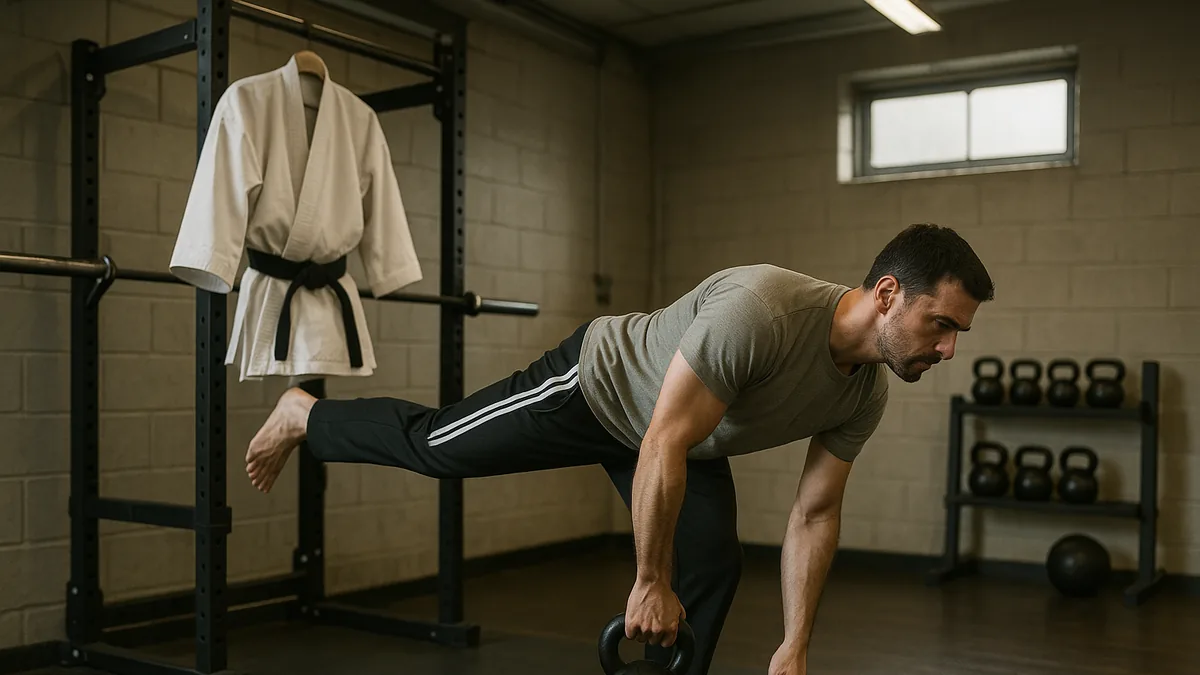
Single-Leg Romanian Deadlift (Bodyweight or Light Load)
This one surprises people when I include it in core training, but I’d argue it’s the most underused exercise for kick recovery specifically.
Why it matters: Every kick you throw requires you to stand on one leg, generate force, and return the chamber without losing balance. The return is where most people are vulnerable. Single-leg RDL trains the posterior chain and trunk stability simultaneously, in a way that directly mirrors the demands of kick recovery.
Setup: Stand on one leg with a slight bend in the knee. If you’re adding load, hold a light dumbbell in the opposite hand.
Execution:
- Hinge at the hip, letting your free leg extend behind you as your torso lowers toward the floor.
- Keep your spine neutral - no rounding. Your hips should stay level, not rotating open.
- Lower until you feel a stretch in the hamstring of the standing leg, then drive back up through your heel.
- The movement should be slow and controlled in both directions.
What to feel for: The challenge here is keeping your hips square as you hinge. You’ll feel your obliques and glute medius working hard to prevent rotation. If your hips are twisting, reduce your range of motion until you can control it.
Progression: Add a light dumbbell. Then try it with eyes closed for an additional balance challenge.
Kick Recovery Specifically
I want to spend a moment on this because I think it’s the most neglected area of core training in most dojos.
Throwing a kick is one skill. Recovering it - pulling the chamber back quickly and setting your foot down without telegraphing your next move - is a different skill entirely. The core work that supports recovery is specifically about eccentric control: your ability to decelerate movement under load.
The single-leg RDL above addresses this directly. So does slow-motion kick practice where you deliberately pause at full extension and then chamber back under control before setting down. It feels wrong at first, especially if you’ve been trained to snap and set down as fast as possible. But the slow version exposes every weakness in your trunk stability and hip control.
I’d recommend pairing this with the flexibility work covered here - specifically hip flexor and hamstring work - because restricted range of motion forces your trunk to compensate in ways that undermine stability.
Community Perspective
There’s a genuine disagreement in karate circles about how much dedicated core training is actually necessary versus how much is covered by kata and kihon practice done correctly.
I’ve trained with instructors who would tell you that a thousand well-executed zuki and a hundred kata repetitions will build all the core strength you need, and that gym-based core work is a modern distraction. I’ve also trained with practitioners who treat core gym work as essential, especially for anyone competing or training with significant intensity.
My honest position: both are right, depending on what you’re doing. If you’re training five days a week with full commitment to technique, your core will develop through practice. If you’re training twice a week - which is most adult practitioners - targeted core work closes the gap considerably. And for anyone training after 40, I’d treat it as non-negotiable. The specific considerations for older practitioners are worth reading if that applies to you.
The other debate is whether core training should be integrated into karate practice or kept separate. I’ve seen both work. What doesn’t work is treating them as completely unrelated - doing your plank in the gym and never thinking about how it connects to your kamae on the dojo floor.
If you’re building a broader strength base alongside this, strength training for karate covers how to structure that without it interfering with your technical training. And if you’re dealing with any lower back or hip issues that affect your core work, check training with injuries before pushing through.
Key Takeaways
- Dead bug is the most underestimated exercise in this list. Do it slowly, do it correctly, and do it before you progress to anything else.
- Anti-rotation strength - the Pallof press - is what keeps you stable when someone hits you or closes distance in sparring. Most core programs skip it entirely.
- Rotational power starts from the foot, not the hip. If you’re initiating with your arms, you’re training the wrong pattern.
- Kick recovery is a core training problem, not just a flexibility problem. Single-leg stability work addresses it directly.
- Slow down your core training. The value is in the control, not the repetition count.
- Connect your gym work to your dojo work deliberately. After core training, spend ten minutes on kihon and pay attention to whether the stability transfers.
The weekly digest
New karate articles, once a week
One email every week with everything new on Karate Lifestyle. No spam; unsubscribe in one click.
We'll email you to confirm. See our privacy policy.