Strength Training for Karate
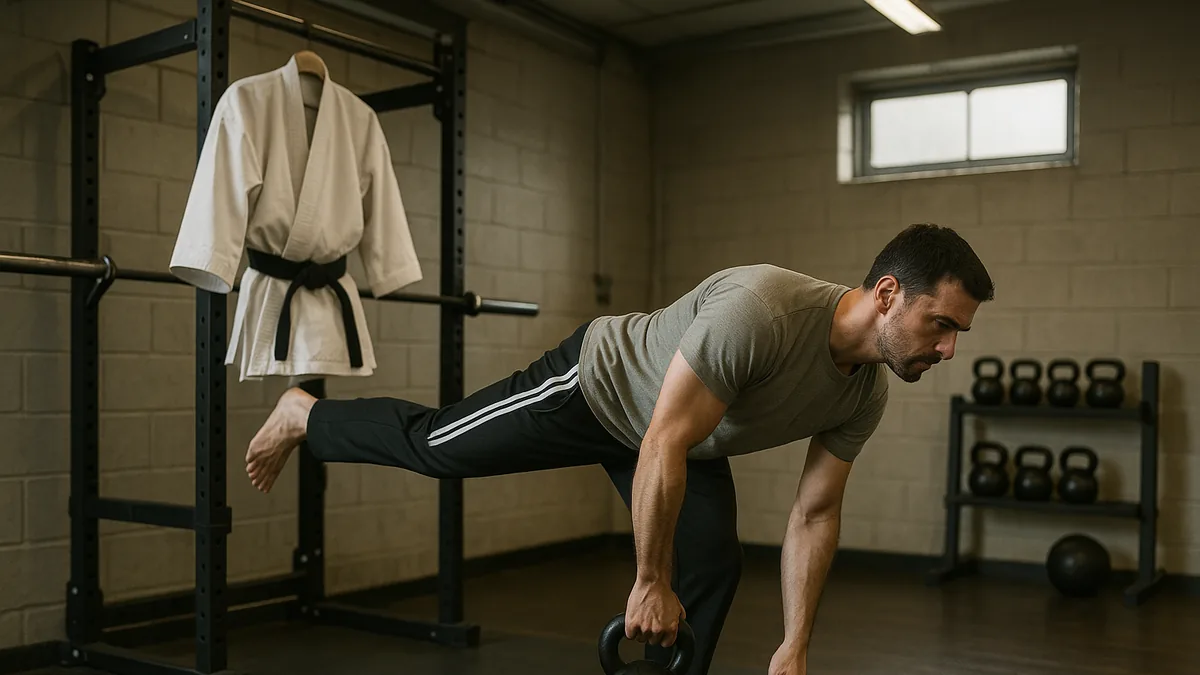
Most karate practitioners who start lifting make the same mistake. They train like bodybuilders - chest day, arm day, isolation work - and then wonder why their gyaku-zuki still feels like it’s got nothing behind it. I spent two years doing exactly that in my mid-twenties. I got bigger, I got stronger by every gym metric, and my sparring actually got worse for a period because I was carrying muscle I hadn’t learned to use and my movement had tightened up. That experience taught me more about strength training for karate than any programme I’ve read since.
What I’m going to share here is what I’ve actually used, what I’ve watched work for students over the years, and where I’ve changed my mind. If you’re intermediate to advanced in your training, you’ve already got enough technical foundation that supplementary strength work can make a real difference. But only if you’re doing the right kind.
What “Transfer” Actually Means
The word transfer gets thrown around a lot in martial arts fitness circles. What it actually means is this: does the strength you build in the gym show up on the dojo floor? Not in a flexed pose - in a mae-geri, in a gyaku-zuki, in the moment you need to generate explosive force from a near-static position.
I’ve noticed that strength built in isolation rarely transfers the way people expect. A student of mine a few years back could deadlift close to twice his bodyweight. Impressive. But his oi-zuki had almost no snap to it because the power chain from his legs through his hips and into his shoulder had never been trained as a connected system. He was strong in segments. Karate demands strength in sequence.
The exercises that transfer are the ones that train your body to produce and transfer force through a kinetic chain - not just produce it in one place. That’s the filter I use when I’m deciding whether something belongs in a karate-specific programme.
Legs: The Foundation That Most People Under-Train
Your instructor has probably told you that your power comes from the ground. You nodded. You probably still think of punching as an arm movement. It took me until brown belt to genuinely feel what that phrase meant - not understand it intellectually, but feel a punch land and recognise that the force had originated somewhere around my back foot.
What to prioritise
Bulgarian split squats are, in my opinion, the single best leg exercise for karate. I prefer them over bilateral squats for most practitioners because the asymmetric loading mirrors how we actually generate power - from one leg, with the hips driving forward and through. They build strength in the hip flexors, glutes, and quads through a range of motion that actually resembles zanshin to hikite. They’re also brutal, which is useful for building mental discipline alongside physical capacity.
Romanian deadlifts develop the posterior chain - hamstrings and glutes - which are the primary drivers of hip extension. When your gyaku-zuki feels like it’s coming from your whole body, it’s because your glutes are firing into hip extension and driving rotation. Weak hamstrings and glutes are one of the most common reasons I see students plateau in punching power despite hours of kihon.
Plyometric work - box jumps, broad jumps, single-leg hops - builds the explosive quality that heavy lifting alone doesn’t. Strength is the capacity. Power is the rate at which you express it. Karate needs power, so you need to train both ends of that equation.
What I’d skip: leg press, leg extension, leg curl machines. They build strength in positions and movement patterns that don’t appear in karate. I’ve never once been in a fight or a sparring situation where I was seated and pushing something away from me with both legs simultaneously.
Core: Not What You Think It Is
Most beginners think core training means sit-ups and planks. By the time you’re intermediate, you’ve probably figured out that’s incomplete. What I’d add is this: for karate, your core training should be almost entirely about resisting unwanted movement and transmitting force, not generating it independently.
The core in a well-executed technique isn’t doing the work - it’s the conduit through which the work travels. When I got this wrong early in my training, I was over-bracing, which actually slowed my techniques down. My instructor at the time kept telling me I was “fighting myself.” I didn’t understand what he meant for months.
What to prioritise
Anti-rotation exercises - Pallof press variations, single-arm carries, half-kneeling cable work. These teach your core to resist rotational force, which is exactly what it needs to do in the split second between hip rotation and shoulder rotation in a punch. If your core can’t resist that force, energy leaks out of the chain.
Dead bugs done properly - not just waving your arms and legs around - build the deep stabilisers that hold your lumbar spine neutral under load. Boring? Yes. Effective? More than almost anything else I’ve added to my own training.
Landmine rotations are the bridge between anti-rotation stability and actual rotational power development. The resistance profile of a landmine - lighter at the start, heavier as you extend - matches the acceleration pattern of a punch reasonably well. I use these with students who are ready to start training rotational power specifically.
Hanging leg raises and ab wheel rollouts for strength through the full range of hip flexion. Mae-geri and mawashi-geri require your hip flexors to work hard and fast. Train them.
Rotational Power: The Thing That Actually Makes the Difference
This is where most strength programmes for karate fall short. They build strong legs and a stable core, then stop. But the conversion of that strength into rotational power - the thing that makes techniques feel effortless and land with weight - requires specific training.
The thing that actually changed my understanding here was watching a senior instructor I trained under for several years. He wasn’t big. He wasn’t visibly muscular. But when he demonstrated a technique on a pad, you felt it in your hands and up into your shoulders. When I asked him about it once after training, he said the power was in the sequence, not the strength. He meant that his hip rotation was initiating before his shoulder moved, and his core was transmitting that force rather than absorbing it.
Medicine ball work is the best tool I’ve found for training this. Rotational medicine ball throws against a wall - both standing and from a split stance - let you train the hip-to-shoulder sequence at speed. The key is initiating from the hip, not the shoulder. Most beginners throw with their arms. You’ll feel the difference immediately when you get it right: the ball leaves your hand faster and your shoulder barely feels like it did anything.
Cable rotations from various heights develop the rotational strength across the full movement arc. I use high-to-low cable rotations specifically because they replicate the downward angle of many striking techniques.
Kettlebell swings are worth including if you’re comfortable with the movement. The hip hinge and explosive extension pattern develops the posterior chain power that drives hip rotation. The timing of the glute snap at the top of a swing is closer to the feeling of a well-executed gyaku-zuki than most people realise.
Programming Around Your Training Schedule
This is where I see the most mistakes from people who are otherwise training intelligently. They lift heavy on Monday, come to dojo on Tuesday with their legs wrecked, and spend the session moving like they’re wading through water. Then they wonder why their kihon feels off.
I’d recommend this framework:
If you train karate 3 times per week:
- 2 strength sessions, placed on days adjacent to - but not immediately before - your hardest dojo sessions
- Keep strength sessions to 45-60 minutes maximum
- Prioritise lower body and rotational work in one session, upper body and core in the other
If you train karate 4-5 times per week:
- 1-2 strength sessions, kept short and focused
- Treat strength work as supplementary, not primary
- Reduce volume before grading or competition periods
The non-negotiable for me is this: your karate training takes priority. Strength work is in service of your karate, not competing with it. If you’re arriving at the dojo too fatigued to train properly, you’ve got your priorities inverted.
Recovery matters more than most people account for. If you’re training hard in the dojo and adding strength work on top, you need to be sleeping well, eating enough protein, and taking rest seriously. I’ve written more about this in the context of recovery for karate practitioners - it’s worth reading alongside this if you’re stacking training modalities.
For practitioners over 40, the recovery equation changes significantly. You can still make excellent progress with strength training, but the volume and frequency need adjusting. Training karate after 40 covers this in more detail.
What to Avoid
I’ll be direct here because I’ve seen these mistakes cost people months of progress.
Avoid training to failure regularly. Bodybuilding uses failure as a stimulus for hypertrophy. For karate, we’re not chasing muscle size - we’re chasing power output and movement quality. Training to failure creates fatigue that lingers and degrades technique in the dojo. Stop two reps short, train more frequently, and stay fresher.
Avoid heavy bilateral squats as your primary leg work - not because they’re bad, but because the carryover to karate is lower than people assume, and the fatigue cost is high. I’m not saying never squat. I’m saying don’t make it the centrepiece of your programme if you’re training karate seriously four days a week.
Avoid upper body isolation work as a priority. Bicep curls, tricep pushdowns, lateral raises - these have almost no transfer to karate performance. If you enjoy them and they fit around your training, fine. But I’ve seen students spend significant time on this and then wonder why their punching power hasn’t improved.
Avoid neglecting the flexibility side of the equation. Strength without mobility creates stiffness that shows up in your technique. A hip that’s strong but immobile will limit your kicking height and your rotational power. I’d recommend reading flexibility for karate: what actually matters alongside any strength programme you follow.
Avoid training your upper body pushing muscles without the corresponding pulling work. One mistake I see constantly is practitioners doing push-ups, bench press, and overhead work without balancing it with rows and pulls. The result is rounded shoulders and a posture that actively fights good punching mechanics. For every pushing exercise, match it with a pulling one.
Community Perspective
There’s a genuine split in the karate community on this topic, and I think it’s worth naming honestly.
Traditional instructors - and I’ve trained under several who hold this view strongly - often argue that supplementary strength training is unnecessary and potentially counterproductive. The argument is that kata and kihon, trained with correct intent, develop the specific strength you need. There’s something to this. The conditioning demands of proper kihon training are significant, and a lot of people who think they need strength training actually just need to train harder in the dojo.
On the other side, sport karate and full-contact practitioners have largely embraced strength and conditioning as a standard part of preparation. At that level, the physical demands are high enough that supplementary work makes a measurable difference.
Where I’ve landed after training across both environments: the traditional view is right that technique-focused training builds a lot of what you need, but it undersells what targeted strength work can add at the intermediate to advanced level - particularly for explosive power and injury resilience. I’ve changed my mind on this gradually over the years. I used to be more dismissive of gym work. Now I think it’s a useful tool if used correctly, and a distraction if used incorrectly.
The disagreement is real and the answer probably depends on your goals, your training volume, and your age. What I’d push back on is the idea that strength training and traditional training are in opposition. They’re not - if you programme the strength work intelligently.
Key Takeaways
- Train the kinetic chain, not individual muscles. Bulgarian split squats, Romanian deadlifts, and medicine ball rotations transfer to karate. Leg press and bicep curls mostly don’t.
- Anti-rotation core work first, then rotational power. You need to be able to resist force before you can effectively transmit it. Most practitioners skip the first step. The dedicated guide on core training for karate covers the specific progressions that work.
- Schedule strength work around your dojo sessions, not alongside them. Arriving fatigued to karate training costs you more than the strength session gains you.
- Match every pushing exercise with a pulling one. Shoulder health and posture directly affect your punching mechanics. Don’t ignore this.
- Reduce volume before gradings and competitions. Strength work should be peaking your performance, not adding fatigue at critical moments.
- If your technique is still developing, prioritise dojo time. Strength training amplifies good mechanics. It doesn’t fix bad ones - it just makes bad mechanics more forceful.
The weekly digest
New karate articles, once a week
One email every week with everything new on Karate Lifestyle. No spam; unsubscribe in one click.
We'll email you to confirm. See our privacy policy.