Nutrition for Karate Training
I used to think nutrition was something other people worried about. Serious athletes, maybe. Competitors. Not someone just trying to get three sessions a week in around work and family. Then I had a grading where my legs stopped working in the last twenty minutes - not dramatically, just that horrible heavy feeling where your kicks slow down and your brain knows what to do but your body has completely checked out. I passed, but only just. My instructor said nothing about my technique. He said, “What did you eat today?” The answer was a sandwich at noon and a coffee at 4pm before a 7pm grading. That was the end of me treating food as an afterthought.
What You Eat Before Training Matters More Than You Think
Most beginners ignore pre-training nutrition entirely. They show up, they train, they go home. I did the same thing for the first couple of years. The mistake isn’t laziness - it’s that when you’re new, the sessions aren’t intense enough to expose the gap. You’re learning basics, your body isn’t working at capacity, and you can get away with it.
By the time you’re doing full rounds of jiyu-kumite, long kihon sequences at pace, or grading-intensity work, that gap becomes very obvious very fast.
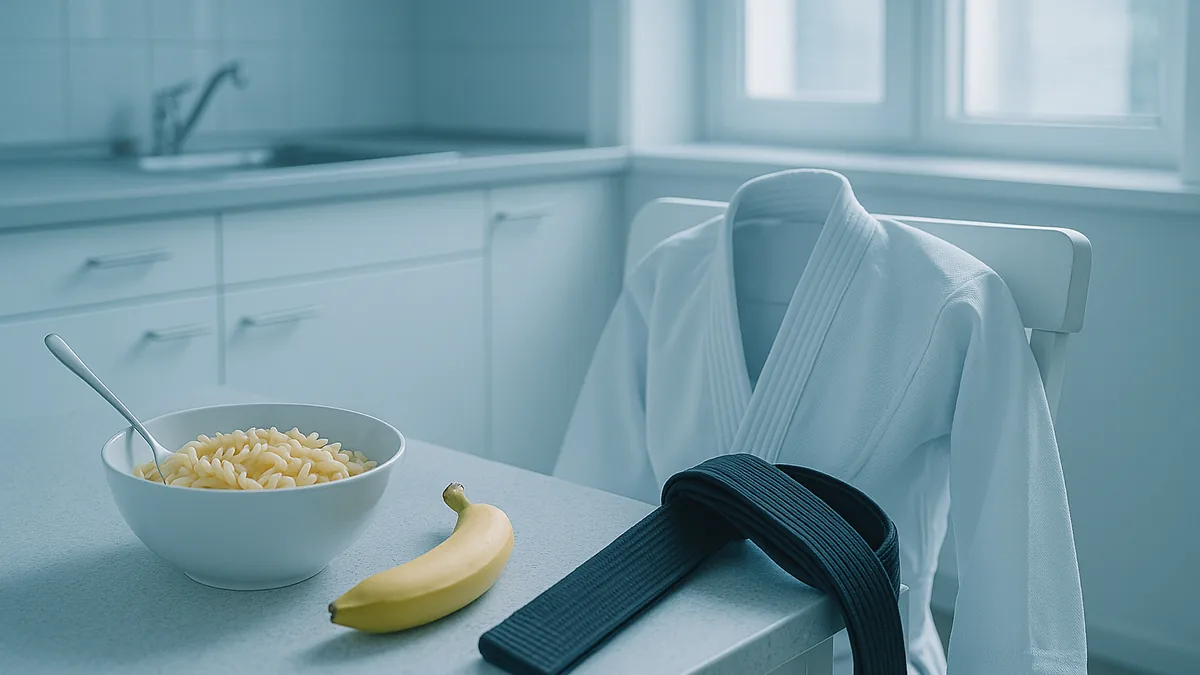
What I tell students is this: your pre-training meal is fuel, not comfort. It’s not about eating something you enjoy - it’s about having the right energy available at the right time. That means carbohydrates. Not a mountain of them, but enough to give your muscles glycogen to work with. A meal two to three hours before training that includes rice, pasta, potatoes, bread - something solid - makes a measurable difference. You’ll feel it in the later rounds of sparring when everyone else starts slowing down.
The Two-Hour Rule
I’ve settled on two hours as the sweet spot for a proper pre-training meal. Closer than that and you’ll feel it in your stomach when the intensity picks up - that uncomfortable sloshing feeling during fast combination work is not something you want. Further away and the energy isn’t as available.
If you’re training in the morning and a full meal two hours before isn’t realistic, something small works - a banana, some oats, a piece of toast. The goal is to not start training completely empty. I’ve trained fasted and I’ve trained fed, and for anything beyond a gentle technical session, fasted is noticeably worse. You’ll feel flat, your reactions slow down, and your mental sharpness - which matters in kumite - drops off.
One mistake I see constantly with students who train after work: they skip lunch, have a big meal at 6pm, and then wonder why they feel terrible during the 7:30pm session. The timing is as important as the content. A big meal an hour before training is worse than a moderate meal three hours before.
What to Actually Eat
I’m not going to give you a meal plan. What I will tell you is what works for me and what I’ve seen work for serious students over the years.
- Rice with chicken or fish, two to three hours before training
- Pasta with a light sauce - nothing heavy, nothing creamy
- Oats with fruit in the morning before early sessions
- A banana or a handful of dates thirty minutes before if you’re running low
What doesn’t work: anything high in fat or fibre right before training. Fat slows digestion. A big bag of nuts an hour before a hard session and you’ll feel like you’re carrying ballast. I learned this the hard way during a summer camp where someone had left a jar of peanut butter in the communal kitchen. Poor decision. Don’t repeat it.
Hydration Is the One Nobody Gets Right
I’ll be direct about this: most people who train in dojos are chronically underhydrated during sessions, and they have no idea. The signs are subtle until they’re not - slightly slower reactions, cramping in the calves or feet (very common during kicking drills), headaches after training, that foggy feeling that you put down to tiredness.
I’ve noticed that white and yellow belts almost never drink during training unless the instructor calls a water break. There’s a culture in some dojos of pushing through, not stopping, not showing weakness. I understand where it comes from but it’s counterproductive. Dehydration doesn’t make you tougher. It makes you slower and more likely to get hurt.
What actually works is drinking consistently through the day before you train, not trying to catch up in the hour before. By the time you feel thirsty during a session, you’re already behind. Drink water steadily from morning onwards. Have some before you leave for the dojo. Sip during training when you can. Have more afterwards.
For most people training three to five sessions a week, water is enough. I think sports drinks are oversold for our level of training. Unless you’re doing multiple sessions in a day, competing in tournaments with back-to-back matches, or training in serious heat, water and food cover what you need. The electrolytes in sports drinks matter in those extreme conditions - they don’t matter much for a standard ninety-minute dojo session.
The one exception I’d make is adding a small pinch of salt to your water bottle during particularly hot summer sessions or intensive camps. Cheap, effective, no branding required.
Recovery Nutrition Is Where Most People Leave Gains on the Table
This is the area I got wrong for years, and it’s the area I see experienced students still getting wrong. The session ends, people bow out, chat for a bit, drive home, and eat whenever. Sometimes that’s an hour later. Sometimes it’s two hours. Sometimes people skip eating entirely because it’s late and they don’t want a full meal before bed.
The thing that actually changed my understanding was noticing how different I felt the next day depending on what I did in the hour after training. When I ate something reasonable within that window - some protein, some carbohydrates - I felt recovered. When I didn’t, I felt beaten up the next morning, sore in ways that didn’t match the session intensity.
Your muscles are most receptive to nutrients in the period right after training. That’s when protein synthesis is elevated and when your glycogen stores are most efficiently replenished. You don’t need to understand the biochemistry. You just need to eat something.
What Recovery Actually Looks Like
A recovery meal doesn’t have to be elaborate. What I tell students who train in the evenings is to have something ready when they get home - not to start cooking from scratch at 9:30pm, because they won’t, and they’ll go to bed with nothing. Prep it in advance or keep it simple.
- Greek yoghurt with fruit - quick, good protein, some carbs
- Eggs on toast - ten minutes, covers the bases
- A protein shake with a banana if you genuinely can’t face food
- Leftover rice or pasta with whatever protein you have
The protein matters more than anything else here. Muscle repair happens overnight. If you train hard and sleep on an empty stomach, you’re shortchanging the recovery process. I’d rather have a small, imperfect meal than nothing.
Sleep is also part of recovery nutrition in a way that doesn’t get talked about enough. Not just the quantity - the quality. If you’re training hard and not sleeping well, no amount of correct eating will fully compensate. This connects to everything else in your recovery for karate practitioners - it’s a system, not a single variable.
Community Perspective
Nutrition is one of those topics where dojos and instructors vary wildly, and I think it’s worth being honest about that. Traditional karate culture doesn’t really have a nutrition philosophy. Some instructors never mention it. Others are deeply invested in it. I’ve trained under both.
There’s a strand of thinking - more common in older-school dojos - that you should just train hard and your body will adapt. Eat normally, train hard, the rest sorts itself out. I have some sympathy for this view. Overcomplicating nutrition creates its own problems. I’ve seen students obsess over macros and meal timing to the point where it became another source of stress rather than a support for training.
On the other side, I’ve seen competitive practitioners who treat nutrition with the same seriousness as their technical training, and the difference in their recovery capacity and consistency is noticeable - especially for anyone training karate after 40, where recovery genuinely slows down and nutrition becomes a bigger lever. That’s worth reading more about if it applies to you: training karate after 40.
My honest position is somewhere in the middle. The basics matter. Timing matters. Getting those right is worth the effort. But you don’t need to weigh your food or track every gram. Consistent, sensible eating beats perfect eating that you abandon after two weeks.
The other genuine debate is around supplements. Protein powders, creatine, BCAAs - you’ll find serious practitioners on both sides. I use protein powder occasionally as a convenience, not as a foundation. Creatine has enough practical evidence behind it that I don’t dismiss it for people doing strength work alongside their karate. If you’re building that kind of training programme, strength training for karate is worth reading alongside this.
The Mistakes I See Most Often
Eating too late before training. Not just what, but when. A heavy meal ninety minutes before a hard session is a common one. Students feel heavy, sluggish, and then blame the session rather than the timing.
Relying on caffeine instead of food. Pre-workout culture has hit dojos. I’ve seen students show up having had a strong coffee and nothing else, wired for the first twenty minutes and then completely flat. Caffeine is not fuel. It changes how fatigue feels - it doesn’t replace the substrate your muscles need to work.
Forgetting to drink until they’re thirsty. By then it’s too late to catch up within the session. The correction is simple: drink steadily through the day, not reactively.
Doing nothing after training. The session ends and nutrition thinking ends with it. The recovery window is real. Use it.
Overcomplicating it. I’ve seen students paralysed by conflicting advice online, eating nothing because they can’t decide what the optimal thing to eat is. Something reasonable, consistently, beats perfect inconsistently every time.
Key Takeaways
- Eat a moderate, carbohydrate-containing meal two to three hours before training - timing matters as much as content
- Drink water consistently through the day rather than trying to catch up in the hour before a session
- Have a recovery meal within an hour of finishing training - protein and carbohydrates, nothing elaborate
- Avoid high-fat, high-fibre foods close to training time; they slow digestion and you’ll feel it during hard work
- For evening training, prepare your recovery food in advance so you actually eat it when you get home
- Consistent basic nutrition beats perfect nutrition you can’t sustain - get the fundamentals right before worrying about anything else
The weekly digest
New karate articles, once a week
One email every week with everything new on Karate Lifestyle. No spam; unsubscribe in one click.
We'll email you to confirm. See our privacy policy.