Warm-Up Routines for Karate Training
Most students walk onto the dojo floor, do a few arm circles, maybe touch their toes, and think they’re ready to train. I’ve seen it hundreds of times. Then they wonder why their hips feel stiff during kicking drills or why their shoulders ache after the first round of pad work. The warm-up isn’t a formality. It’s the first technical decision you make in every session - and most people get it wrong before class even starts.
The biggest mistake I see is treating the warm-up as something to get through rather than something to do well. A good warm-up changes how you move for the entire session. A bad one - or a skipped one - means you spend the first 20 minutes of class gradually unlocking mobility you should have had from the start.
Why Static Stretching Before Training Is Working Against You
I’ll be direct about this because I still see it happening in dojos that should know better: holding long static stretches before you train is counterproductive. Not neutral. Counterproductive.
The research has been clear on this for years, but more importantly, I’ve watched it play out in practice. Students who spend five minutes holding a hamstring stretch before a session often feel looser initially, but their explosive output - kicks, fast combinations, reactive sparring - is noticeably duller in the early rounds. What static stretching does is temporarily reduce the stiffness in your muscle-tendon unit. That stiffness is part of what makes explosive movement powerful and reactive.
I used to think the goal of a warm-up was to get as loose as possible. My instructor at the time kept telling me to move through the warm-up, not hold still in it. I didn’t really understand what he meant until I started paying attention to how I felt during sparring on days I’d done heavy static stretching versus days I’d done dynamic work. The difference was real.
Save static stretching for after training, when you’re genuinely trying to make long-term flexibility gains on already-warm tissue. If flexibility is something you’re working on specifically, Flexibility for Karate: What Actually Matters goes into this in much more depth.
Joint Mobilisation First
Before you do anything dynamic, spend two to three minutes on joint mobilisation. This isn’t dramatic or exciting, but it matters - especially if you train first thing in the morning or you’ve been sitting at a desk all day.
Ankle Circles and Weight Shifts
Stand on one foot and draw slow, full circles with the raised ankle - 10 in each direction, then switch. Then stand with feet shoulder-width apart and shift your weight forward onto the balls of your feet, then back to the heels, then side to side. This sounds basic because it is, but the ankles are the foundation of your stance and every kick you throw. I’ve seen students with chronic ankle stiffness who had never thought to spend 60 seconds mobilising them before training.
Hip Circles
Hands on hips, feet shoulder-width apart, draw large circles with your hips - 10 in each direction. Go slow and make the circles as wide as you can. You want to feel the hip joint moving through its full range, not just your lower back compensating. A lot of students do this too fast and get nothing from it. Slow it down until you feel the rotation coming from the hip itself.
Wrist and Shoulder Rolls
For the wrists: make fists, then open and close the hands while rolling the wrists through their full range. For the shoulders: full arm circles, slow, with the arm relaxed. Then cross one arm across your chest and use the other hand to gently pull it closer - not a held stretch, just a moving pass through the range.
The Dynamic Warm-Up Sequences
This is where the actual warm-up work happens. Dynamic movement raises your core temperature, activates the muscles you’re about to use, and - crucially - trains your nervous system to produce fast, coordinated movement. You’re not just getting warm. You’re switching on.
Leg Swings
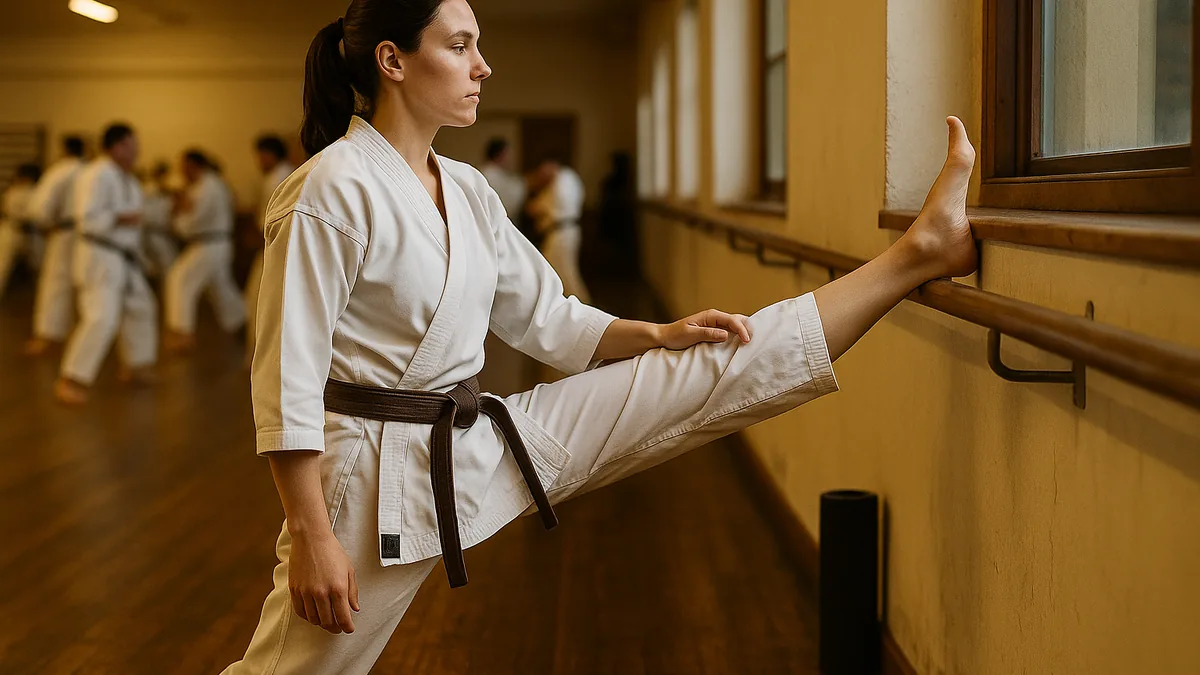
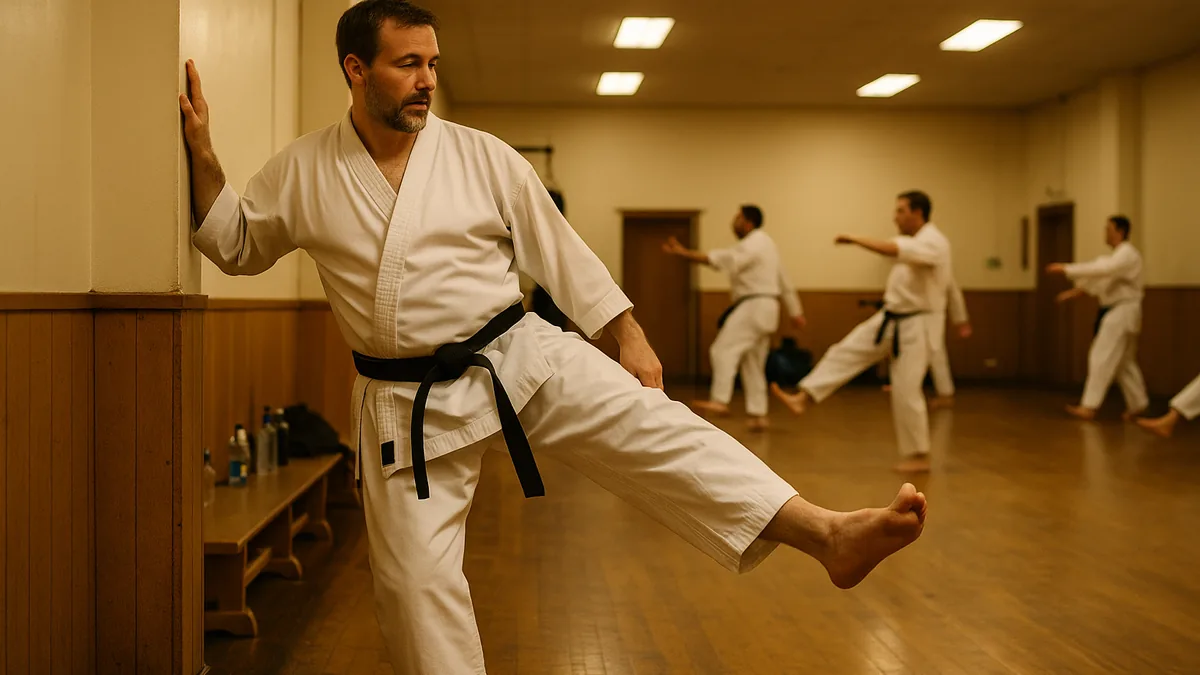
Stand next to a wall for balance. Swing one leg forward and back in a controlled arc - not a kick, not a flick, a genuine pendulum swing where the leg is relaxed and the range increases naturally over 10 to 15 repetitions. Then swing the same leg across your body and out to the side, again letting the range build.
What you’re feeling for: the hip joint opening up progressively, not forced. If you feel pulling or discomfort in the groin on the lateral swing, you’re going too wide too early. Back off and let the movement warm into the range.
The mistake I see most often is students trying to swing as high as possible from the first rep. That’s not the goal. The goal is progressive, controlled movement through the hip’s available range. The height follows the warmth.
Walking Lunges with Rotation
Step into a lunge, drop the back knee toward the floor, and as you hold the bottom position for one second, rotate your torso over the front leg. Reach the arm on the same side as the front leg up toward the ceiling. Then step forward into the next lunge. Do 10 steps on each side.
This one earns its place in every warm-up I run. It loads the hip flexors of the back leg, opens the thoracic spine, and forces you to maintain balance through the whole movement. In karate, you’re constantly transitioning between stances and generating rotation - this movement trains both simultaneously.
What you’re feeling for: a stretch through the hip flexor of the trailing leg, and a genuine rotation through the mid-back, not just the shoulders. Most beginners rotate their shoulders and leave their thoracic spine completely still. The correction that works is to put one hand on the student’s mid-back and ask them to move against that contact.
Hip Hinges and Inchworms
Stand with feet hip-width apart. Hinge at the hips - not the waist - until your hands reach the floor, then walk your hands out to a plank position, do one slow press-up, walk your hands back, and stand up. That’s one rep. Do five to eight.
This feels awkward at first for students who don’t have a strong hip hinge pattern. If you’re rounding through the lower back to reach the floor, your hamstrings are too tight for the full movement yet - bend your knees slightly until the pattern improves. The hip hinge is worth developing because it’s the same movement pattern as loading a front kick or dropping into a low stance with good structure.
High Knees and Lateral Shuffles
Thirty seconds of high knees - drive the knee up to hip height, stay on the balls of your feet, keep the arms pumping. Then 30 seconds of lateral shuffles across the dojo floor and back. These raise your heart rate and get your feet moving the way they need to move in sparring.
The thing most people get wrong with high knees is they lean back. You should feel slightly forward over the balls of your feet, with the core switched on. If you’re leaning back, you’re braking every step.
The 10-Minute Warm-Up
This is the full version. Use it before any serious training session - sparring, grading prep, hard kihon work.
- Joint mobilisation: ankles, hips, wrists, shoulders - 2 minutes
- Leg swings, forward and lateral - 2 minutes (both legs)
- Walking lunges with rotation - 2 minutes
- Inchworms - 90 seconds
- High knees and lateral shuffles - 90 seconds
- Three slow, controlled kicks on each side (mae geri, mawashi geri) - 1 minute
That last step matters. You want to fire the actual movement patterns you’re about to train, at low intensity, before you train them at full intensity. A slow, controlled mae geri at the end of the warm-up tells your body exactly what’s coming.
The 5-Minute Warm-Up
For shorter sessions, competition warm-ups, or when you’re genuinely pressed for time. I’d rather you do this properly than rush the 10-minute version.
- Joint mobilisation: hips and shoulders only - 60 seconds
- Leg swings, both directions - 60 seconds
- Walking lunges with rotation - 60 seconds
- High knees and lateral shuffles - 60 seconds
- Slow controlled kicks, both sides - 60 seconds
This isn’t ideal, but it’s functional. The non-negotiables are the leg swings and the controlled kicks at the end. If you have to cut something, cut the inchworms.
Community Perspective
There’s a genuine split in how different dojos approach the warm-up, and it’s worth being honest about it. Traditional dojos - particularly those with a strong Japanese or Okinawan lineage - often still run warm-ups built around long static stretches, the kind where you sit in straddle position for two minutes at the start of class. Some instructors see this as part of the discipline of training, not just physical preparation.
I respect that tradition, but I think the evidence - and my own experience - points clearly toward dynamic preparation before training. That said, I’ve trained with senior practitioners in their 60s and 70s who have done static-first warm-ups their entire lives and move beautifully. The body adapts to what you consistently do. If you’re training karate after 40 and managing joints that have history, the warm-up calculus changes somewhat - Training Karate After 40 covers this honestly.
The other debate is how long a warm-up should take. Some instructors run 20-minute warm-ups that are essentially a workout in themselves. I think this crosses into diminishing returns - you want to be warm and activated, not fatigued. Ten minutes done well is better than 20 minutes done at half-pace.
Key Takeaways
- Static stretching before training reduces explosive output. Do it after class, not before.
- Start every warm-up with joint mobilisation, not big movements. Two minutes of ankle circles and hip rotations changes how the rest of the warm-up feels.
- Walking lunges with rotation are the single most useful warm-up drill I’ve found for karate specifically. They hit hip flexors, thoracic rotation, and balance simultaneously.
- End every warm-up with slow, controlled versions of the kicks you’re about to train. This is the step most people skip, and it’s the one that directly bridges the warm-up to the session.
- If you only have five minutes, protect the leg swings and the controlled kicks. Everything else is negotiable.
- A warm-up done with attention is better than a warm-up done quickly. Slow down the joint mobilisation, feel the range building, and you’ll train better for the full session.
For the longer picture on how your training structure affects recovery and performance, Recovery For Karate Practitioners and Strength Training for Karate are worth reading alongside this. And if you’re returning to training after time off due to injury, training with injuries covers when to modify and when to stop completely.
The weekly digest
New karate articles, once a week
One email every week with everything new on Karate Lifestyle. No spam; unsubscribe in one click.
We'll email you to confirm. See our privacy policy.