How Much Conditioning Work Is Too Much Before a Karate Session: What Karateka Who Gym-Train Get Wrong About Fatigue Management
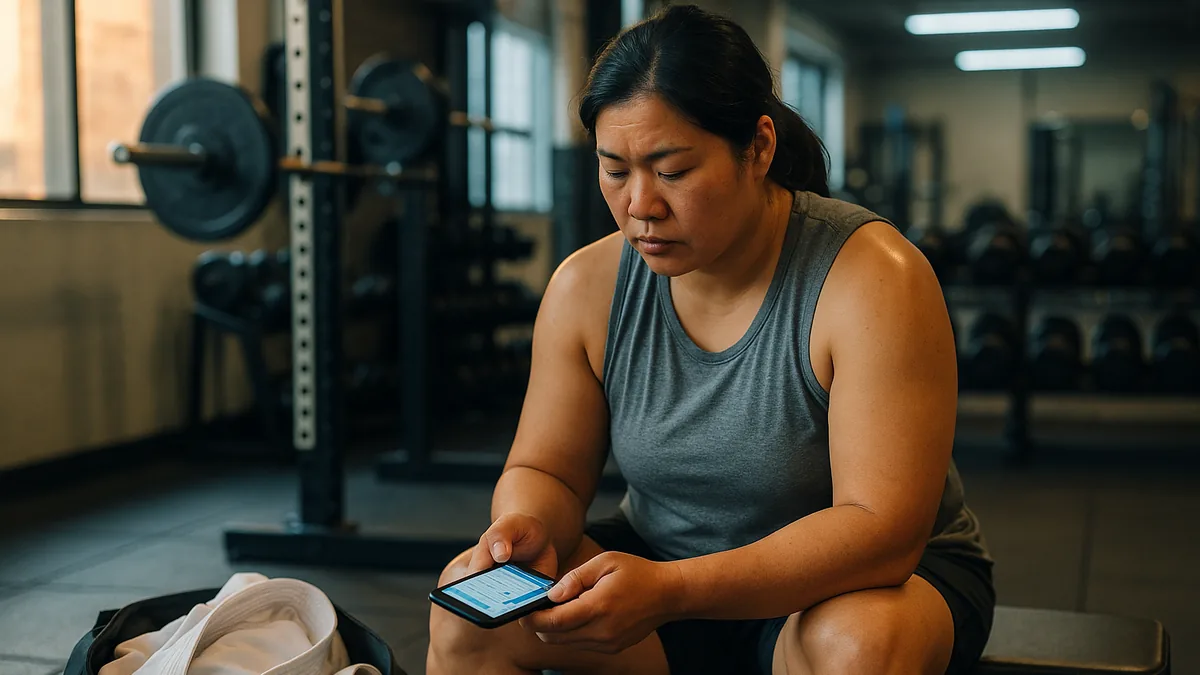
If you train in a gym two or three times a week alongside your dojo sessions, there is a good chance you are arriving at karate practice already compromised - and not realising it until your combinations start falling apart in the second round of kumite.
This is not a fringe problem. The number of karateka who incorporate structured gym work has grown significantly, and the advice most of them receive about managing the two sits somewhere between vague and actively counterproductive. “Just listen to your body” is not a training plan. Neither is “train hard, recover harder.” What actually matters is understanding what kind of fatigue you are carrying into the dojo, where it comes from, and what it does to karate-specific performance.
The Fatigue You Can Feel Is Not the Only Fatigue That Matters
The most common mistake gym-training karateka make is treating soreness as the primary signal. If the legs are not aching and the arms move freely, the assumption is that recovery is complete. This is wrong in a way that has real consequences.
Neuromuscular fatigue - the kind that follows heavy compound lifting, maximal sprint work, or high-volume plyometrics - does not always produce significant muscle soreness, but it degrades the speed, coordination and reactive capacity that karate depends on. Countermovement jump (CMJ) performance is one of the most widely used objective markers of neuromuscular status in sport: a 2016/17 meta-analysis by Claudino et al., published in the Journal of Science and Medicine in Sport, confirmed its sensitivity to fatigue and supercompensation across a wide range of training contexts.1 Research by Thomas et al., published in Medicine and Science in Sports and Exercise (2018), found that strength, jump and sprint training requiring repeated maximal efforts elicits fatigue that requires up to 72 hours to fully resolve, with reductions in voluntary activation persisting for 24 to 48 hours after strength work.2 For a karateka, that suppression shows up as slower gyaku-zuki, sluggish ashi-barai, and combinations that feel disconnected - like the signal from your brain is arriving a fraction late.
That fraction matters. In jiyu-kumite, your fastest counter off a failed attack depends on your nervous system firing cleanly. If it is running at 85% because you squatted heavily 18 hours ago, you will not land that counter. You will be close, and you will not know why you missed it.
The correction that usually helps here is not reducing gym volume immediately - it is scheduling. Heavy lower-body sessions should sit at least 48 hours before a karate session that involves sparring or intensive kihon. Upper-body pushing work needs a minimum of 24 hours. This is not conservative; it is the minimum to avoid meaningful performance degradation.
What “Too Much” Actually Looks Like in Practice
There is no universal threshold, but there are reliable signs that conditioning volume is interfering with karate quality:
- Reaction time feels slow. Not tired-slow, but disconnected-slow. You see the attack and your body does not follow at the speed you expect.
- Technique loses its structure under pressure. A mawashi-geri that is clean in isolation starts collapsing at the hip when you are two minutes into pad work.
- Your kiai sounds flat. This sounds trivial. It is not. A weak kiai usually means you are not generating full-body tension at the point of impact - a sign that the neurological connection between your core and your limbs is not firing properly.
- Combinations that you know well require conscious thought. Automated technique becoming deliberate is a clear sign that fatigue is degrading the neural pathways that normally run on autopilot.
- You are pulling techniques. Not from control, but because you sense they will not land cleanly. This is your nervous system protecting you from exposing poor output.
If you are seeing two or more of these regularly, the volume or timing of your gym work needs adjusting. Not your karate - your gym schedule.
The Specific Mistakes Gym-Training Karateka Make
Treating all conditioning work as equivalent. A 45-minute low-intensity cardio session and a 45-minute maximal-effort strength session are not interchangeable in terms of recovery demand. Many practitioners track volume by time spent in the gym and assume equal recovery need. The actual variable is intensity and neuromuscular demand. Cardio at 60 to 70% of maximum heart rate the day before a karate session is generally fine. A deadlift session at 85% of one-rep max is not.
Programming gym work without reference to the dojo timetable. A common pattern is to gym on Monday, Wednesday and Friday and attend karate on Tuesday, Thursday and Saturday - which sounds balanced until you realise that Friday’s gym session feeds directly into Saturday’s most demanding dojo session of the week. Restructuring to gym on Tuesday and Thursday, with karate on Monday, Wednesday and Saturday, immediately improves session quality without changing total volume.
Prioritising gym numbers over karate performance. This is a values question as much as a programming one. If your goal is to improve as a karateka, the gym is a support tool. When the tool starts undermining the main objective - when you are arriving at grading preparation sessions with legs that cannot generate hip drive - something has gone wrong with priorities, not just scheduling.
We would recommend keeping a simple weekly log that tracks gym sessions against dojo session quality. If you notice consistent dips in technique quality following specific gym workouts, the pattern will become obvious within two or three weeks. The training diary approach covered here is directly applicable to this kind of cross-training management.
The Balance Between Gym Work and Karate-Specific Drills
Here is a position worth taking clearly: gym training improves karate performance when it builds the physical qualities that karate cannot efficiently develop on its own - maximal strength, structural resilience, aerobic base. It does not replace karate-specific work, and it cannot be allowed to compete with it for recovery resources.
The practical implication is that karate-specific drills - kihon combinations at full speed, ippon kumite, makiwara work, pad sessions - should always be performed fresh. These are the sessions where motor patterns are being refined or reinforced. Practising a technique while fatigued does not build a fatigued version of the technique; it builds a degraded version. That degraded version then has to be unlearned. This is a cost that many practitioners do not account for.
Gym work, by contrast, can tolerate more accumulated fatigue without the same technical cost. A squat performed at 80% of capacity while moderately tired still builds strength. A gyaku-zuki performed while moderately tired builds a slightly wrong gyaku-zuki.
This is why the sequencing recommendation is consistent across most serious coaches: karate sessions first in any given day, gym work second. If you only have time for one and you are a karateka, the karate session takes priority. The gym is not the goal.
For related guidance on how rest intervals between sessions affect overall performance, the guide to rest between karate training sessions gives a useful framework that applies here.
Recovery Is Not Passive - It Is Part of the Programme
A common framing problem is treating recovery as the absence of training. Recovery is what makes training productive. Without it, you are not accumulating fitness - you are accumulating damage.
The practical tools matter here. Sleep is the most important and the most frequently undervalued. Research from the Stanford Sleep Disorders Clinic and Research Laboratory, published by Mah et al. in Sleep (2011), found that extending sleep time over five to seven weeks - with a target of at least 10 hours in bed per night - produced measurable improvements in reaction time, mood and physical performance in collegiate basketball players.3 The mechanism is not complicated: most physiological repair and neural consolidation happens during sleep. Cutting it short to fit in an extra gym session is a net negative, not a neutral trade-off.
The full breakdown of sleep and karate performance is worth reading if you are treating sleep as optional. It is not optional. It is the cheapest, most effective recovery tool available.
Cold exposure and contrast bathing have a role in managing acute soreness and perceived recovery, though the evidence on their effect on actual performance adaptation is more nuanced than the enthusiasm around them suggests. The evidence on cold exposure for karate recovery is covered in detail elsewhere. The short version: useful for managing soreness and feeling ready faster, but not a substitute for adequate rest days.
Community Perspective
There is a genuine disagreement within the karate community about whether gym training belongs in a serious karateka’s programme at all. Traditional instructors in some associations argue that karate practice itself - high-volume kihon, kata, kumite - provides sufficient physical conditioning and that gym work introduces movement patterns that conflict with karate mechanics. This is not an unreasonable position for practitioners whose dojo time runs to 10 or more hours per week.
For most practitioners in the UK, dojo time is two to three sessions per week. At that volume, supplementary conditioning is not just acceptable - it is probably necessary if you want to develop the physical attributes that support good karate. The disagreement tends to resolve itself based on available training time rather than principle.
Where practitioners consistently change their view with experience is on intensity. White and blue belts arriving from a gym background tend to bring heavy lifting programmes and high-volume conditioning into their karate training with minimal adjustment. By brown belt, most have learned to reduce gym intensity in the weeks before grading and to treat karate sessions as the non-negotiable fixed point around which everything else is scheduled. That shift in perspective is the thing worth accelerating.
Key Takeaways
- Schedule heavy lower-body gym work at least 48 hours before sparring or intensive kihon sessions. Neuromuscular fatigue does not always produce soreness, but it consistently degrades speed and coordination.
- Use technique quality as your primary fatigue indicator, not muscle soreness. Combinations that require conscious thought, flat kiai, and pulled techniques are more reliable signals than aching legs.
- Karate-specific drills should always be performed fresh. Practising technique while fatigued reinforces degraded movement patterns that then need to be corrected.
- Treat gym work as a support tool, not a competing priority. When the gym is undermining your dojo performance, the scheduling is wrong - not the volume, in most cases.
- Sleep is non-negotiable. It is the most effective recovery intervention available and the one most consistently sacrificed to fit in additional training.
- Track the relationship between gym sessions and dojo quality over several weeks. The pattern of which sessions cause performance dips will become clear quickly, and the fix is usually structural rather than dramatic.
References
Checked by the KarateLifestyle editorial team against peer-reviewed sports science journals (PubMed/PMC), university press releases, and the published abstracts of cited studies in October 2026. The Claudino meta-analysis supports CMJ as a fatigue monitoring tool but does not itself report specific recovery time windows; Thomas et al.
- The countermovement jump to monitor neuromuscular status: A meta-analysis. Claudino JG, Cronin J, Mezêncio B, McMaster DT, McGuigan M, Tricoli V, Amadio AC, Serrão JC. Journal of Science and Medicine in Sport, 20(4):397-402. Published online August 2016, journal volume 2017. DOI: 10.1016/j.jsams.2016.08.011
- Neuromuscular Fatigue and Recovery after Heavy Resistance, Jump, and Sprint Training. Thomas K, Brownstein CG, Dent J, Parker P, Goodall S, Howatson G. Medicine and Science in Sports and Exercise, 50(12), 2018.
- The Effects of Sleep Extension on the Athletic Performance of Collegiate Basketball Players. Mah CD, Mah KE, Kezirian EJ, Dement WC. Sleep, 34(7):943-950, 2011. DOI: 10.5665/SLEEP.1132. Stanford Sleep Disorders Clinic and Research Laboratory, Stanford University.
The weekly digest
New karate articles, once a week
One email every week with everything new on Karate Lifestyle. No spam; unsubscribe in one click.
We'll email you to confirm. See our privacy policy.