Kata for Older Practitioners: What to Adapt, What to Preserve, and What the Changes Actually Teach You
What “Adaptation” Actually Means (and What It Doesn’t)
There is a version of adaptation that is just avoidance. You stop doing the low stances because your knees hurt, you rush the turns because your hips are stiff, and you quietly drop the jump in Kanku Dai because it feels risky. Nothing is replaced. Nothing is understood differently. The kata gets shorter and shallower, and after a few years you are performing something that looks like kata but has lost most of its content.
That is not adaptation. That is erosion.
Real adaptation means identifying what a movement is actually doing - mechanically, structurally, in terms of its application - and finding a way to preserve that function even when the surface form has to change. Sometimes you will find that the adapted version is clearer and more honest than the original, because you have been forced to understand what you were actually doing.
The distinction matters because it changes how you approach every modification you make. The question is never “can I still do this?” The question is “what is this movement for, and how do I keep that?”
What to Adapt: The Honest List
Stance Depth
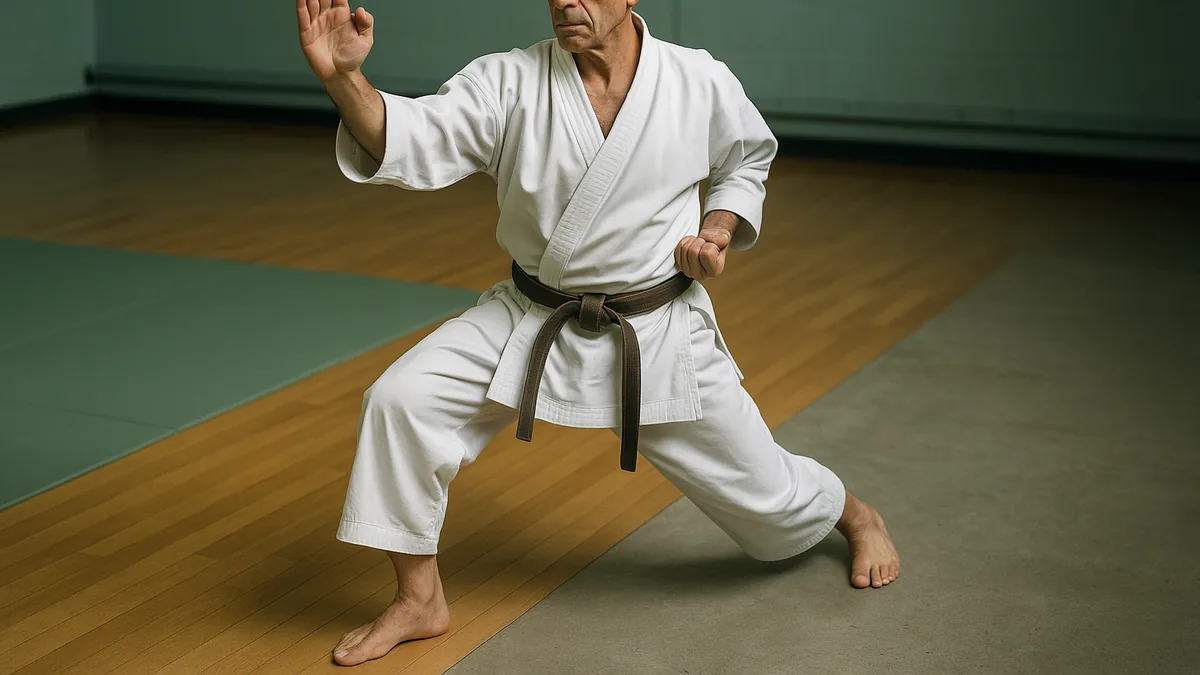
Deep stances - full zenkutsu-dachi, shiko-dachi held low - place significant compressive load on the knees and hips. For tibiofemoral osteoarthritis specifically, compressive forces in the knee joint steadily increase when squatting from a partial to a deep position, and tibiofemoral contact area decreases with increasing knee flexion, meaning contact stresses also rise.1 For practitioners with osteoarthritis, post-surgical joints, or reduced cartilage, maintaining competition-depth stances through a full kata is not just uncomfortable; it is counterproductive. You end up compensating with your back, your ankles collapse inward, and the structure that the stance is supposed to provide disappears anyway.
The correction that actually works is to raise the stance to a depth where you can maintain genuine structural integrity. A higher zenkutsu-dachi with a properly engaged rear hip and a stable front knee is mechanically more honest than a deep stance where the knee tracks inward and the body weight shifts forward uncontrollably. Many instructors cue this as “find the depth where you can still feel the ground.” That cue is worth taking seriously.
What you preserve by doing this: the weight distribution, the directional intent, the connection between stance and technique. What you lose: nothing that matters to the kata’s function.
Jumping Techniques
Jumps in kata - the tobi in Kanku Dai being the obvious example - are not primarily about height. The jump is a displacement: you are taking your body off the line of attack, creating a moment of evasion, and landing with a finishing technique. The height is a byproduct of the mechanics, not the point.
For practitioners where jumping carries genuine injury risk - and that risk assessment should involve your GP or physiotherapist, not just your instructor - the adaptation is to perform the evasive footwork without the vertical component. Step off the line, execute the technique, land with intent. You will feel immediately whether you have understood the movement or not: if the adapted version feels purposeless, you have not yet understood what the jump was doing.
Rapid Direction Changes
Large-angle pivots - the sharp direction reversals in Bassai Dai, the sequential turns in Heian Godan - rely on fast hip rotation and the ability to absorb rotational force through the ankles and knees. The vestibular nucleus decreases in size and neuron count by around 3% each decade beginning at about age 40, and the number of vestibular nerve fibres also declines with increasing age, resulting in an age-related reduction in vestibular afferent signals to the central nervous system.2 These changes mean rapid pivoting can become genuinely disorienting, and that is not something to push through in the middle of a kata.
Slowing the turn is not a failure. A controlled, deliberate pivot that arrives in a stable stance teaches you something that a fast, sloppy turn never does: it shows you exactly where your balance is during the rotation. The turn is not meant to be a blur. It is meant to be a sudden change of direction with full intention. Slowing it down often makes that clearer.
What to Preserve: The Non-Negotiables
Kime
Kime - the focused contraction at the point of technique - is not a young person’s attribute. It has nothing to do with how fast you can move or how deep your stance is. It is about the quality of muscular engagement at the moment of completion. An older practitioner with genuine kime in a higher stance is performing better kata than a young practitioner with deep stances and loose, unconcentrated technique.
This is non-negotiable because once you start letting kime go - telling yourself it does not matter because you have adapted the form anyway - the kata becomes movement without content. Kime is the punctuation. Remove it and nothing makes sense.
Breathing
The breath structure in kata is not decorative. The relationship between exhalation and kime, the controlled breath during transitions, the moment of ibuki in kata that use it - these are functional. They regulate tension, support core engagement, and create the rhythm that holds the kata together.
A common mistake in adapted kata practice is that breathing becomes passive. The practitioner is concentrating on managing their movement modifications and the breath just happens. You will feel this as a kind of flatness in the kata - the techniques arrive but they do not land. Restoring deliberate breath control is often the single biggest improvement available.
Zanshin
Zanshin - the sustained awareness and readiness at the end of a technique - is something that tends to disappear under physical pressure. When a movement is difficult or slightly painful, the natural response is to finish it and move on. The zanshin collapses. The eyes drop. The posture softens before it should.
Instructors repeat the correction for this constantly, and for good reason: zanshin is not a stylistic flourish. It is the acknowledgement that a real situation does not end because you have finished your technique. Preserving it in adapted kata is not about looking good. It is about keeping the martial logic of the form intact.
What the Changes Actually Teach You
This is the part that most guides on this subject miss entirely.
When you are forced to adapt a movement, you have to understand it well enough to preserve its essence in a different form. That process - working out what the essence actually is - is one of the most rigorous forms of kata study available. It is more demanding than simply performing the form as taught, because you cannot rely on muscle memory and pattern repetition. You have to think.
A white belt learning Heian Shodan is focused on the sequence: which technique comes next, which direction, which stance. By brown belt, the focus has shifted to quality within the sequence: the timing, the connection between stance and technique, the rhythm. What adaptation forces you to do is go one level deeper: what is this movement actually doing? If I cannot do it this way, what way preserves the function?
That question, applied seriously to every movement you modify, produces a level of bunkai understanding that is difficult to achieve any other way. If you are adapting the jump in Kanku Dai and you genuinely work out what the evasion is doing, you understand that sequence better than you did when you could jump it without thinking.
We would argue - and this is a position worth taking seriously - that the adapted kata of a senior practitioner who has genuinely worked through each modification is often more instructive to watch than the technically complete kata of a junior who has never had to question the form. The understanding shows. It shows in the eyes, in the timing, in the way each technique arrives with purpose rather than sequence.
For more on developing this kind of depth, The Difference Between a Kata You Know and a Kata You Own is worth reading carefully.
Common Mistakes in Adapted Kata Practice
Adapting too much at once. The temptation when physical limitations become noticeable is to address everything in one go: raise all the stances, slow all the turns, remove all the difficult elements. The problem is that you lose the reference points. Adapt one thing at a time, understand what you have changed, and then move to the next. This is slower but it is the only way to keep track of what you are preserving.
Treating the adaptation as permanent from day one. Some limitations are fixed; others are not. A practitioner recovering from knee surgery may need to raise their stances significantly for several months and then find, with appropriate rehabilitation, that they can return to greater depth. Locking in adaptations too early can mean you stop working toward range of motion that is actually recoverable.
Losing the embusen. The performance line of a kata is not arbitrary. When stances get higher and turns get slower, the embusen often drifts. Practitioners end up finishing several feet from where they started, or the directional angles become vague. This matters because the embusen is part of the kata’s structure - it reflects the spatial logic of the applications. Keep it precise.
Confusing slower with softer. Slowing a technique down for control is legitimate. But slow techniques still need kime, still need breath, still need intention. A common mistake is that “adapted” becomes a synonym for “gentle,” and the kata loses its martial character entirely. Slow and powerful is a valid mode. Slow and soft is not kata - it is something else.
Surface Matters More Than You Might Think
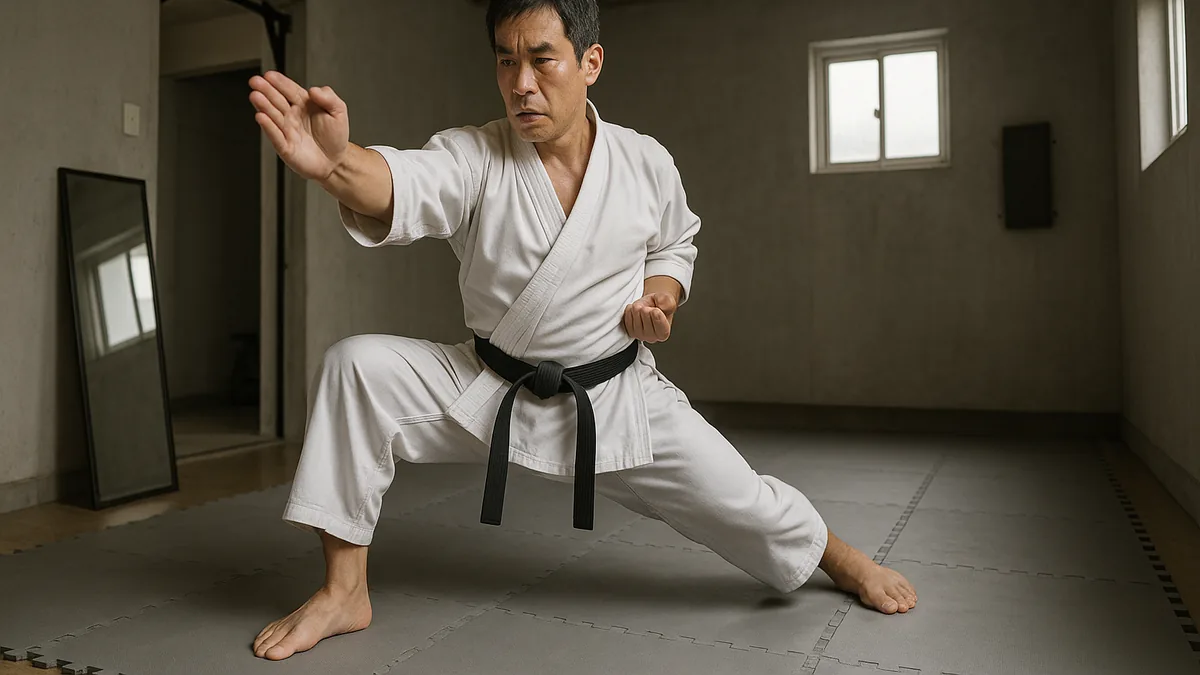
One factor that is worth addressing directly: the surface you train on affects how much joint stress you accumulate across a session, and this matters more as you age. Research comparing impact forces across floor materials - including concrete, wooden, and tatami matting - found that tests on tatami reduced impact to below the average fracture threshold relevant to older people, a result not consistently achieved on harder surfaces.3 If you are training on a hard surface and finding your joints are suffering for it, that is worth addressing before you start modifying your technique. The article on performing kata on different surfaces covers this in practical detail.
Solo Practice and Application Work
One underused resource for older practitioners is solo application work - bunkai drills that do not require a partner and allow you to explore the meaning of each movement at your own pace. This is particularly valuable when you have adapted a technique and want to test whether the adaptation preserves the function. Solo bunkai drills that actually build understanding gives you a practical framework for this.
Community Perspective
There is genuine disagreement within the karate community about how much adaptation is acceptable before a kata stops being that kata. Some associations take the position that the form must be performed as specified, and that any significant deviation means you are no longer performing the kata - you are performing a version of it, which is a different thing. This view has some logic: if Bassai Dai can be anything you decide it is, what is the point of the form?
The opposing view - and it is the one we find more convincing - is that kata are vehicles for principles, not fixed physical templates. The principles are what must be preserved. Funakoshi himself wrote that, hoping to see karate included in universal physical education in public schools, he “set about revising the kata so as to make them as simple as possible” - a clear indication that he regarded kata as something to be shaped for the practitioner and context, not preserved as fixed templates. The argument that kata must always accommodate the individual rather than the reverse is widely attributed to Funakoshi, but a specific verbatim source for that precise formulation has not been established; it should be treated as a summary of his documented approach rather than a direct quotation.
What most experienced practitioners seem to agree on, regardless of where they start on this question, is that adaptation done thoughtlessly is different from adaptation done with understanding. The former is decline. The latter is a legitimate and often illuminating form of practice.
Key Takeaways
- Adapt the form to preserve the function - every modification should start with the question “what is this movement doing?” not “what can I no longer do?”
- Kime, breathing, and zanshin are non-negotiable. They are not physical demands; they are the martial content of the kata. Lose them and you are not doing adapted kata, you are doing something else.
- The process of working out how to adapt a technique is itself one of the most rigorous forms of kata study available. Do not rush it or outsource it to someone else’s modification list.
- Raise stances to a depth where you maintain genuine structural integrity - a higher stance with a stable knee and engaged hip is better kata than a deep stance that collapses under load.
- Keep the embusen precise. Vague directional angles and a drifting performance line are signs that the kata is losing its structure, not just its depth.
- Treat adaptation as an ongoing process, not a one-time decision. Reassess regularly, especially if your physical condition is changing through rehabilitation or training.
References
Checked by the KarateLifestyle editorial team against peer-reviewed biomechanics and vestibular-science literature, a primary-source text by Funakoshi, and fall-impact research in October 2026. The biomechanics of deep squatting in non-arthritic knees is contested in the literature; the stance-depth advice in this article applies specifically to practitioners with osteoarthritis or post-surgical joints, as stated.
- A Biomechanical Review of the Squat Exercise: Implications for Clinical Practice. Straub et al., International Journal of Sports Physical Therapy, 2024
- Perspectives on Aging Vestibular Function. Frontiers in Neurology, 2015
- Comparison of impact force attenuation by various combinations of hip protector and flooring material using a simplified fall-impact simulation device. PubMed / Journal of Orthopaedic Science, 2013
The weekly digest
New karate articles, once a week
One email every week with everything new on Karate Lifestyle. No spam; unsubscribe in one click.
We'll email you to confirm. See our privacy policy.