Teaching Karate to Your Own Child: Why It's Harder Than Teaching Anyone Else and How to Make It Work
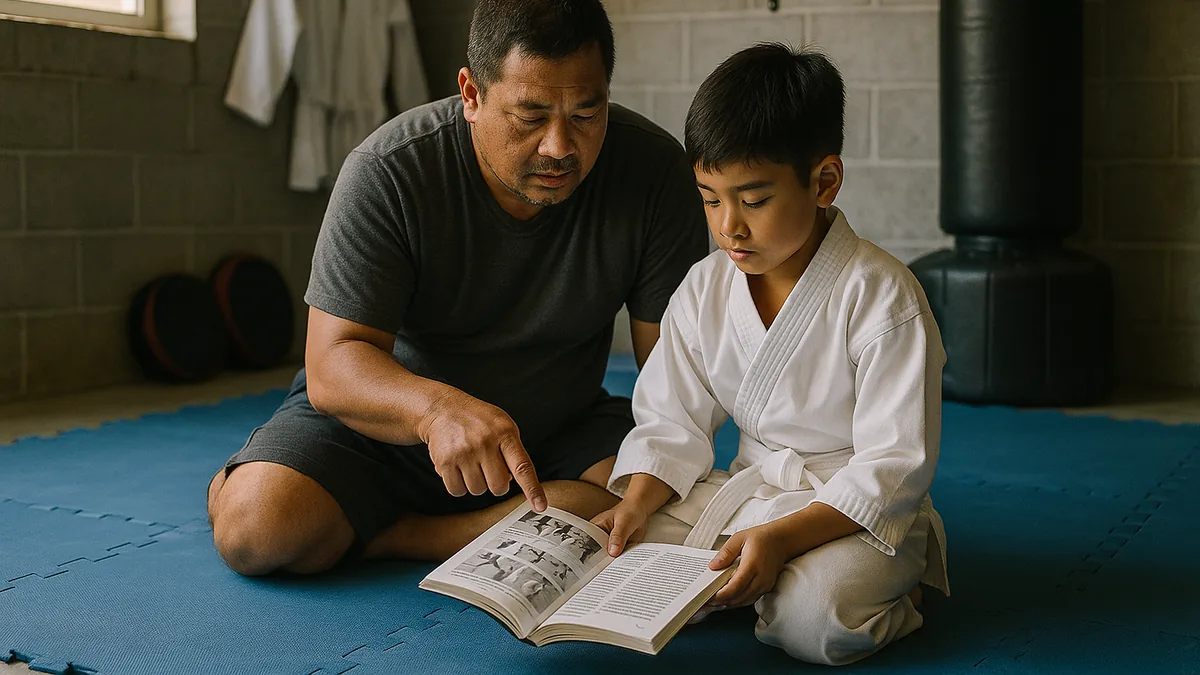
My daughter cried during a kata correction once. Not because I was harsh - I wasn’t. She cried because I was her dad, and something about hearing it from me hit differently than hearing it from Sensei Watkins. I stood there in the garage dojo not knowing whether to be her instructor or her father. I got it wrong that day. It took me a while to figure out how to get it right.
If you train seriously and you’ve started working with your own child, you already know what I’m talking about. The relationship changes everything. The authority you’ve built over years of teaching other people’s kids means almost nothing with your own. And the patience you can find for a complete stranger’s clumsy white belt somehow evaporates the moment your son does the same thing for the fourteenth time.
This isn’t a failure of character. It’s a structural problem, and it helps to name it clearly before you try to solve it.
Why Your Own Child Is the Hardest Student You’ll Ever Have
I’ve taught beginners who couldn’t touch their knees in a front kick. I’ve graded students who froze completely under pressure. I’ve worked with adults who had to unlearn twenty years of bad habits from a previous style. None of that is as difficult as teaching my own child, and I don’t think that’s unique to me.
The reason is investment. With every other student, there’s a professional distance. You want them to improve, but their progress doesn’t feel like a reflection of you. With your child, it does - even when you know it shouldn’t. When they get something wrong in front of other people, you feel it. When they don’t try as hard as you know they can, it’s personal in a way it never is with anyone else.
I’ve noticed this pattern in other parent-instructors too. The ones who struggle most are usually the ones with the highest expectations - not because they’re bad parents, but because they care intensely. That intensity leaks into their instruction and their child feels it immediately. Kids are extraordinarily good at reading emotional subtext. Your frustration doesn’t have to be visible to be felt.
There’s also the authority problem. In the dojo, you’re Sensei. At home, you’re Mum or Dad. Your child has a lifetime of experience negotiating with you, reading your moods, and knowing exactly which version of you they’re dealing with. That history doesn’t disappear when you put on your gi. They’ll push back in ways your other students never would, and they’ll be right to, because the relationship genuinely is different.
The Patience Problem (And Why It’s Not What You Think)
Most people frame this as a patience issue - you need more of it with your own child. I think that’s the wrong diagnosis. The problem isn’t patience in isolation. It’s that your expectations are calibrated differently.
When a student’s child comes to class and struggles with a basic stance, you think: they’re new, they’ll get it. When your own child struggles with the same thing, some part of your brain adds: but I’ve shown them this at home, and they weren’t paying attention, and this is the third week. The frustration isn’t about the technique. It’s about the accumulated context that only exists because of your relationship.
What I tell students who are also parents is this: try to make your instruction session genuinely separate from everything else. Not just in location - in mindset. The argument about homework, the missed dinner, the attitude at breakfast - none of that comes into the dojo. If you can’t leave it at the door, don’t start the session. A bad training session does more damage than a skipped one.
One thing that actually helped me was changing how I gave corrections. With other students, I correct and move on. With my daughter, I used to explain more, justify more, almost apologise for the correction. She found it confusing and slightly patronising. When I started correcting her exactly the way I’d correct any other student - brief, specific, move on - the atmosphere in training improved immediately. She didn’t need the extra explanation. She needed to be treated like a student, not a special case.
Balancing Authority and Encouragement Without Losing Either
Here’s where I see parent-instructors make the biggest mistake: they oscillate. They’re strict, then they feel guilty and overcorrect with praise, then they’re strict again. The child never knows which version of the instructor they’re getting, and that uncertainty is exhausting and demotivating.
The correction that makes the biggest difference isn’t a technique correction - it’s a consistency correction. Your child needs to know that the standards are the same every session. Not harsher than for other students, not easier. The same.
I’ve noticed that praise lands better when it’s specific and earned. “Good kiai” means something. “Well done” means nothing - kids know when you’re filling space. If you can’t find something genuinely praiseworthy in a session, don’t manufacture it. Find the thing they improved on, even marginally, and name it precisely. That’s what builds real confidence, not the reflexive encouragement that they can see through immediately.
The authority piece is harder. I think you have to accept that your child will not give you the same automatic respect they’d give another instructor, and that’s actually fine. What you’re building is a different kind of authority - one based on them seeing you train seriously, seeing you correct yourself, seeing you stay humble in front of your own instructor. That’s a slower process, but it produces something more durable.
If you’re struggling with motivation in your own training while managing this, the piece on how to stay motivated in karate when progress feels invisible is worth reading - some of what applies to you applies to what your child is experiencing too.
Common Mistakes I’ve Seen Parent-Instructors Make
Coaching during class when you’re not the instructor. If your child attends a regular class and you’re also there, either as a student or an assistant, the urge to correct them from the side is almost irresistible. Don’t. It undermines the class instructor, confuses your child about whose authority applies, and usually makes them self-conscious in front of peers. If you see something that needs addressing, wait until you’re home.
Making training about performance rather than process. This one is subtle. It shows up when you’re more focused on how your child looks doing a kata than on what they’re learning from it. You start to care about the grading outcome before they’ve had time to build the foundation. I’ve seen children pushed to grade before they were ready because their parent-instructor was embarrassed to have them stay at the same belt. That’s ego, not pedagogy, and the child pays for it later with gaps in their fundamentals.
Bringing unresolved relationship tension into training. If you’ve had a difficult morning with your child, that tension will be in the room during your session. They’ll be guarded, you’ll be short, and nothing useful will happen. I used to think I could compartmentalise it. I couldn’t, and neither can most people. It’s worth being honest about this and either resolving the tension first or postponing the session. The karate and ego piece touches on how this kind of thing bleeds into training in ways we don’t always want to admit.
Explaining too much. Kids learn physically before they learn conceptually. If you spend ten minutes explaining the biomechanics of a hip rotation, you’ve lost them. Show it, have them try it, correct what you see. Then do it again. The explanation can come later, when they’ve felt what correct feels like and they’re ready to understand why.
What Actually Works: Practical Approaches for the Dojo Floor
Set a clear structure for your sessions and stick to it. Kids - especially your own - need the session to feel like a session, not like a continuation of family time. A formal bow in, a clear agenda, a bow out. The ritual matters. It signals that this is different from everything else, and that signal is more important than you’d think.
Keep sessions shorter than you think necessary. Forty focused minutes beats ninety unfocused ones every time. When training with your own child, you’re managing the relationship and the instruction simultaneously, which is tiring for both of you. Stop while it’s still going well. You want them to leave the session feeling good about it.
Find moments where they can teach you something. This sounds counterintuitive, but it’s one of the most effective things I’ve used. Ask them to show you a kata they’ve been working on as if they’re the instructor. Have them explain a technique back to you. It changes the dynamic, builds their confidence, and tells you exactly what they’ve understood and what they haven’t. You’ll feel it when they’re explaining something they’ve genuinely internalised versus something they’re just reciting.
When they’re struggling with motivation - and they will - don’t push harder. Ask questions. “What part felt wrong to you?” is more useful than “you need to focus.” It treats them as someone capable of self-assessment, which they are, and it moves the conversation away from you judging them toward them understanding themselves.
This is genuinely one of the harder balancing acts in training life, and it’s worth reading about training karate alongside a full-time job if you’re also managing the time pressures of fitting this into a busy household - the scheduling principles overlap more than you’d expect.
Community Perspective
There’s a real split among experienced practitioners on whether parent-instructors should teach their own children at all, or whether it’s better to have them trained entirely by someone else. I’ve heard strong arguments both ways.
The case for handing them over completely is straightforward: the emotional complexity gets in the way of good instruction, and the child benefits from a clean instructor-student relationship uncomplicated by family dynamics. I’ve seen this work well, especially where the parent continues to train themselves and models the attitude they want their child to develop.
The case for teaching your own child is that the relationship, handled well, can produce something a stranger can’t - a depth of trust and shared experience that accelerates certain kinds of learning. You know how your child processes information. You know when they’re tired versus disengaged. You know when to push and when to back off in ways that take a dojo instructor months to figure out.
My honest position: I think a combination works best. Regular class with a separate instructor for the structure and social element, and supplementary work at home where you focus on specific things rather than trying to run a full curriculum. That way you’re not trying to be both parent and sole instructor, which is the role that creates the most problems.
What I’d caution against is the parent who removes their child from regular classes because they think they can do a better job alone. That’s usually more about the parent than the child.
Key Takeaways
- Separate the session from everything else in your relationship - if you can’t leave the morning’s tension at the door, postpone training rather than push through it
- Correct your child exactly as you’d correct any other student: brief, specific, and then move on without over-explaining or apologising for the correction
- Praise specifically and only when it’s earned - “good kiai” builds confidence, “well done” doesn’t mean anything and they know it
- Keep sessions shorter than feels necessary and stop while it’s still going well - you want them associating training with you positively, not with exhaustion or frustration
- Let them teach you occasionally - asking them to explain a technique back to you tells you more about what they’ve actually learned than any test, and shifts the dynamic in a useful way
- Consider whether supplementary home training alongside a regular class with a separate instructor might serve your child better than you being their sole teacher
The weekly digest
New karate articles, once a week
One email every week with everything new on Karate Lifestyle. No spam; unsubscribe in one click.
We'll email you to confirm. See our privacy policy.