How to Train With a Partner Who Trains in a Different Style: What to Adjust, What to Protect, and What You Can Actually Learn
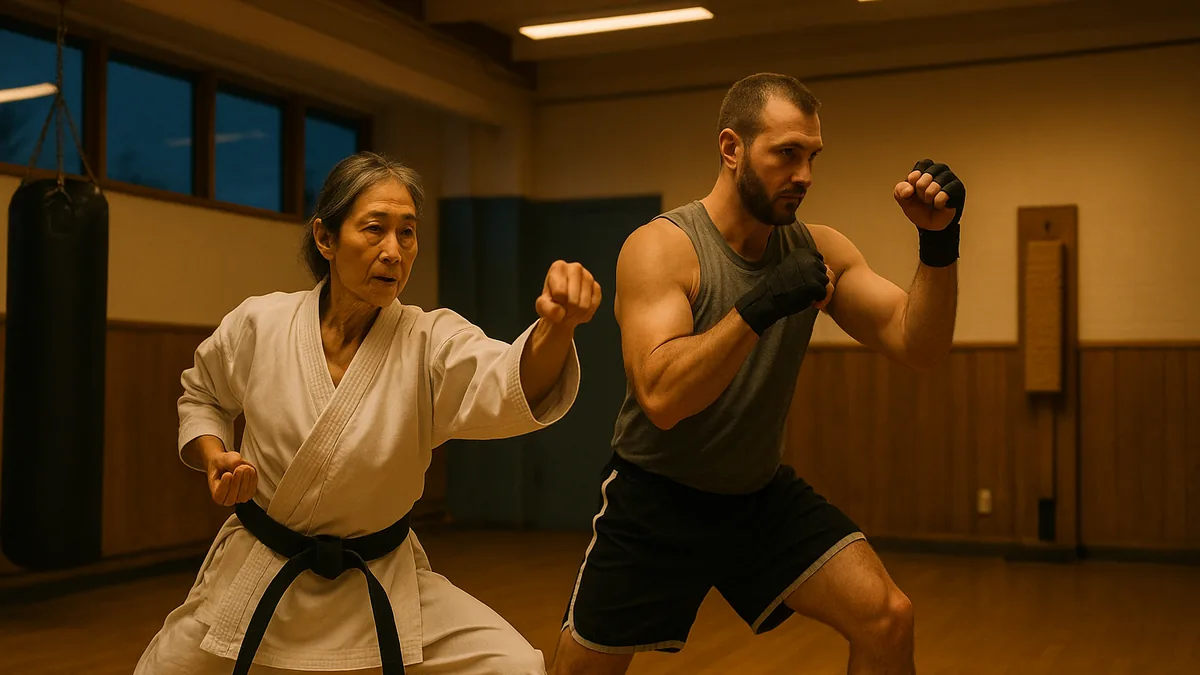
Cross-style partner training is one of the most underused development tools available to karate practitioners, and most people waste it. They spend the session either trying to convert their partner to their own approach, or they disengage entirely because “it doesn’t look like karate.” Both responses miss the point entirely.
The more productive frame: your partner’s different style is a controlled stress test. It reveals which of your techniques are genuinely robust and which only work because your usual training partners have learned to accommodate your habits.
What You’re Actually Dealing With
Before you adjust anything, you need to understand what’s actually different. Cross-style training usually means one of three things:
- Different distancing conventions. A Shotokan practitioner and a Muay Thai practitioner have radically different ideas about where a safe working distance begins. Neither is wrong; they’re optimised for different threat profiles.
- Different body mechanics for similar techniques. A roundhouse kick in karate is driven by rapid knee extension and a pronounced chamber; in Muay Thai it is a hip-rotation-dominant movement, with greater vertical displacement of the centre of mass and the shin used as the primary striking surface.1, 2 The target area may overlap; the physics are meaningfully different.
- Different rules of engagement. What counts as a valid attack, what’s expected to be blocked versus evaded, what level of contact is normal - all of this varies enormously between styles.
The correction that makes the biggest difference early on is simply naming these differences out loud before you start. A two-minute conversation before the session - “I work at this range, I use this level of contact, I don’t usually block like that” - prevents most of the confusion that makes cross-style training feel chaotic rather than educational.
What to Adjust
Your Distancing
This is the most important adjustment and the most commonly ignored one. Karate, particularly in its traditional sport forms, trains practitioners to work at a specific ma-ai - typically the distance from which a single lunge-step closes the gap. That distance is baked into your reflexes. When your partner operates from a different range, your timing falls apart.
A common mistake is trying to drag the partner into your preferred distance rather than learning to work at an unfamiliar one. That’s a missed opportunity. Spending even a few rounds operating at a shorter or longer distance than you’re used to teaches you something about your own game that comfortable training never will.
If your partner is a grappler or a close-range striker, you’ll feel the discomfort of your techniques becoming unavailable. That’s useful information. It tells you exactly where your game has gaps.
Your Timing Assumptions
Karate kumite training - particularly in styles with strong competition traditions like Shotokan, Wado-Ryu and Goju-Ryu, three of the four styles recognised within the WKF competition framework - develops very specific timing expectations.3 You learn when a counter is available, when to reset, when a combination is coming. Those expectations are calibrated to partners who share your training background.
A Judo practitioner doesn’t move like a karateka. A kickboxer doesn’t reset the way your usual partner does. A recurring problem in cross-style training is launching a counter at the wrong moment because your timing is pattern-matched to a different style’s rhythm. You throw your gyaku-zuki into empty space because your partner didn’t move the way your training predicted they would.
The correction here is to slow down. Genuinely slow down, not as a concession but as a deliberate choice to reset your timing from observation rather than habit. You’ll feel it when the timing starts to recalibrate - your counters start landing cleanly instead of chasing.
Your Vocabulary of Attacks
Some techniques that work reliably against karate-trained partners become predictable against someone from a different background - and vice versa. A well-timed jodan mawashi-geri can be a scoring technique against a sport karateka; against a Muay Thai practitioner who has spent years defending head kicks, it’s a different proposition entirely.
This is where cross-style training becomes genuinely valuable rather than just interesting. You’re forced to ask: does this technique work because it’s mechanically sound, or because your usual partners have learned to react to it in a way that makes it work? The answer is often uncomfortable.
What to Protect
Your Partner’s Safety
This is non-negotiable and worth stating plainly: your partner’s unfamiliarity with your style is not a licence to land techniques at full power. The opposite is true. When someone doesn’t know your timing, your favourite attacks, or your level of contact, your responsibility to control increases.
A common mistake is treating a cross-style session like a test of whose style is better. That framing leads to escalation, and escalation leads to injury. The session has no winner. What it has is information, and you can only extract that information if both partners are safe enough to keep training.
The practical rule we’d recommend: drop your contact level by one step when you start with a new partner from a different style. If you normally work at light contact, work at touch. If you work at medium contact, work at light. Calibrate upward only once you’ve established that your partner’s defensive reflexes are tracking your attacks reliably. Many instructors apply this calibration principle precisely because the cost of ignoring it tends to make itself obvious quickly.
Your Own Structural Habits
Cross-style training can introduce bad habits if you’re not careful about what you absorb. Spending a lot of rounds with a partner who has poor posture, drops their guard, or telegraphs attacks will start to normalise those patterns if you’re not actively filtering.
This is particularly relevant if you’re at an earlier stage of your own training. The correction that helps here is to maintain your own structural standards even when your partner doesn’t share them. You’re not there to copy their style; you’re there to test your style against a different stimulus. There’s a meaningful difference, and it’s worth keeping in mind. For more on this, the article on The Problem With Copying Your Instructor’s Karate covers the ceiling that imitation creates - the same principle applies here in reverse.
What You Can Actually Learn
How Your Style Reads to an Outsider
This is the most underappreciated benefit. A partner from a different background doesn’t have your conditioned responses. They react to what your technique actually does, not to what dojo training has taught them to expect.
When a technique that usually scores doesn’t work, and you can’t blame it on a familiar excuse, you learn something real. When something you’ve never rated suddenly lands cleanly because your partner’s defensive structure is different, that’s also real information.
At white-belt level, the focus is naturally on whether a technique looks right. By the time you’re approaching black belt, the better question is whether it works against someone who has no reason to make it easy for you.
Alternative Solutions to Familiar Problems
Different styles have spent decades solving the same problems - how to generate power, how to close distance safely, how to defend a committed attack - and they’ve arrived at different answers. Some of those answers are genuinely worth understanding, even if you have no intention of adopting them wholesale.
A Muay Thai practitioner’s approach to defending a double-leg takedown is different from a karateka’s. A Wing Chun practitioner’s response to a straight punch is different from a Shotokan response. Neither is universally superior. But understanding that multiple solutions exist to a problem you thought had one answer changes how you think about your own technique.
We’d recommend approaching this with genuine curiosity rather than competitive scepticism. The question isn’t “is their way better than mine?” - it’s “what does their way tell me about the problem we’re both trying to solve?”
Pressure-Testing Your Defaults
In jiyu-kumite with a familiar partner, your fastest counter off a failed attack is probably well-grooved. You know the timing, you know the distance, you’ve done it hundreds of times. Against a different style, that counter may not be available in the same form - the opponent’s recovery position is different, their reset is at a different range.
What this exposes is which of your techniques are genuinely adaptable and which are context-dependent. The adaptable ones are your most reliable tools. The context-dependent ones are worth knowing about, because they’ll also fail against a karate opponent who has done their homework on your tendencies.
Community Perspective
Cross-style training generates genuine disagreement within the karate community, and it’s worth acknowledging that honestly.
There are traditionalist arguments that training extensively with other styles dilutes the coherence of your karate - that the system only makes sense as a whole, and cherry-picking from other arts undermines the internal logic that makes it work. That’s a serious position, not a reactionary one. A style is a system, and systems have integrity.
On the other side, many senior practitioners - particularly those with competition backgrounds in open-format tournaments - argue that karate trained only against karate is karate trained in a bubble. The growth of crossover events, and the debate around what WKF competition rules select for relative to broader martial practice, has pushed this question into mainstream karate circles.4
The honest answer is that both concerns are legitimate. Cross-style training done carelessly can introduce confusion and bad habits. Done deliberately, with clear goals and maintained structural standards, it’s one of the most efficient ways to understand what your own training is actually producing.
Where you land on this probably depends on your goals. If you’re training primarily within a traditional framework for depth and coherence, occasional cross-style sessions work best as stress tests rather than regular practice. If you’re training for open competition or self-defence application, regular exposure to different styles is close to essential.
Practical Scenarios
When your partner is a grappler: Expect them to close distance aggressively and to be comfortable in the clinch. Your striking combinations need to be shorter and your awareness of position needs to be higher. This is genuinely useful for understanding why karate’s traditional distancing principles exist - they’re not arbitrary, they’re designed to keep you in a range where your tools work.
When your partner is a kickboxer: The contact level and the continuity of exchange will likely be higher than you’re used to in traditional karate kumite. The correction that helps most is maintaining your structure under pressure rather than defaulting to survival mode. If your posture collapses when the pace increases, that’s important to know.
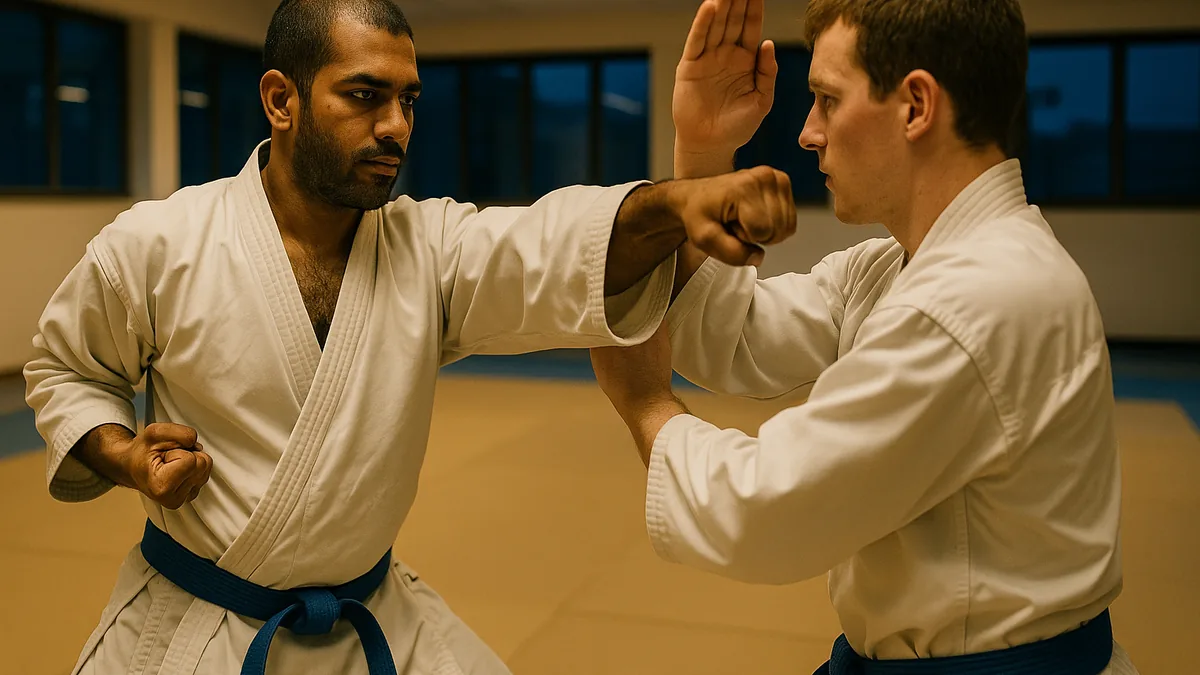
When your partner is from a different karate style: This is often the most instructive and the most surprising. Shotokan and Goju-Ryu practitioners can have profoundly different ideas about timing, distance and what constitutes a committed attack.5 The differences feel smaller but cut deeper.
For structuring what you work on in these sessions, the framework in How to Structure a Solo Training Session When You Only Have 30 Minutes applies equally well to partner work - identify what you’re actually trying to develop, and structure the session around that rather than just free sparring until time runs out.
Key Takeaways
- Before any cross-style session, name the differences explicitly: distancing conventions, contact level, and what counts as a valid attack. Two minutes of conversation prevents most of the confusion.
- Drop your contact level by one step when starting with an unfamiliar partner, and calibrate upward only once you’ve confirmed their defensive reflexes are tracking your attacks.
- Slow your timing down deliberately when you start. Your timing is calibrated to your usual partners’ movement patterns - against a different style, it needs to reset from observation, not habit.
- Maintain your own structural standards throughout. You’re testing your karate against a different stimulus, not adopting a new style. The distinction matters.
- The techniques that work against an unfamiliar partner are your most reliable tools. The ones that don’t are either context-dependent or mechanically weaker than you thought. Both pieces of information are worth having.
- Approach what your partner does differently with genuine curiosity about the problem they’re solving - not with competitive scepticism about whether their answer is better than yours.
Cross-style training is also worth considering alongside your broader training structure. If you’re thinking about how often to train and what kind of variety to build in, How Many Days a Week Should You Train Karate? covers the frequency question in detail. And if you’re working with partners at different skill levels more broadly, the guidance in How to Train With a Partner Who Is Much Better Than You applies directly to the dynamic that often emerges in cross-style sessions, where the experience gap runs in unpredictable directions.
References
Checked by the KarateLifestyle editorial team against WKF official rules documents (wkf.net), peer-reviewed biomechanics papers (PLOS ONE, Journal of Strength and Conditioning Research), and style-specific technical sources in October 2026. The biomechanics literature covers WKF-style and sport karate kicks rather than every style variant, so style-level kick descriptions are necessarily general.
- A biomechanical analysis of the roundhouse kicking technique of expert practitioners: A comparison between the martial arts disciplines of Muay Thai, Karate, and Taekwondo. Gavagan RJ, Sayers MGL. PLOS ONE, 2017. Peer-reviewed biomechanics study comparing roundhouse kick mechanics across Muay Thai, Karate and Taekwondo.
- Kinematic Comparison of the Roundhouse Kick Between Taekwondo, Karate, and Muaythai. Journal of Strength and Conditioning Research, 2021. Peer-reviewed kinematic analysis confirming discipline-specific differences in hip action and striking distance.
- WKF Kumite Competition Rules 2026 (Version 2026.01). World Karate Federation, 2026. Official competition rules document; confirms WKF-recognised styles and competition formats.
- WKF Competition Rules Bulletin 2026. World Karate Federation, 2026. Official bulletin summarising key rule changes effective January 2026, including contact rules and competition format notes.
- WKF Kata Competition Rules 2026 (Version 2026.0). World Karate Federation, 2026. Confirms the four WKF-recognised styles (Shotokan, Shito-Ryu, Goju-Ryu, Wado-Ryu) and kata rules.
The weekly digest
New karate articles, once a week
One email every week with everything new on Karate Lifestyle. No spam; unsubscribe in one click.
We'll email you to confirm. See our privacy policy.