Mirror vs Camera vs Training Partner: Which Feedback Method Actually Improves Your Technique Fastest
Most karate students get feedback wrong - not because they ignore it, but because they rely too heavily on one source and use it at the wrong stage of learning. The mirror feels useful. The camera feels thorough. The training partner feels immediate. All three are right, and all three are wrong, depending on what you’re trying to fix and when.
Here is the honest answer: no single feedback method wins across the board. But if you understand what each one actually does to your learning, you can stop using them interchangeably and start using them strategically.
What the Mirror Actually Does (and What It Doesn’t)
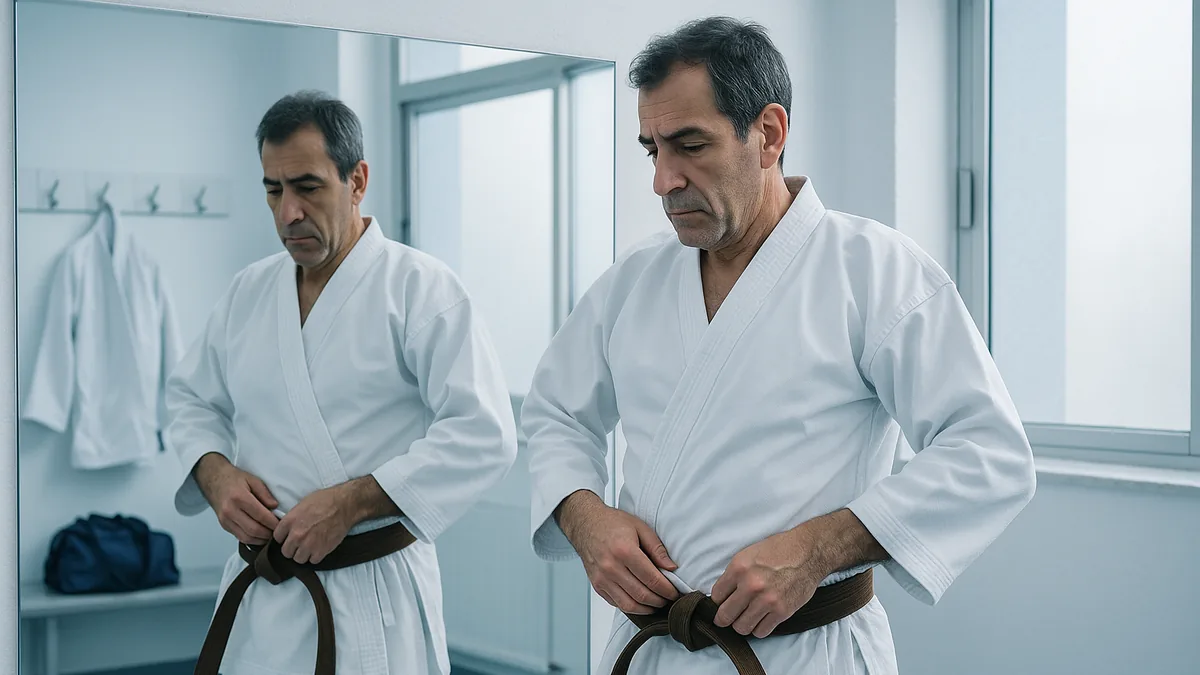
The mirror is the default feedback tool in most dojos, and for basic positional correction it earns that status. If your guard is dropping, your front knee is collapsing inward, or your hikite isn’t pulling back far enough, the mirror tells you immediately. That immediacy matters more than most people realise - you can see the error while you’re still in the movement, which means you can adjust before the wrong pattern gets reinforced.
The problem is what the mirror trains you to do: look. Specifically, look at yourself. This creates a feedback dependency that can become a genuine technical liability once you move into partner work or competition. Motor learning research refers to this as the guidance hypothesis - the principle that augmented feedback used constantly during skill acquisition can cause learners to rely on that external source and stop processing their own inherent sensory information.1 A common consequence at intermediate level is students who have excellent mirror technique and struggle in jiyu-kumite - not because their technique is bad, but because they have trained themselves to process correction visually and externally.2
The correction that usually helps here is to use the mirror for positional checks only, not for movement drills. Set your kamae, check it, then look away. Throw your combinations, then look. Using the mirror as a constant real-time monitor risks training that dependence on external visual information rather than developing the proprioceptive awareness that competition requires.1, 2
What the Mirror Is Actually Good For
- Checking static posture: kamae, stances, guard position
- Identifying gross asymmetry - one shoulder higher than the other, uneven hip alignment
- Early-stage learning of new techniques where visual reference helps build the initial mental map
- Solo kata practice where you need to confirm that what you think you’re doing matches what’s actually happening
The mirror is weakest for timing, speed, and anything that requires you to feel rather than see. You cannot see whether your hip is rotating before or after your arm extends. You cannot see whether your weight transfer is driving the technique or chasing it. These are kinaesthetic corrections, and the mirror gives you no information about them at all.3
The Camera: The Tool Most Students Underuse
Video review is where serious technical development happens, and most club-level karate students barely use it. This is a mistake.
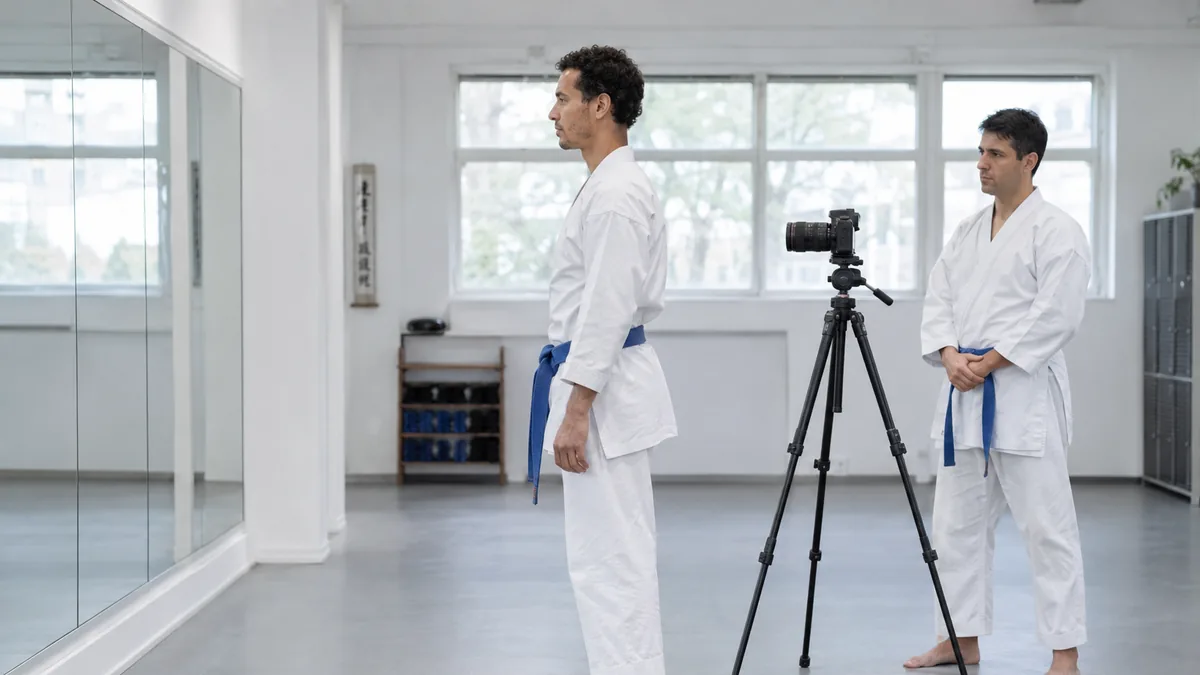
The camera captures what you cannot perceive in real time. When you throw a gyaku-zuki at full speed, you have no conscious awareness of what your shoulder is doing at the moment of impact, whether your back heel is lifting prematurely, or whether your reverse punch is actually reaching full extension or stopping short. The mirror cannot show you this at speed. A training partner can tell you something is off, but they often can’t identify the specific fault. The camera shows you exactly what happened.4
The most useful application is side-by-side comparison. Film yourself performing a technique, then compare it to a reference - a senior instructor in your style, or footage of a high-level competitor whose technique your association recognises as exemplary. Research comparing self-observation alone with self-observation alongside expert modelling consistently finds that combining both produces superior learning outcomes.5 The differences that matter will be immediately obvious in a way that verbal correction often isn’t.
What the camera reveals that nothing else can:
- Timing errors - whether your hip, arm, and weight transfer are sequenced correctly
- Compression before techniques - the small preparatory movements that telegraph your attacks in kumite
- Guard collapse during combination work - your defence while you’re attacking
- Kata rhythm - whether your transitions are consistent or whether you’re rushing certain sequences
A common experience when students first review their own footage is that what feels like a sharp, committed gyaku-zuki often looks tentative on screen, and what feels like a low, stable stance often looks upright. This gap between felt experience and visual reality is one reason camera review is so valuable - it forces an honest recalibration.4
A practical approach: film one technique or one kata sequence per session. Don’t try to review everything. Identify one specific fault, work on it for several sessions, then film again to check whether the correction has actually taken hold or whether you’ve just added a new error somewhere else. Research on self-controlled video feedback supports this kind of focused, deliberate use - learners who request video review selectively and with a specific question in mind show better technical development than those who review footage passively.6
The Limitation Nobody Mentions
The camera is a post-hoc tool. You watch the footage after training, identify the fault, and then have to carry that correction back into the next session - often days later. The feedback loop is long, and without a structured approach to applying what you see, camera review becomes a passive exercise in noticing problems rather than fixing them.
It also tells you nothing about pressure, timing against a live opponent, or whether your distance management is actually functional. For that, you need a training partner.
Training Partners: The Feedback That Can’t Be Faked
A good training partner is the most complete feedback mechanism available, and also the most demanding to use well. The mirror shows you what you look like. The camera shows you what you did. A training partner shows you whether it works.
This distinction matters enormously. In jiyu-kumite, a technique that looks textbook-correct in the mirror might be consistently failing because your telegraphing gives your opponent enough warning to respond. A training partner will either exploit that or, if they’re a good training partner, tell you about it. No other feedback method surfaces this kind of information.
The specific value of partner feedback by training context:
Kihon and drilling: A partner can feel whether your tsuki is actually making contact at the right depth and angle, whether your kizami-zuki is genuinely snapping back or just stopping short, and whether your combination timing is consistent. This tactile feedback is information you cannot get from a mirror or a camera. You’ll feel the difference between a punch that lands with structure behind it and one that’s all arm - the partner feels it too, and their response tells you which one you threw.
Kata bunkai: Partner work is where kata stops being abstract. If your application of a technique doesn’t function against a cooperative training partner, it won’t function anywhere. The correction that usually follows is a realisation that the technique was being performed as a visual shape rather than as a functional movement - the angle was wrong, the distance was wrong, or the timing was wrong in a way that only becomes apparent when there’s a body on the other end of it.
Jiyu-kumite: This is where all the technical work either holds up or doesn’t. A training partner in free sparring will expose telegraphing, guard habits, predictable combinations, and distance management errors faster than any other method. The feedback is immediate, honest, and occasionally uncomfortable.
The limitation of partner feedback is consistency. A good training partner with good observation skills is an exceptional asset. Research into how learners interpret and act on feedback from peers shows that the ability to identify critical errors, articulate them precisely, and deliver them constructively takes time to develop - it is not automatic.7 A partner who doesn’t know what to look for, or who gives vague feedback like “it felt a bit off,” gives you very little to work with. The quality of this feedback method depends entirely on the quality of the partnership.
Community Perspective
There is a genuine divide in how different dojos approach this. Traditional clubs often resist video analysis on the grounds that it encourages students to develop their technique by imitation rather than by understanding, and that the instructor’s correction should be the primary feedback mechanism. This is a defensible position - there is a real risk that students start optimising for how they look on camera rather than how their technique functions under pressure.
Modern competition-focused clubs tend to use video extensively, particularly for kata competitors. At WKF level, kata is scored on a scale from 5.0 to 10.0, with judging criteria covering technical execution, strength, speed, and balance.8 Meeting that standard consistently requires performers and coaches to review footage in detail, and the gap between what the athlete feels and what the judges see can be significant.
The view that shifts most with experience is the one about mirrors. Beginners trust the mirror completely. Many senior practitioners barely use it, having developed enough kinaesthetic awareness to feel when something is wrong without needing to see it. Proprioception - the body’s ability to sense its own position and movement - forms the foundation of this kind of self-correction, and research confirms that developing it is central to motor skill refinement at higher levels of performance.3 The mirror is a useful support for proprioception in early learning; the goal is eventually not to need it.
The honest position is that these tools aren’t in competition with each other. The question is sequencing: mirror for early-stage positional learning, camera for technical audit at any level, and training partners as the ongoing primary feedback mechanism once you have enough basic technique to make partner work productive.
Which Feedback Method Improves Technique Fastest?
We recommend training partners, with camera review as a close second, and the mirror as a useful but limited supplementary tool.
The reason is simple: partner feedback operates at the speed of training. It’s immediate, it’s honest, and it tests whether your technique actually functions - not just whether it looks correct. The camera is the best tool for identifying specific technical faults that you can’t perceive in real time, and it’s particularly valuable for kata. The mirror is useful for beginners and for static position checks, but over-reliance on it risks creating a dependency on external visual feedback that actively hinders development in partner work and kumite.1, 2
This is the same principle that applies across equipment choices in karate training. Whether you’re working with kick shields or curved kick pads, or deciding between focus mitts and Thai pads, the question is always the same: what does this tool actually tell you about whether your technique is working? The closer that feedback is to a real training scenario, the more useful it is.
The heavy bag tells you something about power and structure. The mirror tells you something about shape. A training partner who knows what they’re doing tells you whether any of it is actually functional.
Key Takeaways
- Use the mirror for static position checks and early-stage technique learning - then look away. Using it as a constant monitor risks building a dependence on external visual feedback, which becomes a liability in partner work.
- Film one technique or sequence per session, not everything. Identify one fault, correct it over several sessions, then film again to confirm the change has actually taken hold.
- The gap between what a technique feels like and what it looks like on camera is real and usually significant. Closing that gap is one of the most productive things you can do for your technical development.
- Training partner feedback is the most complete feedback available because it tests whether technique functions, not just whether it looks correct. Prioritise it as soon as your basic technique is developed enough to make partner work productive.
- The quality of partner feedback depends on the quality of the partner. A training partner who can identify specific faults and articulate them clearly is worth more than any equipment.
- As kinaesthetic awareness develops with experience, the need for external visual feedback decreases. The goal is to feel when something is wrong before you see it - that’s when technique has genuinely been internalised.
References
Checked by the KarateLifestyle editorial team against peer-reviewed motor learning literature (PubMed, Springer, Frontiers), official WKF competition rules, and Frontiers proprioception research in October 2026. The guidance hypothesis literature is well-established but relates to augmented feedback broadly; mirror-specific dependency evidence is extrapolated from that body of work rather than drawn from mirror-only studies.
- Augmented visual, auditory, haptic, and multimodal feedback in motor learning: A review. Sigrist R, Rauter G, Riener R, Wolf P. Psychonomic Bulletin & Review, 2013. Reviews the guidance hypothesis and feedback dependency in motor learning.
- Motor Learning with Augmented Feedback: Modality-Dependent Behavioral and Neural Consequences. Peer-reviewed study using fMRI and behavioural data. Found visual augmented feedback induces dependency, leading to performance drops without it; supports guidance hypothesis.
- Editorial: Proprioception in sports and health. Frontiers in Physiology, 2025. Reviews proprioception as the foundation of motor control, postural regulation and kinaesthetic awareness in sport.
- The use of video feedback as a facet of performance analysis: an integrative review. Integrative review; meta-analytic evidence cited supports video modelling efficacy for motor skill acquisition with moderate to large effect sizes.
- The effects of video feedback in gymnastics training on round-off motor skill performance. Frontiers in Sports and Active Living, 2026. Finds that visual information combining expert and self-modelling yields superior learning outcomes compared to self-observation alone.
- The Effects of Self-Controlled Video Feedback on the Learning of the Basketball Set Shot. Barros JAC et al. PLoS ONE / PMC, 2012. Found self-controlled video feedback conferred a learning benefit for motor skill acquisition.
- Video observation in peer feedback and motor learning (Frontiers in Psychology). Frontiers in Psychology, 2025. Found that sports learners using video tools develop more actionable peer feedback and improve ability to identify and articulate technical errors.
- WKF Kata Competition Rules 2026. World Karate Federation, Rules Version 2026.0. Official scoring rules for WKF kata competition, including 5.0 to 10.0 scale and judging criteria.
The weekly digest
New karate articles, once a week
One email every week with everything new on Karate Lifestyle. No spam; unsubscribe in one click.
We'll email you to confirm. See our privacy policy.