How to Manage DOMS After Intensive Karate Training Camps
The Morning After a Camp Will Humble You
Day two of a training camp is where you find out who prepared and who didn’t. You wake up, swing your legs off the bed, and your thighs immediately inform you that yesterday’s kihon sessions were not forgotten. Your shoulders are tight from a hundred repetitions of oi-zuki. Your calves feel like they’ve been replaced with wet concrete. You shuffle to breakfast looking like you’ve aged thirty years overnight.
I’ve been through this cycle more times than I can count - as a student, as an instructor helping to run camps, and as someone who spent years making every recovery mistake possible. The good news is that DOMS (delayed onset muscle soreness) after intensive camp training is manageable. The bad news is that most people manage it badly, and it costs them the back half of the camp.
Here’s what I’ve learned, what I’ve changed my mind about, and what I now tell every student before they pack their bag for a residential course.
Why Camp Training Hits Different
A regular dojo session is two hours, maybe three if you’re doing a grading prep class. A camp is six to eight hours of training across multiple sessions, often with instructors you don’t normally train under, which means your body is working in unfamiliar patterns. You’re throwing techniques you rarely drill. Your posture compensates differently. Your nervous system is constantly adjusting.
I used to think DOMS was just about intensity - that if you trained hard enough in your regular sessions, camp soreness wouldn’t be as bad. I was wrong about that for years. The thing that actually changed my understanding was watching a very fit, very experienced brown belt - someone who trained five days a week - completely seize up on day two of a national squad camp. He trained regularly, but the specific combination of high-volume kata, extended kihon lines, and ground conditioning work hit muscle groups in patterns he simply wasn’t used to.
DOMS isn’t purely about fitness. It’s about novel mechanical stress on muscle tissue. You can be in excellent shape and still get hammered by it when the movement patterns change. Understanding that matters because it stops you from either panicking or dismissing it as a sign of weakness.
Active Recovery: The Thing Most People Skip
The single biggest mistake I see at camps is what happens in the gap between sessions. People eat, sit down, and don’t move again until the next session starts. I understand the impulse - you’re exhausted, your legs hurt, the sofa in the accommodation looks like paradise. But that stillness is working against you.
Active recovery doesn’t mean doing another workout. It means keeping blood moving through the tissues that are already damaged. A fifteen-minute walk after lunch. Some gentle arm circles and hip rotations before dinner. A slow, low-intensity movement session in your room before bed. Nothing that adds stress - just enough to keep circulation going.
What I tell students is this: think of your muscles after a hard session the way you’d think of a bruise. If you press on a bruise and then leave it completely alone, it stiffens. If you gently keep the area mobile, it resolves faster. DOMS is essentially micro-trauma in the muscle fibres. Gentle movement encourages the repair process.
I’ve noticed that the practitioners who recover best between camp sessions are almost never the ones resting most aggressively. They’re the ones doing a quiet twenty-minute walk, doing some light shadow work, or just moving around rather than collapsing. It feels counterintuitive when you’re exhausted, but it genuinely makes a difference to how you feel when the next session starts.
For structured active recovery between sessions, a light kata run-through at about thirty percent intensity works well. You’re reinforcing technique while keeping the body moving. It’s not wasted time. If you want to build this kind of recovery thinking into your regular training, the principles in Recovery For Karate Practitioners are worth reading before your next camp.
Stretching and Foam Rolling: What Actually Works
I’ll be honest - I went through a phase of being sceptical about foam rolling. It felt like a fad. My old sensei had never touched a foam roller in his life and he trained into his sixties without falling apart. I’ve updated that opinion. Not because I read anything, but because I started using one consistently during a particularly brutal training block and felt the difference in my hips and thoracic spine within two weeks.
The thing is, foam rolling doesn’t fix DOMS. That’s a common misconception. What it does is address the fascial tightness and restricted circulation that makes DOMS feel worse than it needs to. You’re not repairing the muscle - you’re reducing the secondary stiffness that compounds the soreness.
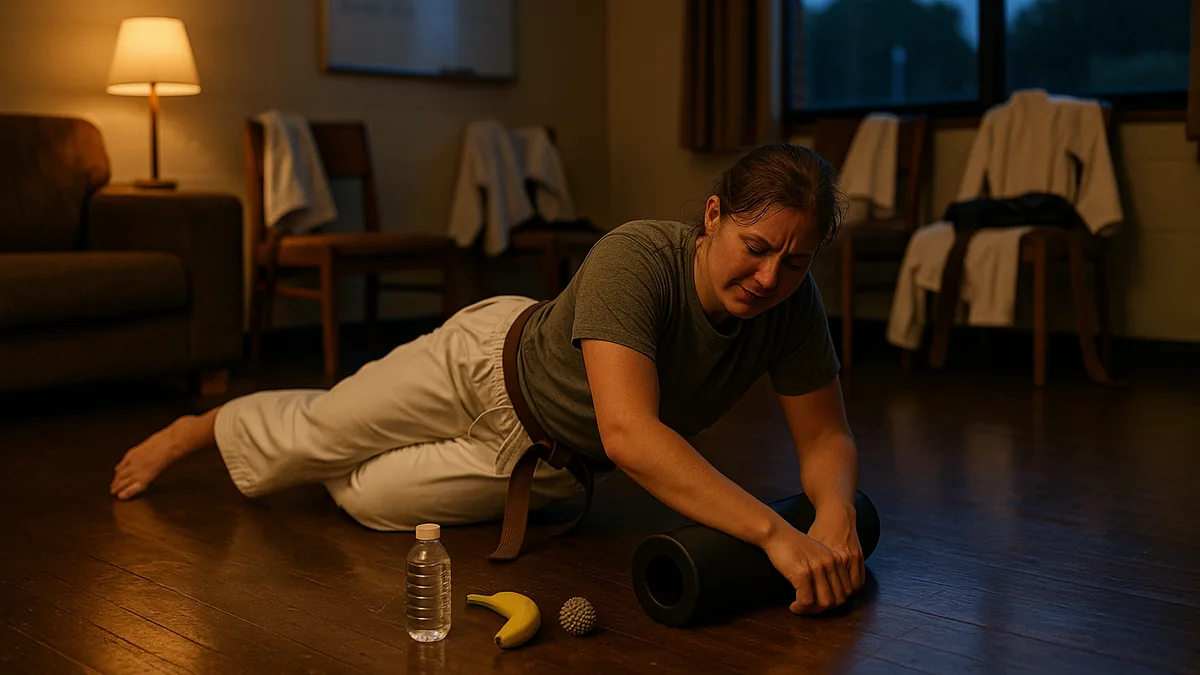
Where I see people go wrong with foam rolling is speed. They roll fast, like they’re trying to get it done. That doesn’t work. The tissue needs sustained pressure to release. Slow down. When you find a tender spot, hold there for fifteen to twenty seconds before moving on. You’ll feel it gradually soften under the pressure - that’s the sensation you’re looking for. If you’re rolling so fast you never find that feeling, you’re just going through the motions.
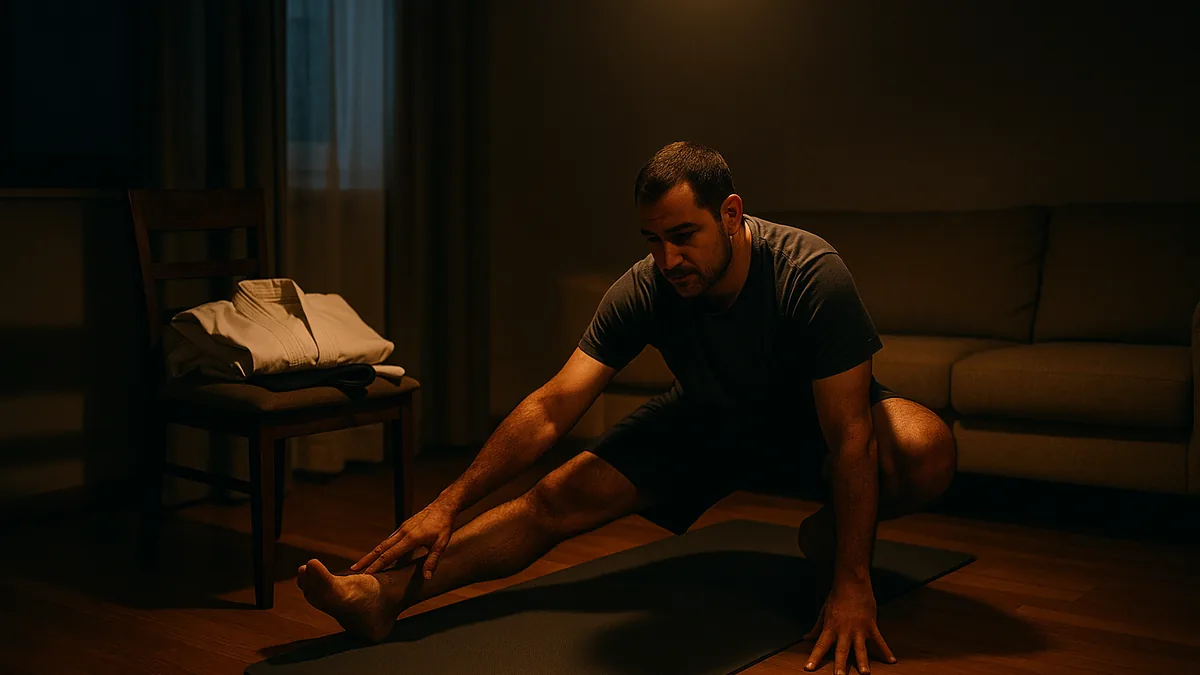
For stretching, I prefer active stretching over passive holds during the acute phase of DOMS - so within the first forty-eight hours after a heavy session. Passive stretching on already-damaged tissue can aggravate it. Instead, move through a range of motion actively: leg swings, controlled hip circles, shoulder rotations. You’re encouraging movement without forcing length onto a muscle that’s already under stress.
After forty-eight hours, longer passive holds become more useful. That’s when I’ll spend time on the hip flexors, hamstrings, and thoracic spine - all areas that take a beating in high-volume karate training. A good warm-up routine adapted for recovery purposes is worth having in your toolkit.
Hydration and Nutrition: The Basics People Ignore
I’ve watched students at camps drink almost nothing between sessions and then wonder why they’re cramping and exhausted by day two. Hydration for recovery isn’t complicated, but it requires consistent attention throughout the day - not just chugging water when you feel thirsty.
When you’re training at camp intensity, you’re losing significant fluid and electrolytes through sweat. Plain water replaces the fluid but not the electrolytes, which matters for muscle function and recovery. I carry electrolyte tablets to every camp now. It’s a small thing that makes a noticeable difference, particularly for preventing the leg cramps that tend to arrive around night two.
On nutrition: the window immediately after a session matters more than most recreational practitioners realise. Your muscles are primed to uptake protein and carbohydrates for repair and glycogen replenishment in the hour or so after training. At camps, this often means eating something at a time when you don’t feel like eating - you’re tired, you need a shower, the dining hall is crowded. Do it anyway. A decent meal with protein and carbohydrates in that window will noticeably affect how your body feels the next morning.
One mistake I see constantly is practitioners eating very lightly during camp because they’re not used to eating around training. They undereat across the day, then wonder why their performance drops on day two and three. Camp training is high-volume physical work. Your body needs fuel proportionate to the output. This isn’t the week to be precious about carbohydrates. For a more detailed breakdown of how to fuel training, Nutrition for Karate Training covers the specifics well.
Anti-inflammatory foods genuinely help here too. Ginger, turmeric, tart cherry juice if you can get it - these aren’t magic, but they support the body’s own inflammatory response management. I’ve added tart cherry concentrate to my post-training routine and I think it helps. Not dramatically, but noticeably.
Common Mistakes That Make DOMS Worse
Doing nothing and hoping it passes. Complete rest feels logical when you’re sore, but it slows recovery. See above.
Training through severe DOMS at full intensity. This is the opposite mistake. I’ve seen students try to prove something by going full intensity on day two when they can barely walk. You’re not recovering - you’re adding more damage to tissue that hasn’t repaired yet. Train at reduced intensity. Your technique will actually be better for it.
Ignoring sleep. This one surprises people. Sleep is when the majority of muscle repair happens. At camps, people stay up late talking, socialising, reviewing kata. I’ve done it myself. But cutting sleep short on camp nights is directly cutting into your recovery. Eight hours minimum. Nine if you can manage it.
Stretching cold. I’ve watched students wake up stiff, immediately drop into a deep hamstring stretch, and then limp for the rest of the day. Warm the tissue first - even a five-minute walk, some gentle movement - before you start lengthening anything. Cold stretching on DOMS-affected muscles is asking for a strain.
Ignoring pre-existing tightness. If you arrive at camp with tight hip flexors or a restricted thoracic spine, the camp will find it and exploit it. The time to address those restrictions is in the weeks before the camp, not during it. The Preventing Common Karate Injuries resource is useful for identifying the common problem areas before they become camp injuries.
Community Perspective
There’s a real split in how different dojos approach recovery at camps, and it’s worth being honest about it.
Traditional camps - particularly those affiliated with Japanese or Okinawan organisations - often have a cultural expectation that soreness is part of the process and that you train through it. The attitude is that discomfort is instructive. I’ve trained in environments where asking for a recovery session would have been met with genuine confusion.
Modern sports science-informed dojos take a very different approach. Recovery is scheduled, nutrition is discussed openly, and managing soreness is treated as part of the training itself rather than a sign of weakness.
I’ve trained in both environments. My honest position is that the traditional approach builds a certain kind of mental resilience that I value - there’s something real about learning to function under fatigue. But I’ve also seen it produce unnecessary injuries that set practitioners back for months. The sports science approach keeps people training longer and with fewer setbacks.
What I’ve landed on, after enough years of seeing both, is that the mental toughness the traditional approach builds is real and worth developing - but you don’t need to sacrifice your body to get it. You can train hard, manage recovery intelligently, and still develop the grit that makes a serious practitioner. They’re not mutually exclusive, even if some instructors treat them as if they are.
Key Takeaways
- Active recovery between sessions - walking, gentle movement, light shadow work - will do more for your day-two performance than complete rest. Move, even when you don’t want to.
- Foam roll slowly. Find the tender spots and hold pressure there. Fast rolling is just theatre.
- Eat a proper meal with protein and carbohydrates within an hour of finishing a session. At camp, this means prioritising it even when you’re exhausted and don’t feel hungry.
- Hydrate consistently throughout the day and include electrolytes, not just water. Cramps on night two are almost always a hydration issue.
- Sleep is non-negotiable for recovery. Late nights at camp are fun, but they’re costing you performance and adding to soreness. Protect your sleep.
- Distinguish between productive discomfort and actual damage. Training through DOMS at moderate intensity is fine. Training at full intensity on severely damaged tissue is how you turn soreness into injury.
The weekly digest
New karate articles, once a week
One email every week with everything new on Karate Lifestyle. No spam; unsubscribe in one click.
We'll email you to confirm. See our privacy policy.