How to Practise Kata When You Only Know One: Getting Real Training Value from a Single Form
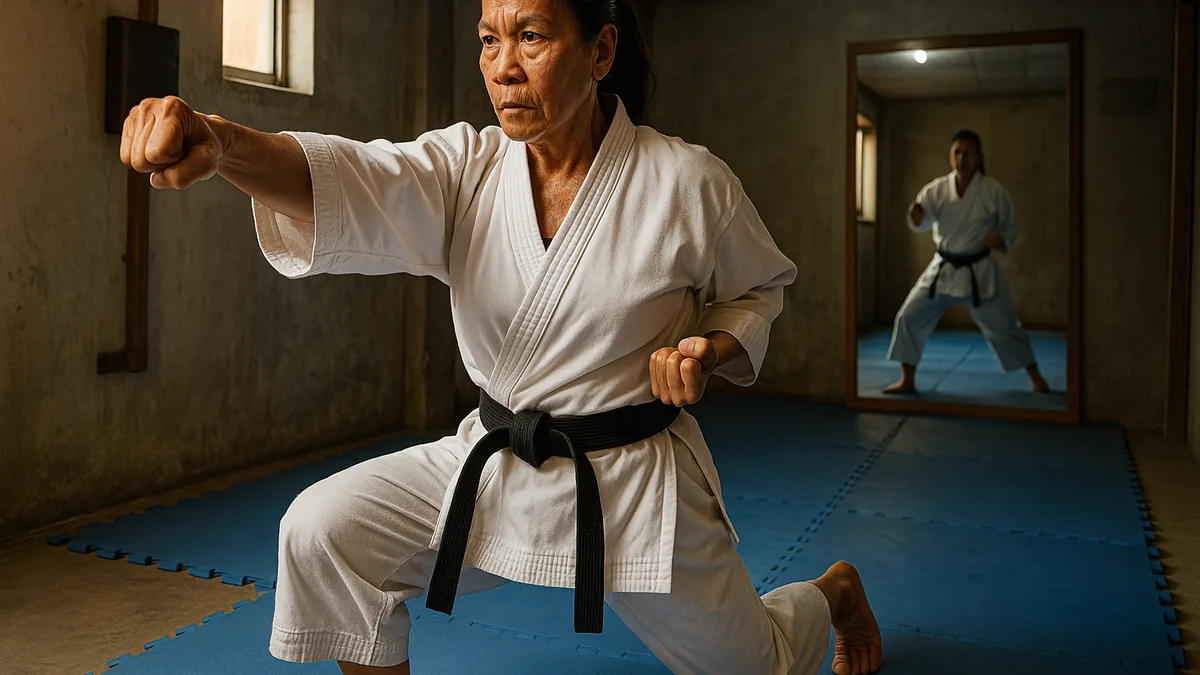
Most people treat having only one kata as a limitation. I’d argue it’s an advantage you’re probably not using.
When students learn their second and third kata, attention splits. They’re managing the sequence, comparing forms, wondering which one to practice today. The student who only knows Heian Shodan - or Taikyoku, or whatever they started with - has no choice but to go deeper. The problem is most of them don’t. They just repeat the same surface-level run-through, over and over, and wonder why they’re not improving.
Here’s what I’ve seen work instead.
Why Repetition Without Variation Is Mostly Wasted Time
I used to think kata training meant running the form until it was automatic. My instructor would tell me “a thousand repetitions” and I’d nod and go do twenty. I didn’t understand what he meant until about three years in, when I finally started breaking the kata apart.
The mistake I see most often is treating kata like a memorisation exercise. Students think the goal is to run through it cleanly, start to finish, without forgetting the sequence. That’s the floor, not the ceiling. Once you know the sequence, the real training begins - and that’s where most people stop.
If you only know one kata, you have an opportunity to understand it at a level most people never reach with their competition forms. The question is how to structure that practice so it actually builds something.
The Drills That Actually Matter
Slow-Motion Kata With Full Tension
This is the drill I come back to more than any other, and it’s the one students resist most because it feels uncomfortable.
Why it matters: Running kata at normal speed lets you hide bad habits behind momentum. Slowing it down to a crawl - we’re talking 3-5 seconds per technique - forces every joint position, every weight transfer, every hip angle to be correct or it falls apart visibly.
Setup: You need enough space to run the full form. No music, no counting. Just you.
Execution:
- Begin the kata at roughly one-fifth of your normal speed
- At each technique, pause at the point of completion and hold for two full seconds
- During that hold, check: where is your weight? Are your hips actually square or slightly open? Is your back shoulder dropped?
- Continue to the next movement, maintaining the same deliberate pace
- Run the whole form twice this way before returning to normal speed
What to feel for: This is where it gets interesting. At normal speed, a punch feels like a punch. At slow speed, you’ll feel whether your hip is actually driving it or whether your arm is doing all the work. You’ll feel the difference in your shoulder - when the hip rotation connects, the shoulder doesn’t strain. When it doesn’t connect, you feel the arm working in isolation and it feels effortful in the wrong way.
The most common mistake: Students slow down their arms but keep their transitions fast. The whole point is to slow the transitions - the moments between techniques - because that’s where the balance and weight transfer live.
Bunkai Extraction - Even From One Sequence
I’d recommend this even if you only have three or four techniques to work with. Pick one sequence from your kata - a block and a counter, or a turn and a strike - and spend an entire session exploring what it might mean.
Why it matters: Kata techniques are not decorative. If you’re practicing a form without any sense of what the movements represent, you’re essentially doing an elaborate warm-up. Bunkai - the practical application of kata movements - transforms repetition into understanding. You can read more about this in Training Kata for Self-Defence.
Setup: You need a training partner for this, ideally, but you can do a version solo with a heavy bag or even just visualisation.
Execution:
- Choose one sequence: for example, the first three movements of Heian Shodan - the turn, the gedan barai, the oi-zuki
- Ask yourself: what attack does this respond to? Most lower-level kata techniques respond to grabs, pushes, or haymakers - not the crisp reverse punches we drill in kihon
- Have your partner throw the attack. Work the kata movement as a response, slowly, without concern for how it “looks”
- Repeat the same sequence ten times. Then ask: what else could this be?
- Try at least two interpretations before moving on
What to feel for: When the bunkai is working, the kata technique feels inevitable. The block doesn’t feel like a block - it feels like a redirect that naturally sets up the counter. When it’s not working, you’re forcing it, and you’ll feel the awkwardness in your grip or your footwork.
The common mistake: Students try to make the bunkai look like the kata. It usually doesn’t. The kata is a compressed, stylised representation. The application is messier, closer, and often involves the opposite hand from what you expect.
Timing Variation Runs
This is something I started doing after realising my kata had a rhythm problem - every technique was landing at the same speed, with the same pause between movements. Real timing isn’t like that, and neither is the kata when you understand it properly.
Why it matters: Kata has built-in timing variations. Some techniques should be explosive. Some should be slow and controlled. Running everything at the same pace misses the structure entirely. If you want to go deeper on this, Kata Timing: Why Your Rhythm Is Wrong and How to Fix It covers it in detail.
Execution:
- Run your kata once at normal, even pace
- Now identify the techniques that should be fast - typically strikes and explosive blocks
- Identify the transitions that should be controlled - typically weight shifts, turns, and drawing movements
- Run the kata again, deliberately making the contrast sharper. Fast techniques should feel sudden. Controlled transitions should feel deliberate
- Record yourself if possible. What you think feels dramatic usually looks subtle on video
What to feel for: When the timing is right, the kata has a rhythm that feels almost musical - not uniform, but structured. The fast techniques feel like they release something that was coiling during the controlled transitions. It feels like snapping a rubber band that was being stretched, not like pressing a button.
The Single Technique Drill
Pick one technique from your kata. Just one. Spend twenty minutes on nothing else.
I’ve watched students run Heian Shodan fifty times in a session and still have a broken gedan barai. Twenty minutes on just that block, in isolation, would have fixed it permanently. This is the drill most people skip because it feels too simple. It’s not.
Execution:
- Identify the technique you’re least confident about
- Perform it solo, slowly, thirty times. Count them
- Now perform it with a focus mitt or partner’s arm - feel what it actually contacts
- Return to the kata and run just the section containing that technique, five times
- Run the full kata once
The correction that makes the biggest difference here is context. Students isolate a technique and it looks fine. They put it back in the kata and it breaks. That usually means the problem is in the transition before it - the setup - not the technique itself.
What Changes With Experience
As a white belt, I thought kata was about remembering the sequence and making the techniques look correct. By brown belt, I understood it was about understanding what each movement was solving. Now, after fifteen-plus years, I think of kata as a conversation with whoever designed the form - every time I run it, I’m asking “what did you mean here?”
A beginner running one kata is focused on sequence. An intermediate practitioner is focused on technique quality. A senior practitioner is focused on the question behind each movement.
If you only know one kata, you can reach that third level faster than someone who knows ten, because you’re not constantly switching contexts. The form becomes familiar enough that you stop thinking about what comes next and start thinking about what it means.
I’ve noticed that students who spend a long time with a single kata before learning their second tend to have better bunkai instincts overall. They’ve had to ask hard questions about one form rather than moving on when it got difficult.
How to Make It Harder
Once the basics are solid, the progressions that actually build something are:
Eyes closed: Run the kata with eyes closed once you know the sequence confidently. This forces you to feel your balance rather than correct it visually. It feels wrong at first - you’ll drift off the embusen (performance line) immediately - but trust the mechanics. After a few sessions, your proprioception sharpens noticeably.
Against resistance: Have a partner provide light resistance against your techniques at the moment of execution. Not blocking you - just enough pressure that you have to generate real power to complete the movement. You’ll immediately discover which techniques you were “performing” versus actually executing.
Verbal bunkai: Run the kata and narrate what’s happening out loud. “Grab defence, redirect, counter to the face.” It sounds strange but it forces conscious engagement with the meaning of each movement. Students who do this consistently develop much better instincts for application.
For self-assessment between sessions, the guidance in How to Self-Assess Your Kata When You Have No Instructor Watching is worth reading - particularly around what video actually shows you versus what it hides.
Community Perspective
There’s a genuine split in how dojos approach single-kata training. Some instructors - particularly in traditional Okinawan lineages - actively delay introducing new kata, keeping students on one form for six months or more. The argument is that depth matters more than breadth, and that a student who truly understands Taikyoku Shodan is better prepared than one who can recite five kata superficially.
Other instructors, particularly in sport-oriented associations, move students through kata quickly to build a competition repertoire. Neither approach is wrong, but they produce different practitioners.
I’ve seen students from slow-progression dojos who could extract bunkai from any sequence they encountered because they’d learned how to ask the right questions. I’ve also seen them struggle initially with unfamiliar forms because they’d never had to adapt. The practitioners who moved through kata quickly often had better surface performance but shallower understanding.
My honest view: if you only know one kata right now, that’s not a problem to solve by learning another one. It’s an invitation to go deeper. The Kata Nobody Wants to Practice makes a similar argument about the shorter forms that get abandoned too early.
Key Takeaways
- Slow-motion kata with holds at each technique is the single most efficient way to find your actual technical problems, not the ones you think you have
- Bunkai work transforms repetition into understanding - even two or three interpretations of one sequence changes how you see the whole form
- Timing variation is not decoration - the contrast between explosive techniques and controlled transitions is structural, not stylistic
- The technique that looks fine in isolation is usually breaking because of the transition before it, not the technique itself
- Eyes-closed kata is underused and underrated - it builds proprioceptive awareness faster than almost anything else
- One kata trained deeply will teach you more than five kata trained superficially, and the understanding transfers when you eventually learn the next form
The weekly digest
New karate articles, once a week
One email every week with everything new on Karate Lifestyle. No spam; unsubscribe in one click.
We'll email you to confirm. See our privacy policy.