Performing Kata Under Pressure: Why Your Form Falls Apart When It Matters and How to Train for It
Most students don’t realise their kata has a pressure problem until they’re standing in front of judges and their mind goes blank. They’ve trained the sequence hundreds of times. They know every technique. But the moment the stakes go up, something breaks down - timing collapses, kiai gets strangled, transitions that felt sharp in the dojo suddenly feel like they’re happening underwater.
I’ve seen this so many times that I can almost predict exactly where a student will fall apart before they even start. And the frustrating thing is, it’s almost never a technique problem. It’s a training method problem. We practice kata in the most forgiving conditions possible - same time of day, same floor, same training partners watching - and then we’re surprised when adding pressure to the equation exposes everything we haven’t actually trained.
Here’s what I’ve learned: pressure doesn’t create weaknesses. It reveals them. And the only way to fix that is to build pressure into training long before competition day.
Why Kata Falls Apart Under Pressure
The brain under stress defaults to the most recently reinforced pattern, not the best pattern. If you’ve been drilling your kata in a calm, controlled environment, that’s the pattern that’s reinforced. Add judges, add an audience, add the weight of a grading or competition, and your nervous system starts operating differently. Heart rate goes up, fine motor control degrades, and your internal timing reference - the one you rely on to pace the kata - gets disrupted.
I used to think nerves were just something you pushed through. My first instructor used to say “the kata knows the way, trust it.” I didn’t understand what he meant until I watched a student with technically excellent kata completely lose the embusen during a prefectural competition, drifting so far off the floor pattern that she had to visually correct herself mid-sequence. Her kata was fine. Her training hadn’t prepared her for what pressure does to spatial awareness.
If you want to understand how embusen functions and why losing it under pressure is such a significant problem, this article on kata floor patterns explains the mechanics in detail. But the short version is: your floor pattern is a structural anchor for the whole kata, and when pressure disrupts your internal compass, it goes first.
The other thing pressure attacks is breathing. Specifically, it makes you hold your breath or breathe too shallowly, which then affects kiai, which affects the whole rhythmic architecture of the kata. I’ve written more about this in the kata breathing guide - but the relevant point here is that breathing is the first thing to monitor when you’re stress-testing your kata, because it’s the first thing that breaks.
The Drills That Actually Fix This
Drill 1: The Interrupted Performance
This is the most important drill I use with competition students. Nothing else comes close.
Why it matters: You need to train recovery, not just execution. A kata performed under pressure will have moments of disruption. The student who recovers quickly and invisibly scores better than the student who never gets disrupted but has no recovery mechanism.
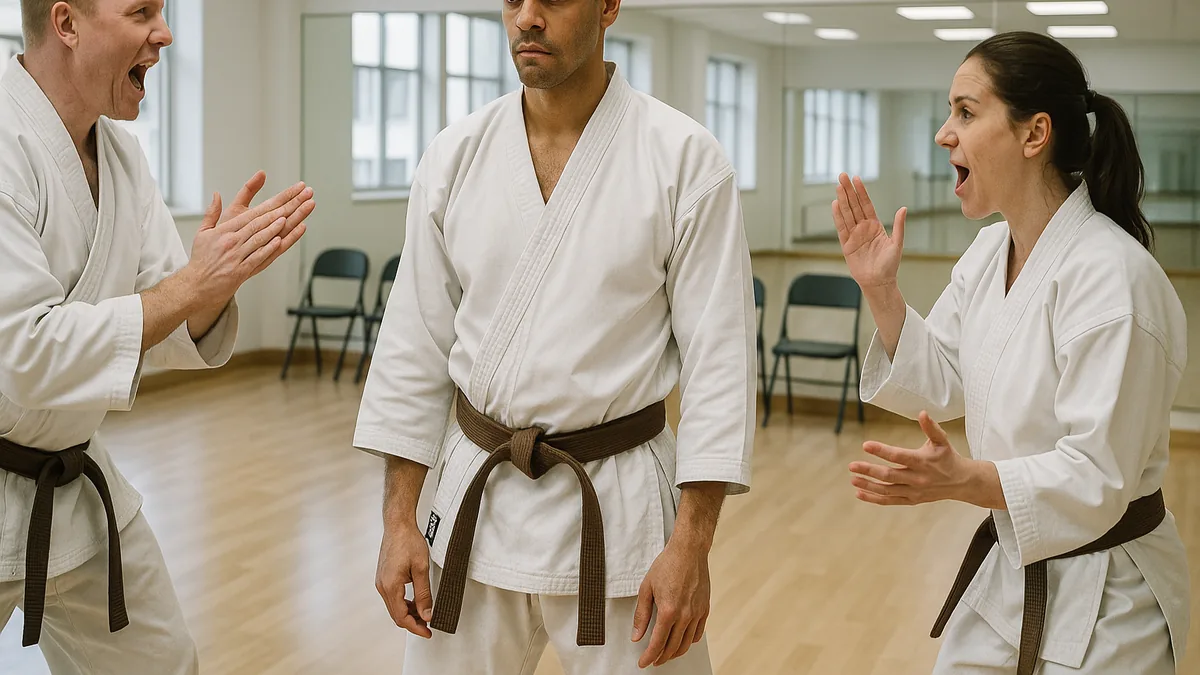
Setup: You need at least one training partner, ideally two or three. You’ll perform your kata in full, and your partner’s job is to interrupt you - verbally, with a loud noise, by stepping into your peripheral vision, by calling out a wrong technique name. The interruption is unpredictable.
Execution:
- Begin your kata from yoi, full commitment, as if it’s a real performance.
- Your partner watches and chooses a moment - usually mid-sequence, during a transition, or right before a kiai - to interrupt.
- When interrupted, you have a three-second rule: pause, breathe, find your position, continue from exactly where you stopped.
- After the session, review which interruptions caused the biggest disruption. Those are your weak transitions.
What to feel for: When you get this right, the pause feels controlled rather than panicked. You’ll feel your breath drop back down into your abdomen before you continue. That’s the signal you’ve recovered rather than just pushed through.
The mistake I see most often: Students try to ignore the interruption and bulldoze through. This feels strong but it’s actually avoidance - you’re training yourself to suppress the disruption rather than process and recover from it. The correction is to actually stop, fully, and restart cleanly.
Drill 2: The Stranger Performance
Why it matters: Most students have only ever performed their kata in front of people they know. The social dynamics of performing in front of strangers are genuinely different, and you need to train that specific discomfort.
Setup: Arrange to perform your kata somewhere outside the dojo. A park, a community hall, a different dojo. Ideally with people present who don’t train and have no framework for evaluating what you’re doing.
Execution:
- Perform the kata once with no warm-up beyond what you’d have at a competition.
- Perform it a second time immediately after, without the option to reset mentally.
- Note specifically what changed between the first and second performance.
What to feel for: The first performance will usually feel exposed and slightly rushed. If you notice your kiai getting quieter in front of strangers, that’s your ego protecting itself - and that’s exactly what you’re training against. The second performance should feel more settled. If it doesn’t, you need more repetitions of this drill.
What I tell students: The discomfort of performing in front of strangers is training data. Don’t try to eliminate it. Try to function inside it.
Drill 3: Fatigue-State Performance
Why it matters: Competition nerves raise your heart rate before you’ve done anything physical. Your kata needs to work when your body is already in a stressed physiological state.
Setup: Choose a physically demanding conditioning circuit - burpees, squat jumps, fast pad work, whatever elevates your heart rate significantly. You’re not training fitness here; you’re training performance under physiological stress.
Execution:
- Run the conditioning circuit for 60-90 seconds, hard.
- Immediately - within 10 seconds - begin your kata from yoi.
- Perform the full kata without stopping.
- Record it if you can.
What to feel for: Your breathing will want to be fast and shallow. The drill is to feel yourself deliberately slow the breath during the opening movements, using the kata’s own rhythm to bring your system back down. When it works, you’ll feel the kata actually settling your body rather than your body disrupting the kata.
The biggest difference between beginners and senior practitioners doing this drill is that beginners try to wait until they feel ready. Senior practitioners start the kata before they feel ready and use the kata’s structure to get there. That’s the whole point.
Mental Resilience Isn’t a Mindset Problem
I want to push back on something here, because I think the framing of “mental resilience” leads students in the wrong direction. Most students interpret it as “think more positively” or “believe in yourself more.” That’s not how it works.
Mental resilience in kata performance is a skill built through repeated exposure to discomfort, not through motivation. Every time you do the Interrupted Performance drill and recover cleanly, you’re building a neural pathway that says: disruption is survivable and recoverable. Every time you perform in front of strangers and your kiai stays strong, you’re building evidence that you can function under social pressure.
I’ve noticed that the students who develop the most consistent competition performance are not the ones who talk the most about mental strength. They’re the ones who have put themselves in uncomfortable performance situations the most often. The confidence is built from evidence, not from intention.
This connects directly to timing. Pressure specifically attacks your internal rhythmic sense - the part that knows when to pause, when to accelerate, when a technique needs to land with weight rather than speed. If you want to understand what correct timing feels like and how to build it so it survives pressure, the kata timing guide covers that in depth. But the short version is: timing built only in calm conditions is fragile. It needs stress-testing to become reliable.
Community Perspective
There’s a genuine split in how dojos approach competition preparation, and I think it’s worth being honest about it.
Traditional schools often argue that pressure training is a distraction from the real work - that if the kata is deep enough, it will hold under any conditions. I understand this position, and I think it’s partially right. A kata you’ve only done 50 times won’t be saved by stress drills. The technical foundation has to be there.
But I’ve also trained with practitioners from more competition-focused backgrounds who treat pressure simulation as a core training method from early on, and I’ve seen those students perform more consistently at tournaments. The kata might not be as deep in the traditional sense, but it holds its shape when it counts.
My position is that both things are true at different stages. Build the kata properly first - if your kata looks the same at brown belt as it did at yellow belt, that’s a different problem entirely. But once the structure is solid, pressure training is not optional for competition students. It’s the work that makes everything else count.
There’s also disagreement about how much competition kata should diverge from the kata you’d perform at a grading. Some instructors treat them as the same thing performed at a higher level. Others effectively teach a competition version with deliberate amplification of visual moments. I think this is a conversation worth having with your instructor directly, because it touches on deeper questions about what kata is actually for - questions that don’t have the same answer across styles.
Key Takeaways
-
Pressure doesn’t create weaknesses in your kata - it reveals the ones that calm practice hid. Your training environment needs to match the conditions you’re preparing for.
-
The Interrupted Performance drill is the most valuable single tool I’ve found for competition preparation. Run it weekly in the months before competition, not just in the final week.
-
Recovery is a trainable skill. A student who disrupts cleanly and recovers invisibly will outscore a student who performs perfectly in training but freezes under pressure.
-
Your kiai is a pressure gauge. If it gets smaller or tighter in front of strangers, that’s the problem to fix - not your technique.
-
Mental resilience is built through exposure, not intention. Put yourself in uncomfortable performance situations repeatedly. The confidence you need is built from evidence that you’ve already functioned under pressure.
-
Fatigue-state performance training teaches you to use the kata’s own structure to regulate your physiology - which is exactly what you need when competition nerves have already raised your heart rate before you’ve taken a single step.
The weekly digest
New karate articles, once a week
One email every week with everything new on Karate Lifestyle. No spam; unsubscribe in one click.
We'll email you to confirm. See our privacy policy.