Naihanchi, Naifanchi, Tekki: Why the Same Kata Has Three Names, Three Histories, and Is Trained Completely Differently Depending on Your Style
The Name Problem Is Actually a History Problem
The confusion starts in Okinawa, before karate had a standardised name, let alone standardised kata. The form most people call Naihanchi - or Naifanchi, depending on your source - was a central kata in the Tomari-te and Shuri-te traditions. Anko Itosu, who introduced karate into the physical education curriculum of the Okinawan public school system in 1901, taught it and passed it to students who would go on to shape every major Japanese karate style.
The name question comes down to dialect and transmission. “Naihanchi” is closer to a Japanese pronunciation of the characters; “Naifanchi” is closer to the Okinawan reading.1 When Gichin Funakoshi demonstrated karate to mainland Japan - most consequentially at the First National Athletic Exhibition in Tokyo in 1922, after which he remained in Japan to teach - he eventually renamed many kata. In his own words in Karate-do Kyohan, he explained the change as a response to ambiguous names of Chinese origin, with Tekki (written with characters meaning “iron horse” or “iron horseman,” referring to the distinctive horse-riding stance) replacing Naihanchi.1 The renaming was also a deliberate effort to make the art more palatable to Japanese audiences and to distinguish it from its Chinese roots.
So the short version: Naihanchi and Naifanchi are two romanisations of the same name, reflecting the difference between Japanese and Okinawan pronunciation. Tekki is Funakoshi’s Japanese rename. They are the same kata at root, but centuries of separate transmission have produced real technical differences - not just cosmetic ones.
For more on how this kind of renaming reflects style politics, the article on Pinan vs Heian: Why the Same Kata Have Different Names and What That Tells You About Style Politics covers the same phenomenon in detail.
What Actually Changed in the Transmission
The stance is the most visible difference, and it is the one most practitioners fixate on. But fixating on the stance alone is a beginner’s mistake.
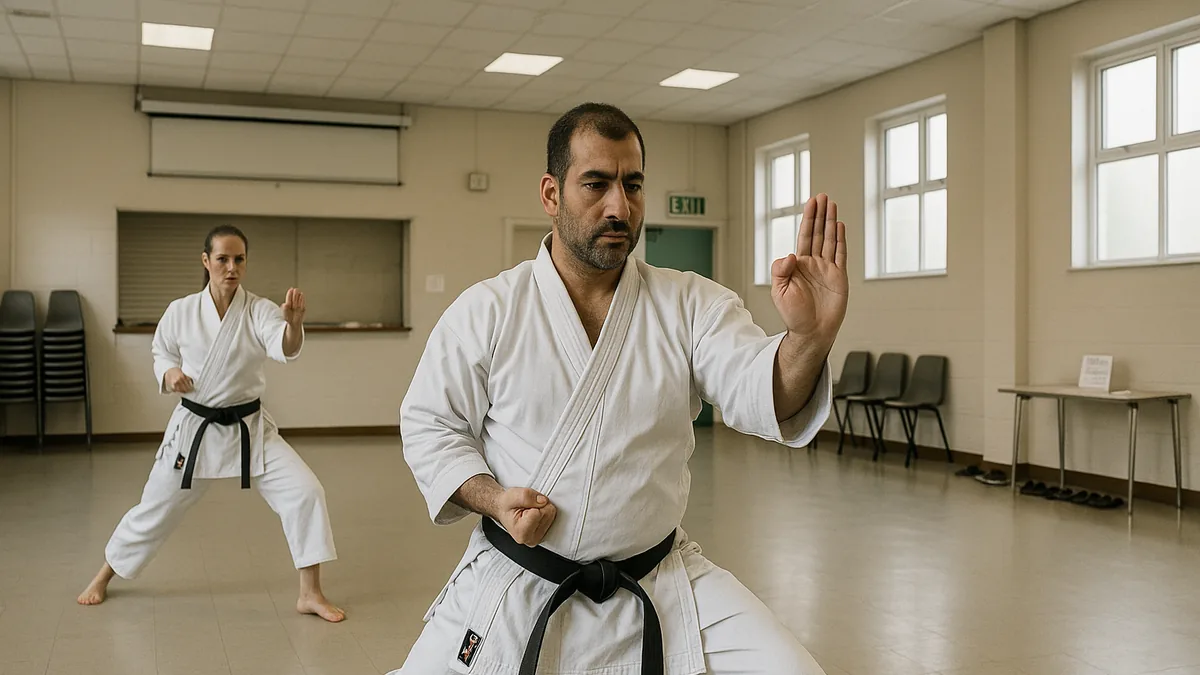
In Shorin-ryu and most Okinawan systems, the kata is performed in a relatively natural, upright kiba-dachi - sometimes called naihanchi-dachi - with the feet turned slightly inward and the knees tracking over the toes. The body sits lower than a normal standing position but not dramatically so. The weight distribution is even, and the practitioner can move from it.2
In Shotokan’s Tekki, the kiba-dachi is wider, lower, and more rigid. The kata is performed almost entirely in this stance with minimal shifting. The emphasis is on stability and the generation of power from a fixed base. That is a deliberate stylistic choice, not a corruption. Funakoshi’s successors - particularly Masatoshi Nakayama, who as Chief Instructor of the Japan Karate Association (JKA) from its founding in 1949 codified much of modern Shotokan through the JKA grading system and his eleven-volume Best Karate series (Kodansha International, 1977 to 1990) - leaned into the idea of kiba-dachi as a strength-building exercise. The stance became a training tool in itself.
The practical consequence is that the two versions feel completely different when you perform them. In the Okinawan version, you’ll feel the body shifting weight and rotating around a mobile centre - there is a sense of potential movement throughout. In Tekki, you’ll feel the tension of holding a fixed position while generating force laterally. Neither is wrong. They are training different physical qualities.
The elbow techniques, the knee raises, the crossing step - all appear in both versions. But the timing, the emphasis, and the application theory attached to them vary considerably depending on the lineage.
The Three-Kata Structure and Why It Matters
Here is something that often gets lost: in most Okinawan traditions, there are three Naihanchi kata - Shodan, Nidan, and Sandan. Shotokan preserves this as Tekki Shodan, Nidan, and Sandan. But many Okinawan schools - particularly those in the Shorin-ryu tradition - treat Naihanchi Shodan as the foundational kata of the entire system, sometimes the first kata a student learns.
Before Itosu created the Pinan kata, Naihanchi was traditionally taught first in Tomari-te and Shuri-te schools, which indicates its central importance in the older curriculum. A student of Itosu, Kentsu Yabu, reportedly told his own students that “karate begins and ends with Naihanchi.” That is a very different pedagogical position from the Shotokan approach, where Tekki Shodan typically appears around purple or brown belt level, after the student has already worked through the Heian series.
Some accounts associate Chotoku Kyan - one of the prominent Okinawan masters of the early twentieth century who trained in both Shuri-te and Tomari-te - with an approach that emphasised Naihanchi early in training. However, the historical record on precisely what Kyan taught and to whom is genuinely disputed: the most detailed scholarly accounts suggest his core repertoire centred on kata such as Chinto, Passai, and Kusanku, and that any Naihanchi teaching on his part may not have been extensive. The general principle - that the Okinawan tradition places Naihanchi earlier in the curriculum than Shotokan does - is well established, even if the specific attribution to Kyan is uncertain.
The ordering matters because it shapes how you understand the kata. A practitioner who learns Tekki Shodan at brown belt, after years of Heian kata, approaches it as a specialist form - a kata about close-range fighting and lateral movement. A practitioner who learns Naihanchi Shodan as their first or second kata builds their entire foundational understanding of body mechanics from it. The applications they find, the way they feel the weight transfer, the instincts they develop - all of it is shaped by that early exposure.
This is one reason why the same technique in the same kata can be interpreted so differently by two senior practitioners from different lineages. They did not just learn different versions. They built different bodies through different training sequences.
Common Mistakes: What Goes Wrong and Why
The stance becomes the point instead of the vehicle. The biggest mistake in Tekki training is treating kiba-dachi as a strength exercise that happens to have arm movements attached. The stance is not the kata. The kata is the kata. The correction that usually helps is to focus on what the arms and torso are doing and let the stance serve that, rather than the other way around. When you feel the hip rotation connecting to the elbow strike, the stance suddenly makes sense as a support structure rather than a destination.
Lateral movement is ignored or performed superficially. The crossing step in Naihanchi - the fumikomi-style stamp and the crossing of the feet - is not decoration. It is the kata’s central movement principle. A common mistake is to treat it as a transition between techniques. Many instructors cue this as “you are moving along a wall” - the idea being that your back is against something and you cannot retreat, so all movement is lateral. Whether you accept that application theory or not, it changes how you feel the footwork. The stamp should be committed, not tentative.
The elbow techniques are thrown without understanding the range. Naihanchi and Tekki are close-range kata. Every technique in them is designed for a distance where you are already in contact with an opponent or close to it.2 A common mistake is to perform the gedan techniques and elbow strikes with the spacing of a mid-range punch. When you adjust your mental model to “this is a clinch-range kata,” the techniques stop looking awkward and start feeling purposeful.
Nidan and Sandan are treated as bonus material. Many practitioners learn Tekki Shodan for grading and rarely return to Nidan and Sandan with any seriousness. This is a missed opportunity. Nidan in particular contains techniques that are not in Shodan, and training all three as a connected system reveals a coherence that is not visible when you treat them separately.
What Experienced Practitioners Do Differently
A beginner performing Tekki Shodan is managing the stance, counting the movements, and trying to remember which direction comes next. That is appropriate - that is what beginners should be doing. But it means the kata looks like a series of disconnected events.
By brown belt, the sequence is automatic, and the practitioner starts to feel the connections between movements - the way the morote-uke sets up the following elbow, the way the hip drives the arm rather than the arm moving independently. The kata stops feeling like a list and starts feeling like a conversation between body parts.
What senior practitioners often describe - and what becomes apparent when you watch someone who has trained a kata for decades - is a quality of compression. Every movement is shorter, more direct, more connected to the ground. There is no wasted motion. The kiba-dachi does not look lower because the practitioner is showing off the stance. It looks lower because the practitioner is genuinely rooted, and the techniques are generating force through the floor rather than through muscular effort alone.
You’ll feel this difference yourself when it starts to happen: instead of pushing a technique out, you’ll feel the technique arriving from the ground up, through the hip, through the torso, and expressing at the point of contact. It feels less effortful, not more. That is not a mystical description - it is what efficient force transfer feels like when the body is properly aligned.
For a broader look at why kata can plateau visually even when understanding is developing, Why Your Kata Looks the Same at Brown Belt as It Did at Yellow Belt addresses exactly this.
Community Perspective
The question of which version is “correct” - Naihanchi or Tekki - generates more heat than it deserves. The honest answer is that neither is more authentic in any meaningful sense. Both descend from the same source material through legitimate lineages. Both have been shaped by intelligent practitioners who made deliberate choices about what to emphasise.
Where practitioners genuinely disagree is on application theory. The Okinawan tradition - particularly through the work of researchers and practitioners such as Iain Abernethy and the broader bunkai community - tends to read Naihanchi as a close-range grappling and striking kata, with applications involving grabs, throws, and clinch work. Historical records support this reading: Choki Motobu, who built much of his fighting reputation around Naihanchi, taught an interpretation that included grappling and throwing techniques alongside striking. The Shotokan tradition has historically been more conservative about application theory, with Tekki often taught as a form whose primary value is physical conditioning and stance training.
Neither camp is entirely right. The conditioning value of Tekki is real - training kiba-dachi under load does build specific strength. But treating the kata as purely a conditioning exercise is a waste of the information encoded in it. The correction that usually helps practitioners stuck in this debate is to try both approaches seriously before dismissing either. Perform Tekki as a conditioning kata for six months. Then spend six months working the applications as close-range grappling. Your opinion will be more useful after both experiences.
There is also genuine disagreement about sequencing - whether Naihanchi Shodan is best taught early, as the older Okinawan tradition suggests, or later, as Shotokan practice implies. We think the Okinawan approach has the stronger argument. The kata’s emphasis on rooting, hip rotation, and close-range mechanics makes it an excellent foundation for everything that follows. Teaching it late means students spend years developing habits that the kata would have corrected earlier.
For more on how the same kata performs differently across styles, Performing the Same Kata in Different Styles: What Changes and What Doesn’t is worth reading alongside this.
Key Takeaways
- The name tells you the lineage: Naihanchi and Naifanchi reflect the difference between Japanese and Okinawan pronunciation of the same form; Tekki is Funakoshi’s Japanese rename, chosen for the kata’s defining horse-riding stance. The technical differences between versions are real and worth understanding, not just cosmetic.
- The correction that makes the biggest difference in Tekki and Naihanchi training is shifting focus from the stance to what the stance is supporting. The hip drives the technique; the stance provides the platform.
- Train all three in the sequence - Shodan, Nidan, Sandan - as a connected system. The coherence of the kata becomes visible only when you do.
- If your style teaches Tekki late in the curriculum, consider supplementing with bunkai work that treats it as a close-range kata from the start. The applications make the mechanics clearer, not more complicated.
- When you encounter a different version of this kata - whether that is a Shorin-ryu Naihanchi or a Wado-ryu interpretation - treat it as information, not as a wrong answer. Performing the Same Kata in Different Styles: What Changes and What Doesn’t is a useful reference for approaching these differences constructively.
- The moment when the kata clicks is usually the moment you stop performing it laterally and start feeling it vertically - the force moving through the ground, up through the stance, and expressing at the point of contact. That is what you are training towards.
References
Checked by the KarateLifestyle editorial team against governing body records, association history pages, a peer-reviewed martial arts journal (EJMAS), and primary-source quotations from Funakoshi's Karate-Do Kyohan and Nakayama's Best Karate series in October 2026. The historical record on Chotoku Kyan's specific teaching of Naihanchi is genuinely disputed across sources; claims about him have been softened accordingly.
- Naihanchi a History - Artisan Martial Arts. Artisan Martial Arts, history article, c. 2021
- Naihanchi Kata - Jissen Karate. Jissen Karate, kata reference page, 2024
The weekly digest
New karate articles, once a week
One email every week with everything new on Karate Lifestyle. No spam; unsubscribe in one click.
We'll email you to confirm. See our privacy policy.