How to Build a Kumite Game Plan for a Specific Opponent: Scouting, Adapting, and Executing Under Pressure
Most competitors walk into a tournament with a vague idea of how they want to fight and call it a game plan. That’s not a game plan. That’s just hoping your default style is better than theirs. I’ve watched students lose matches they should have won because they prepared in the gym but not for the person standing across from them. Scouting, adapting, and executing under pressure are three separate skills - and you need to train all three deliberately.
What Scouting Actually Means
Scouting isn’t just watching someone fight. Watching without a framework gives you impressions, not information. You walk away thinking “he’s fast” or “she’s aggressive” but you can’t do anything useful with that.
What I tell students is to watch for patterns in three specific areas: preferred entry, reaction to pressure, and recovery habits.
Preferred entry is how they close distance. Do they step in behind a jab? Do they wait for you to commit and counter? Do they use a feint to get your hands moving before they attack? Most competitors have one or two entries they go back to when the match is tight. That’s the one you need to know.
Reaction to pressure is what they do when you crowd them or push the pace. Some fighters get sharper under pressure - they’re better when they’re forced to react. Others slow down, start grabbing, or back into corners. Knowing which type you’re facing changes everything about how you open the match.
Recovery habits are what I find most useful and what most people completely ignore. Watch what someone does in the half-second after they score or after they get scored on. Do they reset immediately? Do they celebrate for a moment and give you a window? Do they rush back in emotionally after conceding a point? That half-second is where a lot of matches are actually won.
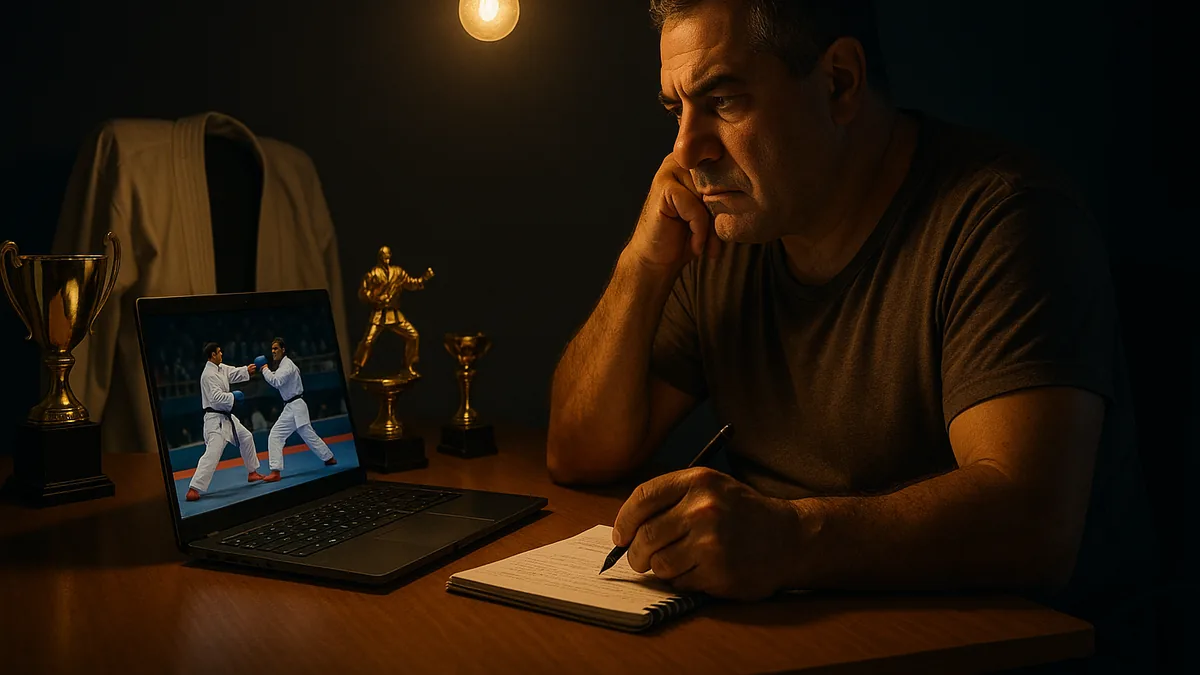
If you can watch video, watch at least three separate matches. One match tells you what they did that day. Three matches tells you who they actually are.
The Scouting Sheet Drill
I use this with students before any significant tournament. It sounds simple but the discipline of writing it down forces you to actually look.
- Watch the first match with no notes. Just observe. Get a feel for their rhythm.
- Watch again and write down every technique they score with. Not every technique they throw - only the ones that land.
- Note which side those techniques come from and what the opponent was doing when they got hit.
- Write down two situations where they looked uncomfortable or lost points.
That’s your document. Two columns: what they’re good at, and what gives them trouble. Your game plan lives in the second column.
Building the Strategy Around Their Tendencies
Here’s where most people make the mistake. They identify a weakness and then try to attack it directly. That rarely works because competitors know their own weaknesses too - they’ve been protecting that side for years.
I used to think the goal was to hit them where they’re weak. My instructor corrected me on this during a team training session years ago. He said: “You don’t attack the weakness. You use their strength against them.” What he meant was - if they’re dangerous with their right gyaku-zuki, you make them want to throw it, and you’re ready when they do. You’re not avoiding their strength, you’re setting a trap around it.
If they lead with a strong oi-zuki, work on your blind side awareness and practice your deflect-and-counter until it’s automatic. You want them to throw that punch. You want to be the one who already knows what’s coming.
The Tendency Trap Drill
This is the most valuable drill I know for turning scouting into actual sparring strategy. You need a training partner who’s willing to play a specific role.
- Tell your partner to simulate one specific habit from your opponent - for example, always countering with a gyaku-zuki after they block.
- You spar with the goal of triggering that counter intentionally. Throw an attack that invites the block, then be ready for what follows.
- Run this for three-minute rounds. Count how many times you successfully anticipated the counter.
- Switch - let your partner try to bait you. This builds the other side of the skill.
What you’re feeling for is the moment the anticipation stops being mental and becomes physical. When it’s working, you’re not thinking “he’s going to counter now” - you’re already moving before the thought forms. That’s the state you want in competition.
The mistake I see most often here is students who practice the counter but not the setup. They can handle the gyaku-zuki when it comes, but they never learn to make it come on their terms. The setup is half the technique.
Training Adaptability - Because Plans Fall Apart
Every game plan survives until the first exchange. After that, you’re adapting. This is where most of the real work is, and it’s the part most people under-train.
I’ve noticed that students who struggle with adaptability usually have one of two problems: either they’re so attached to their plan that they keep trying to force it even when it’s not working, or they abandon the plan completely at the first sign of resistance and just fight on instinct. Neither works.
What actually works is building a decision tree in training. Not a rigid plan, but a set of if-then responses that become automatic. If they’re countering my entries, I switch to drawing attacks. If they’re staying passive, I use pressure and feints to force action. If I’m down on points, I know exactly which combination I’m going to commit to.
The feinting work you do in training matters a lot here. A good feint isn’t just a deception - it’s a diagnostic tool. You feint, you watch how they respond, and that tells you something about what’s available.
The Constraint Sparring Drill
This is the drill I’d keep if I had to cut everything else. It builds adaptability faster than anything I’ve tried.
- Set a specific constraint for the round. Examples: you can only score with gyaku-zuki, or you can only score after your partner attacks, or you’re not allowed to use your strongest technique.
- Spar normally, with your partner trying to win without any constraints.
- The constraint forces you to find solutions you wouldn’t normally look for.
- Rotate constraints every round.
The discomfort is the point. When your go-to option is off the table, you discover what else you have. You also discover what you’ve been over-relying on - which is uncomfortable and useful.
This connects directly to the problem described in why your kumite looks nothing like your kihon. The gap usually isn’t technical. It’s that you’ve never been forced to use your full toolkit under pressure.
Executing Under Pressure
I think the biggest difference between competitors who have a game plan and competitors who execute a game plan is the ability to slow down internally while the match is moving fast.
Pressure does one thing to most people: it speeds up their thinking until they stop thinking and just react. That’s not always wrong - trained reactions are valuable. But if you’re reacting without any thread back to your plan, you’re just fighting. You’re not competing.
The physical sensation of being in control under pressure feels different from being in survival mode. When you’re in control, your breathing is there. Your shoulders aren’t up around your ears. You can see the whole person, not just their hands. When you’re in survival mode, everything narrows. You feel it as a kind of tunnel - you’re tracking one thing and you’ve lost the rest.
Training this means deliberately putting yourself in uncomfortable positions during sparring and practicing the reset. Not just enduring pressure - actively resetting your state in the middle of it. Take a breath. Widen your focus. Come back to what you know about this person.
If you’re working toward understanding how scoring actually works at a technical level, that knowledge helps here too. Knowing exactly what you need to score - and what your opponent needs - gives you a reference point when the pressure is high.
The Comeback Round Drill
Set up a sparring round where you start two points down. Your only goal is to execute your game plan and close the gap.
- Partner scores two points before the round begins.
- You spar for two minutes with the explicit goal of coming back.
- After the round, debrief: did you execute your plan or abandon it? What changed?
Most students, when they’re down on points, either panic and rush or go passive and hope. This drill forces you to find a third option: controlled aggression with a specific target. The combination work you’ve built in training is what you’ll lean on here - but only if it’s been drilled enough to survive the pressure.
Community Perspective
There’s a genuine split in how dojos approach opponent-specific preparation. Traditional training culture tends to emphasise developing your own game so thoroughly that it works against anyone. The argument is that if you’re always adjusting to opponents, you never develop a core identity as a fighter.
The sport-focused approach - particularly in Olympic-style karate - leans heavily on video analysis, specific scouting, and tactical preparation that would look familiar to any team sport coach.
I’ve trained in both environments. My honest view is that the traditional approach builds better fighters over time, and the sport approach wins more matches in the short term. The practitioners I’ve seen do both well are the ones who have a deeply trained default game and the flexibility to layer a specific strategy on top of it for important matches. The default game is what keeps you functional when the plan breaks down. The specific strategy is what gives you an edge when it doesn’t.
What I’ve noticed is that this opinion tends to shift with experience. Younger competitors often want the tactical edge and focus heavily on scouting. Senior competitors usually trust their own game more and use scouting as confirmation rather than direction.
Key Takeaways
- Watch for three things when scouting: preferred entry, reaction to pressure, and recovery habits after scoring. Everything else is secondary.
- Your strategy should be built around their strengths, not just their weaknesses. Set traps around what they’re confident throwing.
- Train adaptability with constraints - take your best option off the table and find what else you have. That’s where your real game is.
- The transition from “knowing the plan” to “executing the plan under pressure” is a physical skill. Train the reset deliberately, not just the techniques.
- Combination attacks and feints are only useful in a game plan if they’re already automatic. If you have to think about them in competition, they’re not ready yet.
- Your default game needs to be solid enough to function when the specific plan falls apart - because it will, usually in the first thirty seconds.
The weekly digest
New karate articles, once a week
One email every week with everything new on Karate Lifestyle. No spam; unsubscribe in one click.
We'll email you to confirm. See our privacy policy.