How to Spar Without Getting Hit
Most beginners think sparring is about hitting. It’s not. It’s about not getting hit - and everything else follows from that.
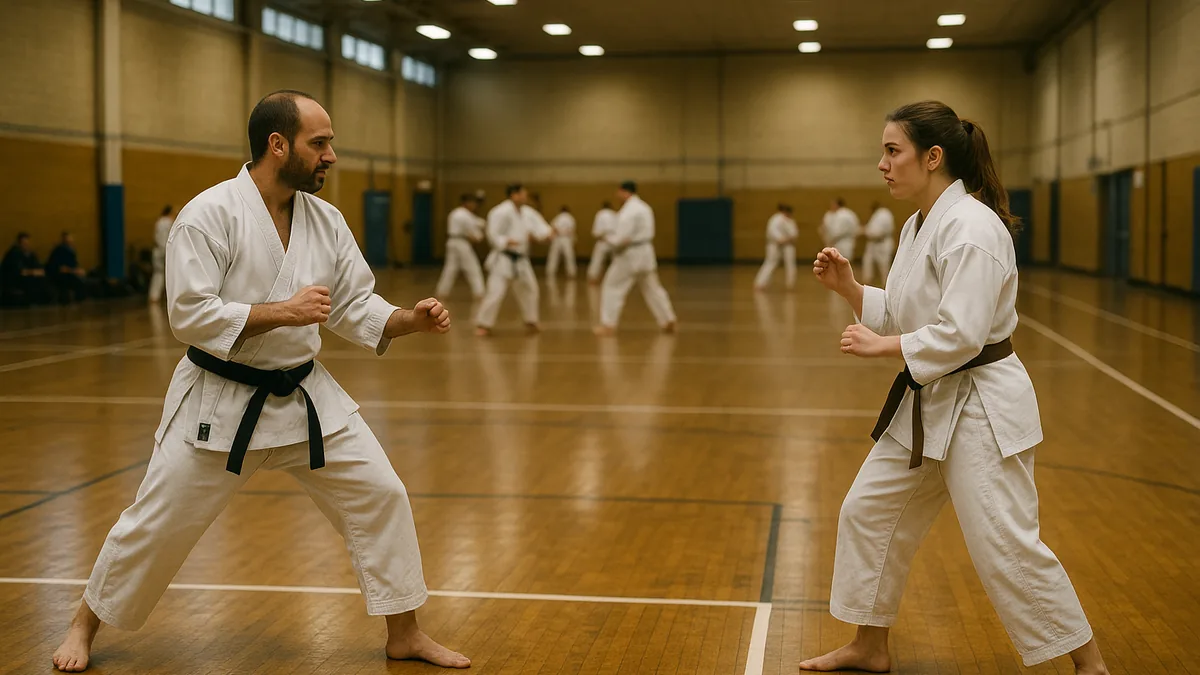
I’ve watched hundreds of white and yellow belts step into their first jiyu-kumite session and do exactly the same thing: they square up, they tense their shoulders, and they wait to react. Then they get tagged repeatedly, and they assume the problem is their blocks. It’s not the blocks. The blocks are too late because the positioning was wrong before the attack ever started. You’re solving the wrong problem.
Getting hit less isn’t about faster hands. It’s about being somewhere the punch wasn’t aimed at in the first place.
Distance is Your First Line of Defence
There’s an article on this site that goes deeper into the mechanics of distance management in kumite, and I’d recommend reading it alongside this. But here’s the version I give students on the floor: if you’re standing at the range where your opponent can hit you without adjusting their feet, you’ve already made your first mistake.
I used to think ma-ai (fighting distance) was just about being far enough away to have reaction time. My instructor corrected me on this probably four or five times before it actually landed. What he was telling me - and what I eventually understood through getting caught repeatedly - is that distance isn’t a static thing. It’s something you’re constantly adjusting. You’re never just standing at the right distance. You’re always moving to maintain it.
What that feels like in practice: when someone initiates an attack and you haven’t had to consciously react yet, you’re working at good distance. When you’re scrambling to respond, you’re already inside the problem.
The correction that makes the biggest difference for beginners here is getting them to stop treating their stance as a home base they return to. Your stance travels with you. The moment you think of it as a fixed position, you stop moving and you become predictable.
The Danger Zone Most Beginners Live In
I’ve noticed that most beginners hover at a distance where they feel safe but aren’t. They’re too far to score easily, but just close enough that a committed attack with a step catches them. They think the distance feels safe because nothing is happening yet. But that’s not safety - that’s just a pause before the problem.
Either be genuinely out of range, or be close enough to control the engagement. The middle ground is where you eat punches.
Reading the Attack Before It Happens
This is the part that takes years to develop, and I won’t pretend there’s a shortcut. But there are things you can train your eye for earlier than most people do.
The reading your opponent in kumite article covers the broader picture. What I want to add from my own experience is this: you’re not looking for the technique. You’re looking for the preparation.
Every attack has a tell. It might be a shoulder that drops slightly before a gyaku-zuki. A weight shift to the back foot before a mae-geri. A breath change. An eye flicker toward the target. These aren’t things you can catalogue and memorise - they’re things you absorb over hundreds of rounds of sparring. But you can accelerate that process by training yourself to watch the centre of the body rather than the hands.
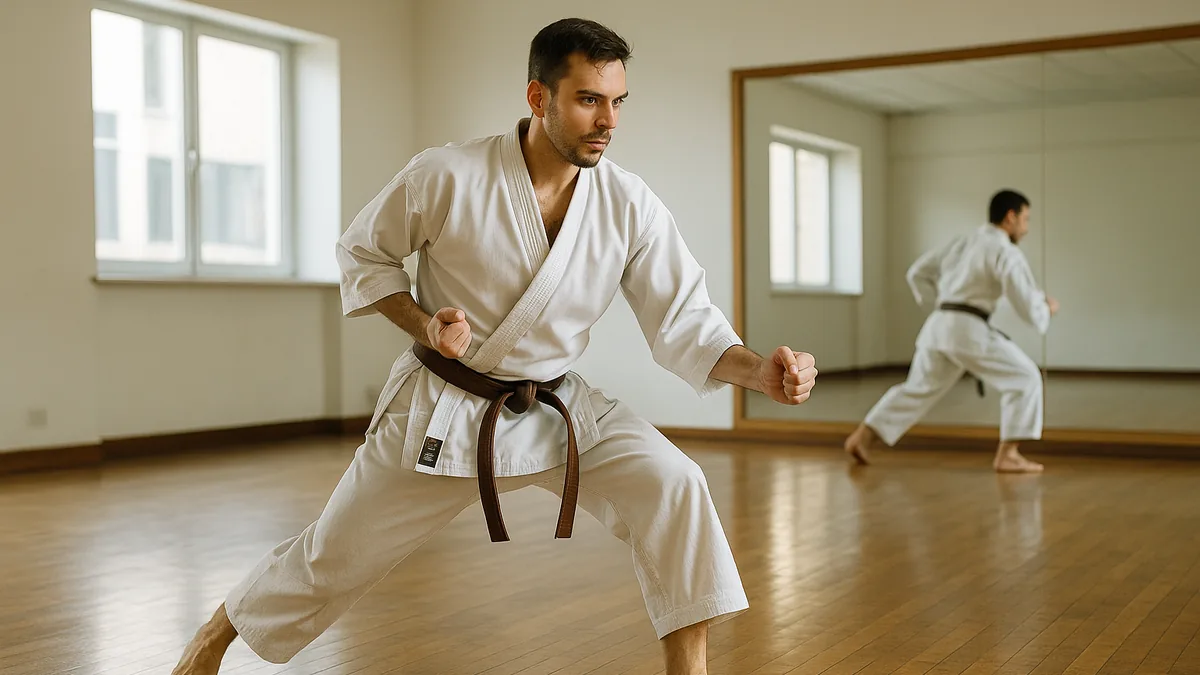
As a white belt I watched hands. I thought that’s where the punch comes from, so that’s what I needed to track. By brown belt I realised you watch the chest and hips, because that’s where the commitment happens first. The hands are the last thing that moves, and if you’re waiting for them, you’re already behind.
What I tell students is: soft focus, centre of mass, let the periphery pick up the limbs. It feels wrong at first because your instinct is to track the thing that’s going to hit you. But tracking the source - not the delivery - is what gives you the extra fraction of a second you need.
Off-Angle Positioning: The Skill Nobody Teaches Early Enough
This is the one I wish someone had drilled into me much earlier. Off-angle positioning is, in my opinion, the single most underrated defensive skill in karate kumite - and it’s almost never taught explicitly to beginners.
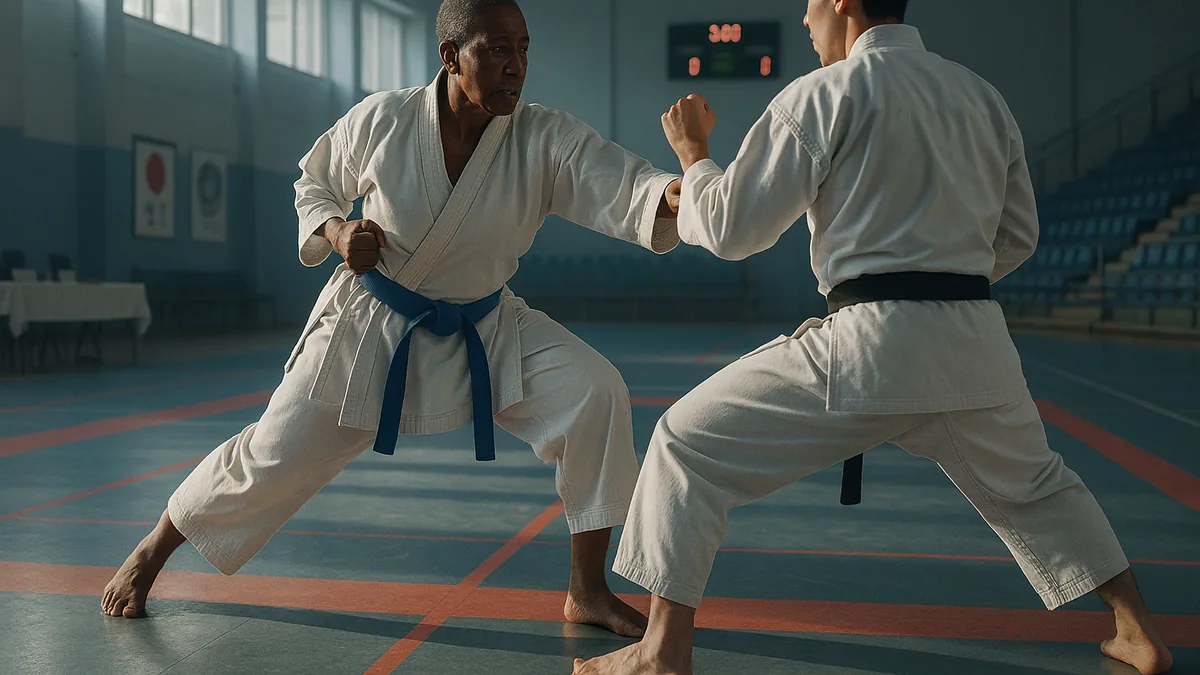
Here’s what it means in practice: instead of moving straight back when someone attacks, you move to a diagonal. You step off the line of the attack. What this does is two things simultaneously. It takes you out of the path of the technique, and it puts you in a position where your opponent is now slightly turned away from you - which opens their back quarter for a counter.
In jiyu-kumite, this becomes your fastest counter off a failed attack. Your opponent commits to a chudan oi-zuki. You step 45 degrees to the outside. They’ve punched through air, their weight is forward, and their ribs are exposed to your side. That counter is there without you having to manufacture it.
I think the reason this isn’t taught earlier is that it requires good footwork as a foundation, and most beginners are still working on basic movement. But I’d argue you can introduce the concept earlier than most dojos do, even if the execution is rough. The kumite footwork fundamentals article is worth reading before you try to apply this - the diagonal step only works if your base is stable when you land it.
Why Beginners Move Straight Back
The instinct when something comes at you is to move directly away from it. That’s not a training failure - it’s a survival reflex. But moving straight back keeps you on the line of attack, keeps your opponent facing you squarely, and often just delays the hit rather than avoiding it.
The correction I use with students: I have them practise the diagonal step in isolation, without any attack involved, until the movement feels natural. Then we introduce a slow attack. The goal is to make the off-angle movement the default response, not a conscious decision. When it’s a decision, it’s too slow.
The Defensive Strategies That Actually Hold Up Under Pressure
I want to be direct about this: passive blocking as a primary defence doesn’t work well in free sparring. I know that’s not what your first few gradings might suggest, but by the time you’re sparring with someone who has genuine speed and commitment, waiting to block is a losing strategy.
What works is a combination of:
- Distance management - not being where the attack lands
- Evasion - moving the target rather than intercepting the technique
- Interception - meeting the attack early, before it develops full power
- Off-angle movement - removing yourself from the line and creating counter opportunities
I prefer evasion over blocking as a primary response, because a good block still absorbs some impact, and against someone stronger than you that matters. Evasion costs you nothing. The trade-off is that evasion requires better reading of the attack - you have to move earlier, which means you have to read earlier.
For counter-attacking in karate, the off-angle step and the evasion-based defence are where your best opportunities come from. A blocked attack still leaves your opponent in structure. An evaded attack often leaves them momentarily off-balance and committed.
What I See Going Wrong Most Often
One mistake I see constantly with intermediates - not just beginners - is tensing up when they sense an attack coming. The shoulders come up, the arms tighten, and they essentially freeze for a split second. That freeze is what gets them hit. The attack doesn’t land because the defender was slow. It lands because they stopped moving.
The tension comes from anxiety, which comes from not trusting your responses yet. I get it. But the physical fix is to stay loose in the shoulders and keep weight slightly forward, not back. When you’re braced to absorb, you’re not positioned to move. When you’re light and forward, you can go in any direction.
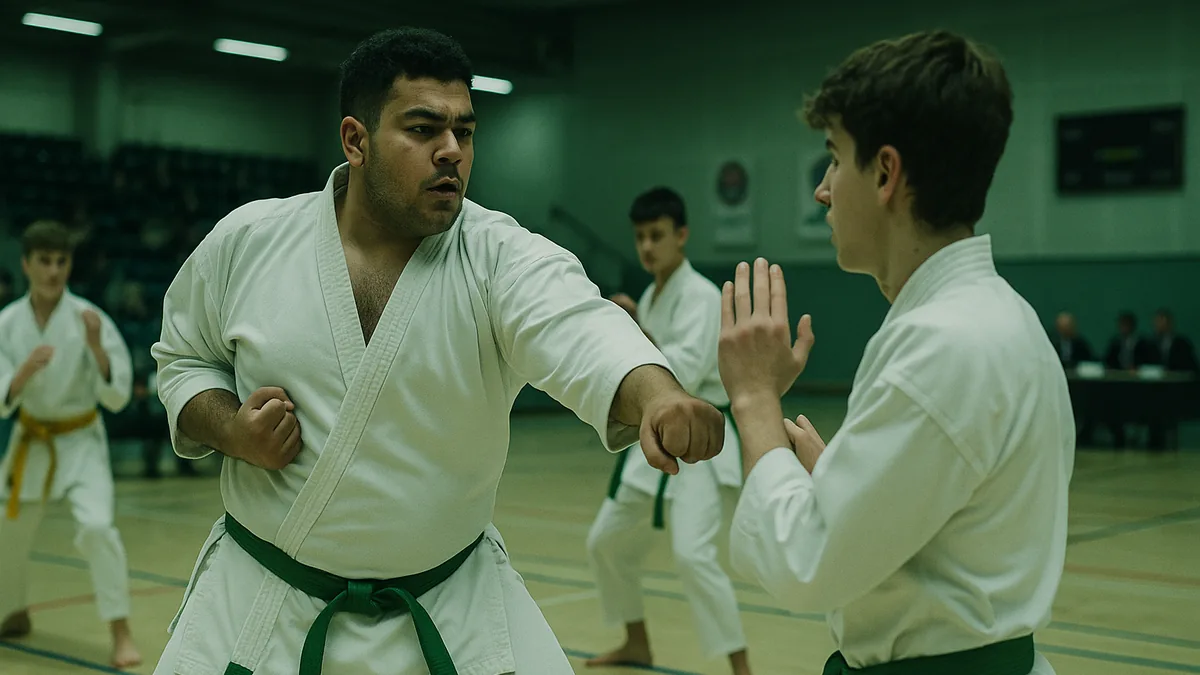
Another one: looking at the floor during exchanges. I’ve seen this in students at every level up to about green belt. When they get into a fast exchange, their eyes drop. They’re processing internally and disconnecting from the external information they need. I used to tell students “keep your eyes up” and it made no difference. What actually works is giving them something specific to look at - the opponent’s collar, the sternum - rather than just telling them not to look down.
Community Perspective
There’s a genuine split in how different dojos approach defensive training, and I think it’s worth being honest about it rather than pretending there’s one right answer.
Traditional Shotokan training tends to emphasise the block-counter combination as the foundation of kumite defence. You learn to receive the attack cleanly and respond. WKF sport kumite, by contrast, has pushed practitioners toward much more fluid, evasion-heavy movement because the scoring system rewards speed and the rules limit certain contact.
I’ve trained in both environments and I think the honest answer is: the block-counter foundation gives you something to fall back on under pressure, but if that’s all you have, a fast, committed attacker will find gaps. The evasion-heavy approach requires better reading and footwork, and if your timing is off, you’re undefended.
What I’ve settled on - and this has changed over the years - is that you need the block-counter as a fail-safe and the evasion as your primary game. When the evasion works, it’s cleaner. When it doesn’t, you need something to catch the attack with.
If you’re newer to sparring, the kumite for beginners article gives useful context on what to expect in those early sessions before the defensive instincts start to form.
Key Takeaways
- Stop treating your stance as a fixed position - distance is something you maintain continuously, not something you set once at the start of an exchange
- Watch the centre of mass, not the hands - the body commits to the attack before the limb does, and that’s where your read comes from
- Train the diagonal step until it’s automatic - off-angle movement is your fastest route to both avoiding an attack and opening a counter
- Stay loose in the shoulders during exchanges - tension is what causes the freeze, and the freeze is what gets you hit
- Evasion is your primary defence, blocking is your backup - not the other way around
- Read the preparation, not the technique - by the time the punch is visible, you’re reacting to something that’s already halfway done
The weekly digest
New karate articles, once a week
One email every week with everything new on Karate Lifestyle. No spam; unsubscribe in one click.
We'll email you to confirm. See our privacy policy.