Kumite Footwork Fundamentals
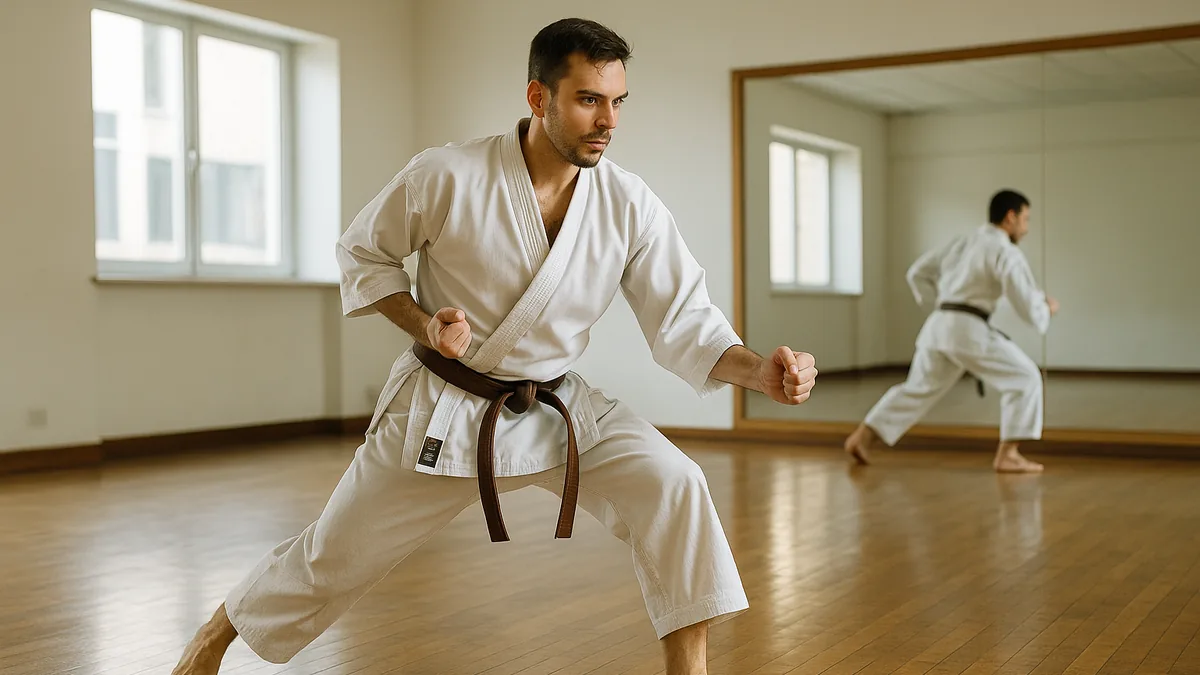
Most beginners stand like they’re doing kata when they get into sparring range. Feet too wide, weight too settled, knees too bent. They look stable. They are stable. And that’s exactly the problem.
Stability and mobility are not the same thing, and in kumite, mobility wins. I’ve watched students train for months, get their kihon looking solid, then step into jiyu-kumite and immediately revert to a stance that works great for delivering a single technique and terrible for everything else. The footwork is where kumite either opens up or shuts down, and it’s the thing most people underinvest in.
If you want to understand what kumite actually demands before we get into the mechanics, What Is Kumite? is worth reading first. But if you’re already sparring and wondering why you keep getting caught flat-footed, this is where the answer lives.
Why Most Beginners Stand Wrong for Sparring
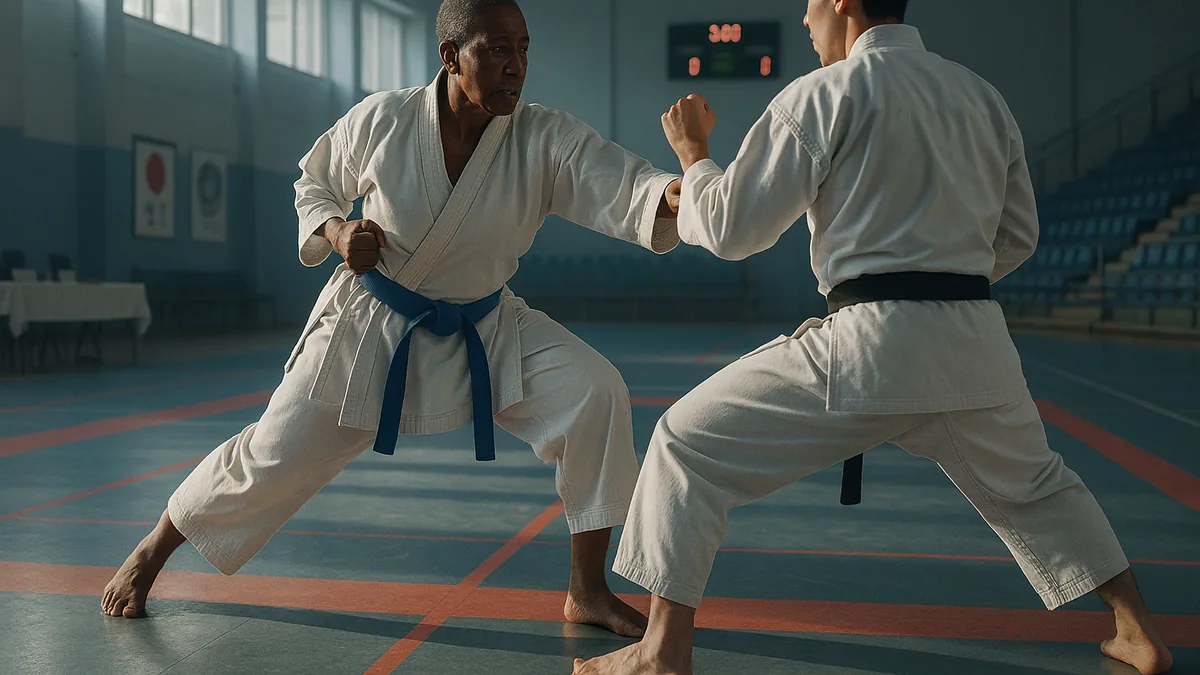
The mistake I see most often is a stance that’s optimised for power delivery rather than movement. Students learn zenkutsu-dachi, they practice it thousands of times, and their body defaults to it under pressure. Wide base, deep knee bend, weight loaded into the front leg. It’s a great platform for launching a strong gyaku-zuki. It’s a terrible position to be caught in when someone is moving around you.
What I tell students is to think of sparring stance as a ready position, not a power position. You’re not trying to generate force from static ground - you’re trying to stay mobile enough to create and close distance on demand.
The correct sparring stance is narrower than most beginners expect. Feet roughly shoulder-width apart, maybe slightly less. Weight distributed close to 50/50, with a very slight bias toward the balls of your feet. Knees soft - bent enough to absorb and spring, not so bent that you’re squatting. When I tell students to “unlock” their knees rather than “bend” them, something shifts in how they hold themselves.
The other thing I’ve noticed is that beginners tend to stand too square. They face their opponent directly, which feels natural and confrontational, but it actually limits hip mobility and exposes more of your body. A slight side-on angle - not fully bladed, but enough that your lead shoulder is forward - gives you better hip rotation for techniques and a smaller target profile.
Here’s what correct sparring stance feels like: you should be able to hop lightly on the spot without adjusting your feet first. If you have to shift weight to hop, your stance is too committed. That little hop test is something I use with new students all the time. If they can’t do it immediately, their stance needs to come up and in.
Sliding vs Stepping - The Distinction That Changes Everything
This is where I see a clear dividing line between beginners and people who’ve been training for a while.
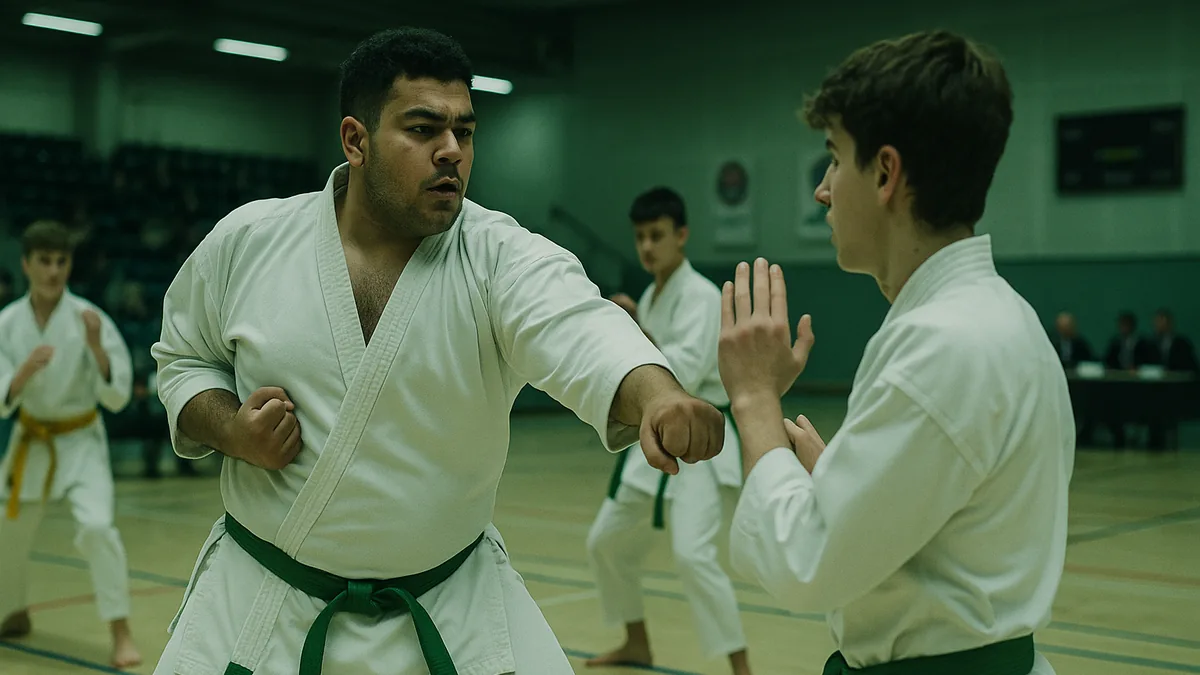
Beginners step. They pick up a foot, move it, put it down, then bring the other foot to match. It looks like walking. It creates dead time - moments where your weight is transitioning and you have no stable base to attack or defend from.
Experienced practitioners slide. The feet skim the floor. The stance width stays constant. The weight stays centred. You move as a unit rather than as a person taking steps.
I used to think sliding was just a stylistic preference. My instructor corrected me on this during a session where he kept interrupting my movement to point out that every time I stepped, I was creating a window. He’d move in on me mid-step, before I’d completed the transition. I started to understand that stepping isn’t just slower - it’s a vulnerability.
The mechanics of sliding are simple but feel unnatural at first. For forward movement, the lead foot moves first, the rear foot follows to restore the original gap. For backward movement, the rear foot moves first, the lead foot follows. The feet never cross, the stance width never collapses, and crucially, you never lift your feet more than an inch or two off the floor.
This feels wrong at first, but trust the mechanics. It feels like shuffling, which feels weak. What you’ll discover after a few months of drilling it is that it’s actually much faster than stepping for short distances, and it keeps you ready to fire a technique at any point in the movement, not just at the end of it.
Core Drills for Kumite Footwork
Drill 1: Line Work - Forward and Back Sliding (The Foundation)
This is the most important drill in this section. I’d run this every single session if I could. It builds the habit of sliding before anything else gets added on top.
Why it matters: If your forward and backward movement isn’t clean, nothing else works. Lateral movement, angling, combination footwork - all of it sits on top of this foundation.
Setup: Find a line on the floor, or use a strip of tape. Stand in your sparring stance with your lead foot just behind the line. You need about 10 metres of space.
Execution:
- Start in sparring stance, weight 50/50, knees soft.
- Slide the lead foot forward roughly 30-40cm, keeping it close to the floor.
- As soon as the lead foot lands, slide the rear foot forward the same distance to restore your original stance width.
- Pause. Check your width, check your weight distribution, check your knee bend hasn’t changed.
- Repeat for the length of the floor, then reverse - rear foot moves first, lead foot follows.
What to feel for: The movement should feel almost effortless when it’s right. You’re not pushing hard off the floor - you’re transferring weight smoothly and letting the legs follow. If your upper body is bouncing, you’re working too hard. The head should stay at a constant height throughout.
What most people get wrong: The rear foot drags too late. There’s a pause between lead foot landing and rear foot moving, which means you’re in a collapsed stance for a moment. The correction that works is to think of the rear foot as being pulled forward by the lead foot, not following it independently. They should feel connected.
Drill 2: Mirror Footwork with a Partner
Once solo sliding is clean, this is the drill I move students to next. It’s also one of the most honest tests of whether your footwork is actually functional.
Why it matters: Reactive movement is different from rehearsed movement. This drill forces your footwork to respond to someone else rather than following a pattern you’ve memorised.
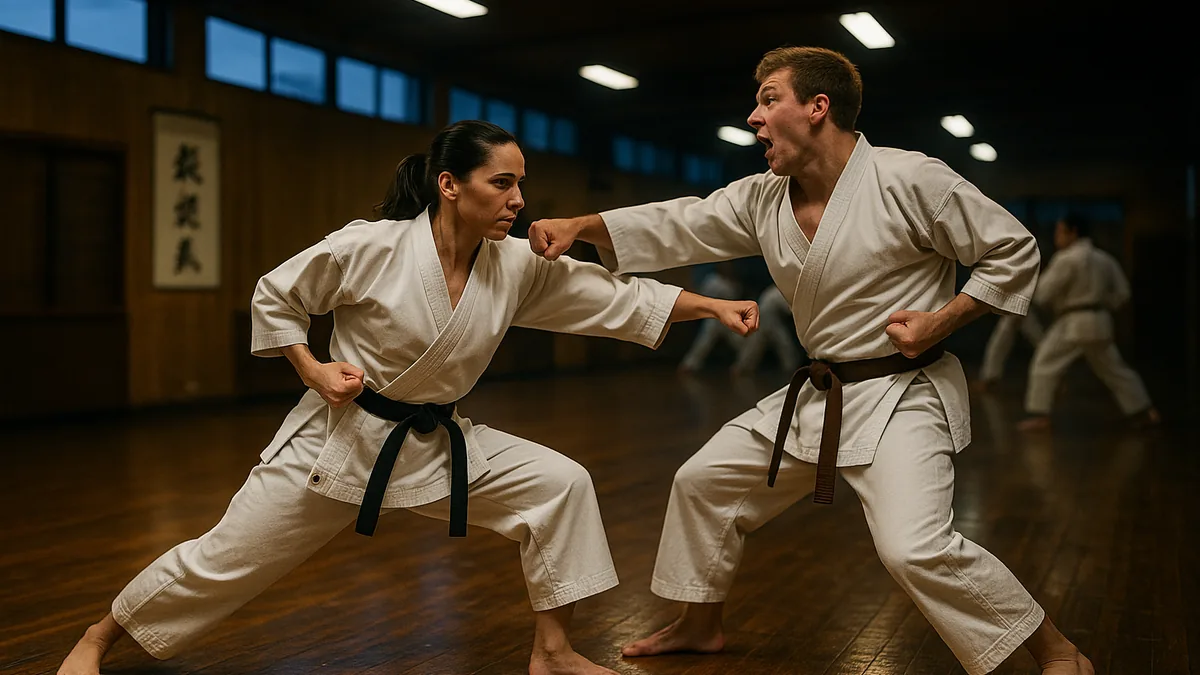
Setup: Two people, facing each other in sparring stance, roughly 1.5 metres apart. No striking. One person leads, one person mirrors.
Execution:
- The leader moves - forward, backward, left, right - in slow, deliberate increments.
- The mirror maintains the same distance and angle at all times.
- Start at a pace where the mirror can succeed. Gradually increase the speed and unpredictability.
- Switch roles every 90 seconds.
What to feel for: When you’re mirroring well, it stops feeling like you’re reacting and starts feeling like you’re anticipating. You read the weight shift before the foot moves. That’s the real skill - footwork that reads intention, not just position.
What most people get wrong: Looking at the feet. I see students do this because they think they need to see where the feet are going, but the real issue is that feet are the last thing to move - weight shifts first. Train your eyes to read the hips and shoulders. The feet will tell you where someone has been. The hips tell you where they’re going.
Drill 3: Lateral Triangle Movement
This is the drill that opens up angling for beginners. I prefer this over pure lateral shuffles because it builds the habit of moving off the line of attack, not just sideways along it.
Setup: Mark three points on the floor in a triangle - roughly 60cm between each point. Stand at one point in sparring stance.
Execution:
- From point A, slide diagonally forward-left to point B. This is not a straight lateral step - you’re moving at roughly 45 degrees.
- From point B, slide diagonally forward-right to point C.
- From point C, slide back to point A.
- Reverse the direction. Drill both sides equally.
What to feel for: The diagonal movement should feel like you’re stepping off a train track, not just moving sideways. When you get it right, you’ll feel that you’ve moved out of the space where an attack would have landed while simultaneously moving closer to your opponent’s flank. That’s the payoff - you’re not just evading, you’re repositioning.
What most people get wrong: The movement becomes too large. Students exaggerate the angle trying to get “out of the way,” and end up moving so far off line that they’ve lost the counter-attack opportunity entirely. Keep the movement tight - 45 to 60cm is enough. In jiyu-kumite, this becomes your fastest counter off a failed attack precisely because you haven’t gone far.
Progression
Once the solo sliding is clean and the mirror drill is working, the next step is attaching techniques to the movement. Not adding movement to techniques - attaching techniques to movement. The distinction matters. The footwork leads. The technique follows.
Start with a single gyaku-zuki off the forward slide. The punch should land as the rear foot completes its slide, not before. If you’re punching before you’ve finished moving, you’re leading with the technique and the power generation will be off. This connects directly to timing work - if you want to develop that further, How To Improve Kumite Timing covers the next layer.
For lateral movement, add a lead-hand jab off the diagonal triangle step. The jab fires as you land at the new point. One movement, one technique, clean.
The progression after that is combination footwork - forward slide into lateral triangle, or lateral triangle into backward slide. This is where it starts to feel like actual sparring movement rather than drills.
Community Perspective
There’s a genuine disagreement in karate training about how much footwork should be drilled in isolation versus drilled in context. Some instructors - particularly in traditional clubs - feel that too much isolated footwork training produces mechanical movement that doesn’t transfer to sparring. Others, particularly those with competition backgrounds, treat footwork as a fundamental that needs thousands of clean repetitions before it can be applied under pressure.
I’ve seen both approaches produce good fighters and both produce students who can drill well but freeze in kumite. My own view is that isolated drilling builds the physical habit, but you need to stress-test it with partner work early and often. The mirror drill is the bridge between the two approaches.
There’s also disagreement about stance width between styles. Shotokan tends toward wider stances even in kumite. Shito-ryu and Wado-ryu practitioners often stand narrower and more upright. Neither is wrong, but the principles of weight distribution and sliding movement apply across all of them. If you’re training in a specific style, work within your style’s framework - but don’t let style conventions override the functional requirements of staying mobile.
This also connects to a broader question about how much solo kata training transfers to kumite footwork. The honest answer is: less than most traditional instructors claim, and more than most competition-focused practitioners admit. Does Kata Actually Help Your Sparring? addresses that question directly if you want to go deeper on it.
Key Takeaways
- Your sparring stance should pass the hop test - if you can’t hop immediately without adjusting, it’s too wide or too loaded.
- Sliding keeps you ready to attack or defend throughout the movement. Stepping creates windows. Drill sliding until it’s your default.
- The rear foot in forward sliding should feel pulled by the lead foot, not following it. Close the gap immediately.
- In mirror footwork, read the hips not the feet. Weight shifts before feet move - that’s where the information is.
- Diagonal movement is more valuable than pure lateral movement because it repositions you, not just displaces you.
- Add techniques to footwork, not footwork to techniques. The movement leads. The technique is the payoff.
- Once your footwork is clean, the next step is learning to use it defensively under pressure. The guide on how to spar without getting hit builds directly on these movement principles.
The weekly digest
New karate articles, once a week
One email every week with everything new on Karate Lifestyle. No spam; unsubscribe in one click.
We'll email you to confirm. See our privacy policy.