What Is Kumite?
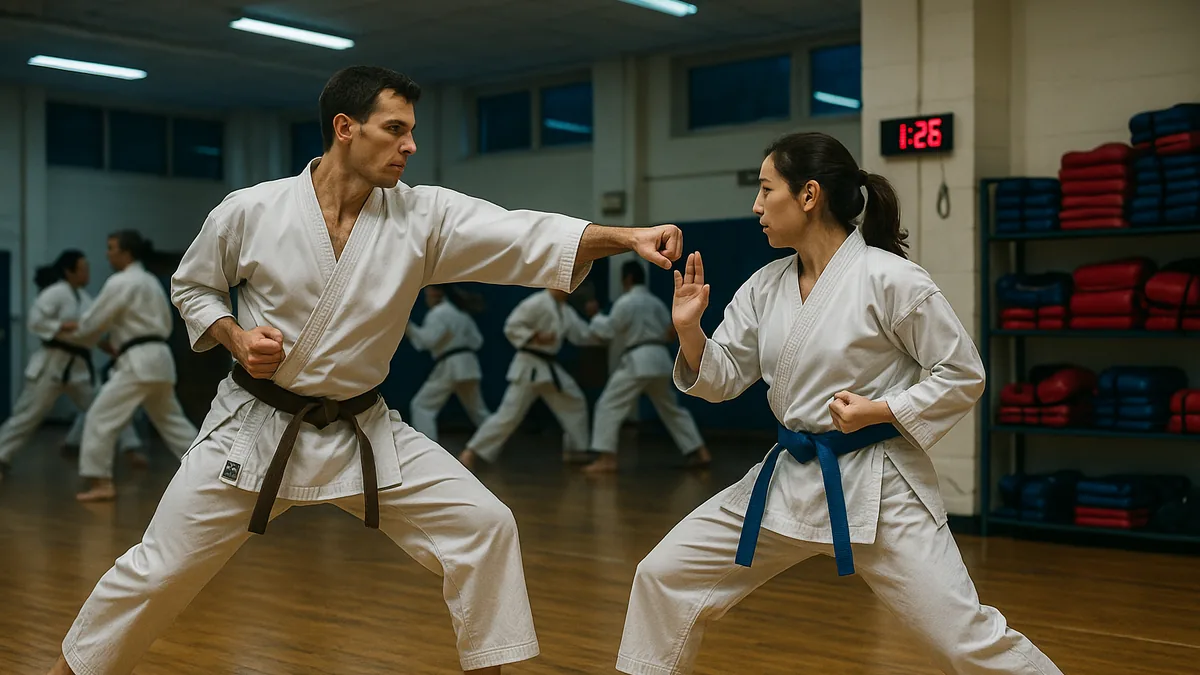
Most beginners think kumite is the fun part - the bit where you finally get to use what you’ve been drilling in kihon and kata. I thought the same thing. Fifteen years later, I’d say that framing gets it almost completely backwards. Kumite isn’t where you apply your training. Kumite is its own form of training, with its own logic, its own progressions, and its own very specific things it teaches that nothing else can.
If you’ve been treating sparring as the reward at the end of class, you’re missing most of what it’s actually for.
What Kumite Actually Is
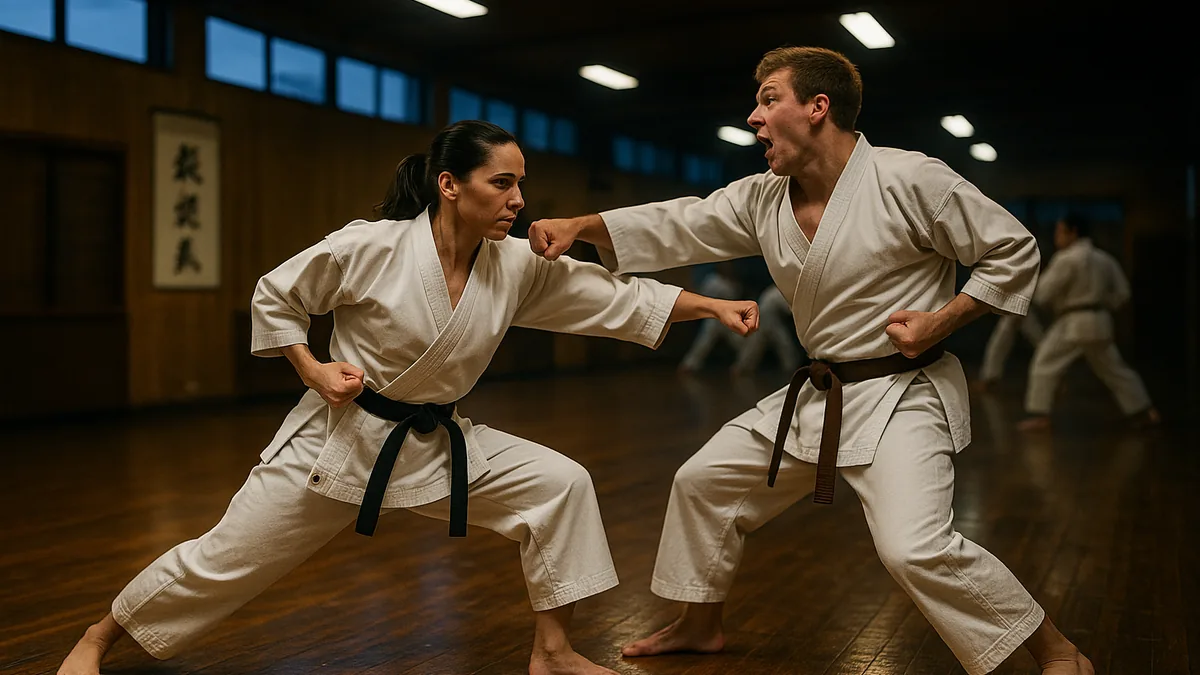
Kumite means “meeting of hands” - though that translation never quite captures it for me. What it actually means in practice is: training with a resisting partner under some set of rules or agreements. The rules change depending on the type. The partner changes. The pressure changes. But the core of it is always the same - you are no longer working in isolation. Someone else is there, and they have their own intentions.
That’s the thing that makes kumite fundamentally different from kihon and kata. In kihon, you control every variable. You decide the technique, the timing, the direction. In kata, you’re responding to imagined opponents at a rhythm you set yourself. Kumite removes that control. You can’t decide when the attack comes. You can’t choose the angle. You have to read, react, and make decisions under pressure - and that’s a completely different skill from executing a clean gyaku-zuki in a line drill.
I’ve noticed that students who are exceptional at kihon and kata often struggle badly when they first start kumite. Not because their technique is wrong, but because they’ve never had to apply it while someone is actively working against them. The timing is different. The distance is different. The psychological pressure is different. Kumite trains the gap between knowing a technique and being able to use one.
The Types of Kumite - and What Each One Actually Trains
This is where I think a lot of dojos do their students a disservice. They rush through the structured forms to get to jiyu-kumite, treating everything before it as a stepping stone rather than valuable training in its own right. Each type of kumite trains something specific. Skipping any of them leaves a hole.
Yakusoku Kumite - Pre-Arranged Sparring
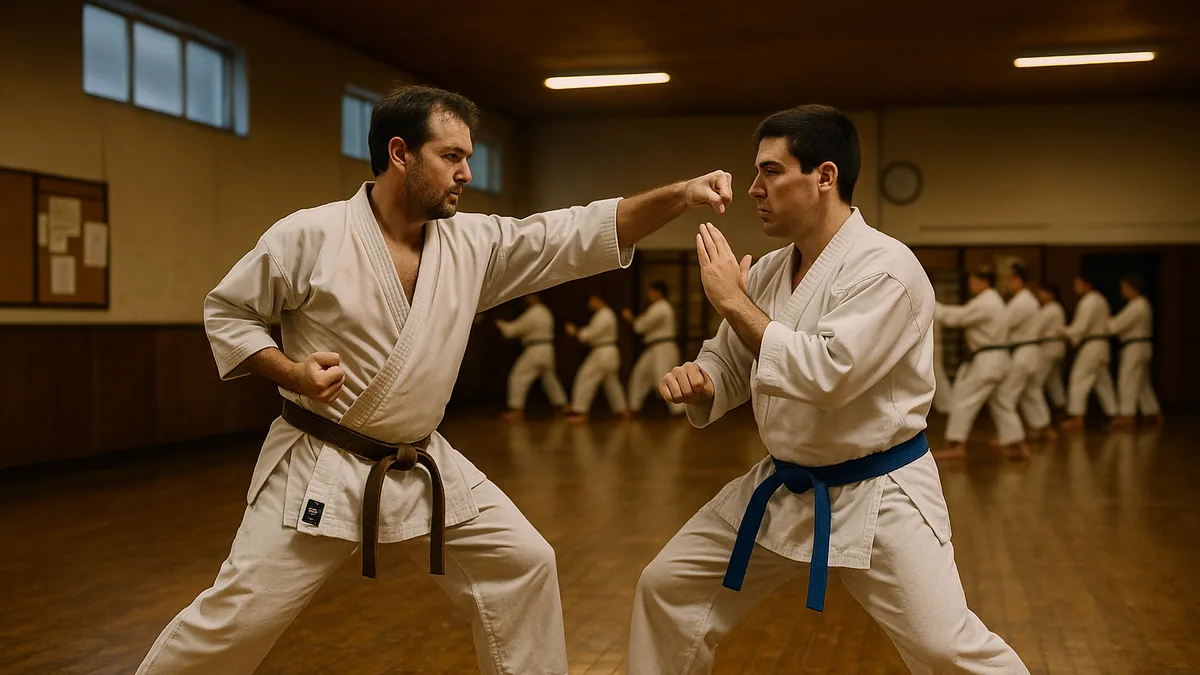
Yakusoku means “promise” - both partners have agreed on exactly what’s going to happen. One attacks with a specific technique, the other defends and counters in a specific way. Everything is scripted.
White belts often find this boring. I used to as well. What I didn’t understand then is that yakusoku kumite is where you build the basic architecture of partner work - distancing, timing, the feel of a real attack coming at you rather than air. When someone is actually stepping in with a committed lunge punch, the distance feels completely different to what you’ve been practicing in kata. Yakusoku gives you that experience in a controlled environment where you can afford to get it wrong.
What I tell students when they’re working yakusoku for the first time: don’t focus on the counter. Focus on reading the attack. Can you feel the difference between a half-committed attack and a committed one? Can you feel when the uke is hesitating? That sensitivity - that ability to read what’s coming - is what you’re actually training here.
Ippon Kumite - One-Step Sparring
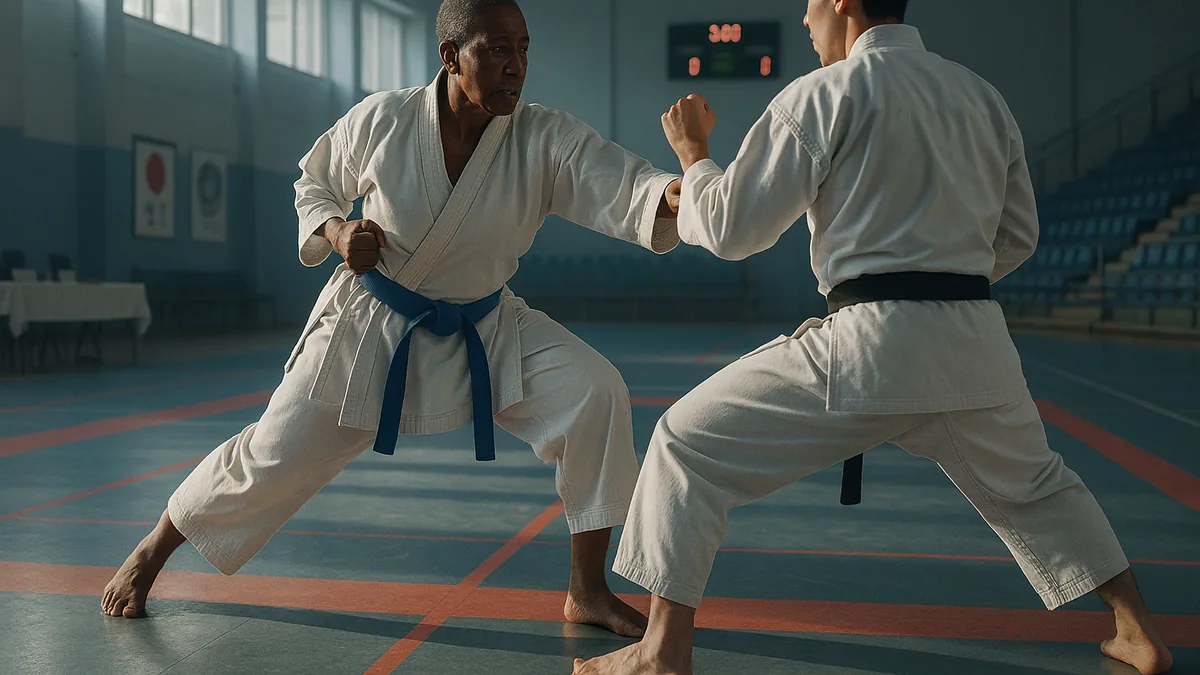
One attack, one defence, one counter. Simple in structure, endlessly deep in practice.
Ippon kumite is where you start making decisions. The attack might be pre-agreed, but you’re choosing your response. This is where the connection between kata and kumite starts to become visible - if you’ve been doing Heian Shodan properly, you already have the movements for several ippon kumite responses. The problem is most students don’t make that connection until someone points it out directly.
The biggest mistake I see in ippon kumite is students who block and counter as two separate things. Block… then counter. There’s a pause in the middle where they’re mentally switching gears. By the time they counter, the opportunity has passed. The correction that makes the biggest difference here is getting students to feel the block and counter as one continuous movement - the block creates the opening, the counter fills it immediately. When it works properly, you’ll feel it as a single action rather than two. When it doesn’t, you’ll feel the gap.
Sanbon Kumite - Three-Step Sparring
Three attacks in sequence, one defence at the end. The attacker steps forward three times with the same technique; the defender steps back three times blocking, then counters on the third.
This one is primarily about distancing and rhythm. You’re learning to manage space over multiple exchanges rather than a single moment. I’ve seen students who are fine in ippon kumite completely fall apart in sanbon because they don’t understand how to manage their retreat - they either run out of space or they end up too far away to counter effectively on the third step.
Sanbon also teaches commitment. The attacker has to commit to three full attacks. The defender has to commit to three controlled retreats. There’s no hesitation allowed. That commitment - doing something fully even when you’re uncertain - is a physical habit that matters enormously in jiyu-kumite later.
Gohon Kumite - Five-Step Sparring
Same principle as sanbon, extended to five steps. More time under pressure, more distance management, more sustained commitment. Some styles use this as a grading exercise specifically because it reveals whether a student can maintain their composure and technique over a longer sequence. One bad step in gohon and the whole thing unravels.
Jiyu Ippon Kumite - Semi-Free One-Step Sparring
This is where it gets interesting. The attacker declares what they’re going to throw - “jodan,” “chudan,” “mae-geri” - but the timing and distance are their choice. The defender knows what’s coming but not when.
As a white belt I thought this was about X - that knowing the attack in advance made it easier. By brown belt I realised it’s about Y - that knowing what’s coming and still struggling to deal with it teaches you something crucial about timing and distance that you can’t get any other way. You can’t blame surprise. You knew it was coming. If you got hit, something in your timing or positioning was wrong.
Jiyu ippon kumite is where I think most of the real technical development happens for intermediate students. It’s structured enough that you can isolate specific problems, but open enough that you’re making real decisions under real pressure. If you’re not spending significant time here, you’re probably jumping to jiyu-kumite before you’re ready.
Jiyu Kumite - Free Sparring
Both partners can attack and defend freely within whatever rules the dojo or competition format uses. This is what most people picture when they hear “kumite.”
I’d push back on the idea that jiyu-kumite is the pinnacle of kumite training. It’s not. It’s one type of training with specific things it develops - primarily the ability to manage unpredictability, to fight your instincts under pressure, and to apply techniques in genuinely chaotic conditions. But it’s also the type of kumite where bad habits are hardest to correct, because the pressure of free sparring tends to reinforce whatever you already do rather than helping you build new patterns.
There’s a reason experienced instructors sometimes pull students back from jiyu-kumite and make them work ippon or jiyu-ippon for a period. It’s not punishment. It’s because the structured forms are better for fixing specific technical problems. Skill acquisition and skill testing are different processes, and jiyu-kumite is almost entirely testing. If you only ever test, you stop developing.
How Kumite Develops Differently from Kihon and Kata
Kihon builds the technique. Kata builds the application of technique in sequence, with correct body mechanics and intent. Kumite builds the ability to use technique against a real person who doesn’t cooperate.
The development is genuinely different - not just “more difficult” but different in kind. In kihon, you’re training motor patterns. In kata, you’re training those patterns with intent and flow. In kumite, you’re training decision-making under uncertainty. Those are three separate skills and they develop at different rates.
I’ve noticed that students who only do kihon and kata tend to freeze in kumite - not because they don’t know the techniques, but because their nervous system has never had to select a technique under pressure. They have the tools but not the process for choosing between them in real time.
The reverse is also true, and this is something I changed my mind about over the years. I used to think kumite was the most important training. I now think that’s wrong. Students who do a lot of jiyu-kumite but neglect kata tend to develop a narrow game - they find two or three things that work for them and repeat them. Their kumite looks effective but it’s not actually developing. The kata keeps the range broad. The connection between kata and sparring is real, but it’s not automatic - you have to work to make it explicit.
Timing is the thing that kumite teaches that nothing else can, and it’s the thing that takes longest to develop. You can read about timing. You can drill timing exercises. But the actual feel of a technique landing because you read the opponent’s intention correctly - that only comes from hours of partner work. If you want to understand this in more depth, the article on how to improve kumite timing goes into the specific drills that actually move the needle.
Mistakes I See Constantly
Treating kumite as a test rather than training. The moment students treat every kumite session as a competition, they stop learning. They default to what works rather than experimenting. I’ve had students who were technically excellent but who had been sparring the same way for three years because they’d never tried to develop anything new. Kumite should feel like practice, not performance.
Skipping the structured forms. I see this a lot in dojos that want to get students into jiyu-kumite quickly because it’s more exciting. The problem is that students who haven’t done serious yakusoku and ippon work don’t have the distancing instincts or the timing architecture to make sense of free sparring. They just flail around and call it experience. It’s not experience - it’s chaos. Structure the chaos first.
Tensing up on contact. This one I remember vividly from my own early training. The moment someone throws a real attack at you, everything tightens up. Shoulders rise, breathing stops, technique collapses. It feels like self-protection but it actually makes you slower and easier to hit. The correction isn’t “relax” - telling someone to relax when they’re nervous does nothing. The correction is more contact, more often, until the nervous system stops treating it as a threat. You have to habituate to it. There’s no shortcut.
Confusing aggression with pressure. Some students think that being intense in kumite means being aggressive - charging forward, attacking constantly, trying to overwhelm. Pressure in kumite is actually about control - controlling the distance, controlling the timing, making the opponent react to you. The most pressurising kumite partners I’ve trained with were not the ones who attacked most. They were the ones who made me feel like I was always slightly out of position.
Community Perspective
There’s a genuine split in how different dojos and styles approach the kumite progression. Traditional Shotokan dojos tend to spend a lot of time on the structured forms - gohon, sanbon, ippon - before students see much jiyu-kumite. Some competition-focused dojos move to free sparring very quickly and use the structured forms mainly as grading requirements rather than serious training tools.
I’ve trained in both environments and I think the traditional approach produces better all-round karateka, but I understand the argument for the competition approach. If your goal is to compete, you need time in conditions that resemble competition. The kata vs kumite debate often maps onto this same split - traditional vs competition-oriented training.
What I’d say to anyone navigating this: the structured forms aren’t just for beginners. Senior practitioners doing ippon kumite with full intent and commitment look completely different to white belts doing the same drill. If you’ve stopped finding value in yakusoku or ippon kumite, you’re probably not doing it with enough intent, not that you’ve outgrown it.
There’s also a real disagreement about contact levels in jiyu-kumite. Some dojos train with very light contact, some with significantly more. Both approaches have genuine trade-offs. Light contact allows more technical experimentation without injury risk. More contact builds a different kind of composure and reveals whether techniques actually work under realistic pressure. I’ve trained under both and I think some exposure to harder contact is necessary - but I’ve also seen dojos where the contact level was so high that it was just brawling. The solo training drills that transfer to kumite become especially important if your dojo doesn’t give you much partner time, whichever contact approach they use.
Key Takeaways
- Don’t rush to jiyu-kumite. Yakusoku, ippon, and jiyu-ippon kumite each train something specific that free sparring can’t replace - spend real time in each. The differences become even clearer when you compare WKF vs traditional kumite rules and see how each ruleset shapes entirely different fighters.
- The block and counter in ippon kumite should feel like one movement, not two. If there’s a pause in the middle, that’s the thing to fix.
- Kumite is a skill acquisition environment as much as a testing environment. If you’re only sparring the way you already know how to spar, you’ve stopped developing.
- Timing is the thing kumite teaches that nothing else can - but it only develops through consistent partner work, not solo drilling alone.
- If you freeze or tense up in kumite, the answer is more contact more often, not more mental preparation. The nervous system adapts through exposure.
- The structured kumite forms don’t stop being useful at blue belt. Senior practitioners doing ippon kumite with genuine intent are doing completely different training to beginners going through the motions.
The weekly digest
New karate articles, once a week
One email every week with everything new on Karate Lifestyle. No spam; unsubscribe in one click.
We'll email you to confirm. See our privacy policy.