Kumite Weight Categories Explained: How They Work in WKF Competition, Why They Matter, and How to Compete at Your Natural Weight
Most competitors who struggle with weight categories are not confused about the numbers. They are confused about what the numbers mean for how they should actually compete. That is a different problem, and it is worth solving properly.
What the WKF Weight Categories Actually Are
The World Karate Federation runs separate weight divisions for male and female competitors across all major events, including the WKF World Championships, Karate 1 Premier League, and the European Karate Championships. The senior categories are fixed, not rolling: for men, under 60 kg, under 67 kg, under 75 kg, under 84 kg, and over 84 kg; for women, under 50 kg, under 55 kg, under 61 kg, under 68 kg, and over 68 kg.1 You compete in the division that covers your weight at the official weigh-in.
Male categories:
- Under 60 kg
- Under 67 kg
- Under 75 kg
- Under 84 kg
- Over 84 kg
Female categories:
- Under 50 kg
- Under 55 kg
- Under 61 kg
- Under 68 kg
- Over 68 kg
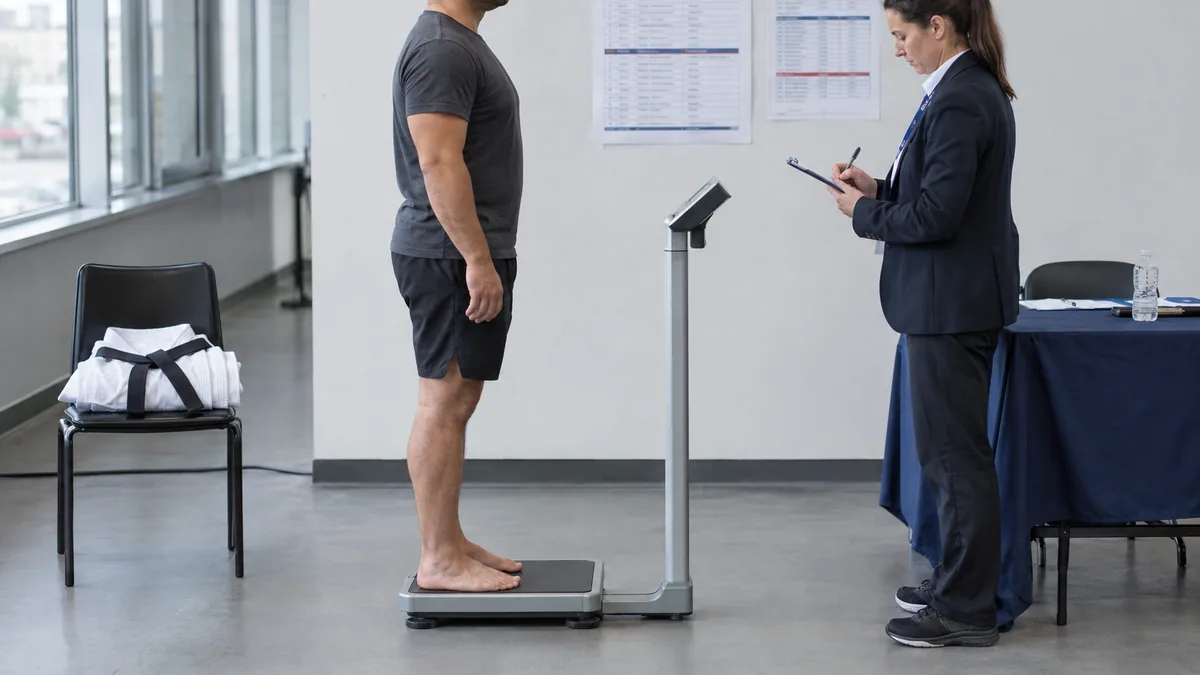
At WKF-sanctioned events, weigh-in must take place no later than the day before the competition for the category, unless specified otherwise for a specific competition.2 The exact weigh-in time is published in the event bulletin. This means you typically have a recovery window of 16 to 24 hours before your first bout, not a matter of hours as is sometimes assumed.
The tolerances admitted are 0.2 kg for all male categories and 0.5 kg for all female categories.2 The same tolerance applies to both the upper and lower limits of a weight class.2 There is no second weigh-in and no grace period beyond that band. A competitor who does not turn up for the weigh-in period or fails to weigh within the prescribed limits for the category in which the competitor is registered will be disqualified (KIKEN).2 You are not moved to the next category and not given a bye - you are out.
This is worth understanding clearly before you think about any weight management strategy.
Why the Categories Exist and Why They Matter More Than You Think
The purpose of weight categories is straightforward: to create fair match conditions where skill, speed, and technique determine the outcome rather than a 20 kg size advantage. A 58 kg competitor with excellent timing should not be routinely dismantled by a 78 kg opponent simply because of the physical mismatch.
But there is a subtler point that takes time to appreciate. Weight categories do not just protect smaller competitors - they also define the style of fighting that tends to succeed within each division. The under 60 kg bracket rewards explosive speed and high-volume combinations. The over 84 kg open weight division tends to favour competitors who can generate power efficiently and manage distance well, since the margin for error on a mistimed entry is higher when your opponent is larger and stronger.
Understanding this changes how you prepare. You are not just trying to make weight - you are trying to compete in an environment where your physical attributes give you the best possible return. That is what competing at your natural weight actually means.
Competing at Your Natural Weight: What It Means and Why It Matters
The phrase “natural weight” sounds obvious until you actually think about what it means in practice. It does not mean the weight you walk around at when you are not training. It means the weight at which you can train fully, recover properly, maintain your speed and power, and still make the scale without a significant cut.
A common mistake is treating weight categories as targets to chase rather than frameworks to fit. Competitors who cut two or three kilograms of water weight to make a lower category often feel fine at weigh-in and pay for it by the time their first match starts. Combined sport-specific reaction time for men and women after dehydration has been shown to be significantly higher than before dehydration (p = 0.0040) - and reaction time is precisely what wins and loses kumite matches.3
The correction that works is simple in principle even if it requires honest self-assessment: identify the category where you can make weight comfortably - within the tolerance band and ideally without any cutting at all - and train specifically for that division.
If you are sitting at 73 kg in training and cutting to 67 kg for competition, you are not competing at your natural weight. You are competing compromised. The competitor across from you who made 75 kg without cutting is fresher, faster, and more dangerous than they look on paper.
The Weight Cut Debate: Where We Stand
This is a genuinely contested area in the karate community, and we will not pretend otherwise. Some coaches argue that a moderate cut is manageable and allows a competitor to fight at a lower category where they will have a size advantage over opponents who actually belong there. The logic is not irrational.
We think this approach works in a narrow set of circumstances and fails more often than it succeeds. Here is why. Senior male and female kumite bouts run to three minutes effective time.2 In that timeframe, the gap between your sharpest reflexes and your dehydrated reflexes is measurable. A Jodan Mawashi Geri that you would normally read and counter becomes the one you do not see in time.
The picture on rehydration is more nuanced than it first appears. Because WKF weigh-in is the day before competition, you have a longer recovery window than in sports with same-day weigh-ins. However, the research on combat athletes suggests that window is not always enough. A longer period of time of 48 hours or more may be required to completely recover from the rapid weight loss phase of weight cutting.4 Despite rehydration attempts, some performance variables do not fully return to baseline values.5 A 2022 meta-analysis in the International Journal of Sports Physiology and Performance found that significant cellular dehydration in combat sport athletes persisted 24 to 36 hours post-rehydration.4
The competitors who cut weight successfully tend to be those who have done it many times, know exactly how their body responds, and have access to proper nutritional support for rehydration. For most club-level competitors preparing for their first WKF-sanctioned events, the risk-to-reward calculation does not favour cutting.
The better investment is building your game around the category you belong in naturally.
Strategising for Your Category
Once you have settled on the right division, the category itself should inform how you fight - not just who you expect to meet, but how you structure your match strategy.
In lighter categories (under 60 kg for men, under 50 kg for women): Speed is the decisive variable. Matches at this level are often won by the competitor who can execute first, not the one who sets up the most carefully. Drilling fast, clean combinations until they fire without conscious initiation is not optional here - it is the whole game. Distance management becomes especially important because the margins are fine; a centimetre either way determines whether your Gyaku Zuki scores or gets blocked. See our guide on distance management in kumite for detail on how to control that space.
In mid-range categories (under 75 kg for men, under 61 kg for women): These divisions tend to be the most technically balanced. You will face competitors who have real power and real speed. Feinting becomes more valuable here because opponents are experienced enough to react to genuine attacks, which means they can be drawn. A common mistake is faking without a clear follow-up plan. The correction that makes the biggest difference is treating every feint as a committed entry that you have chosen, at the last moment, not to complete. Your body language has to be convincing. We cover this in depth in feinting in kumite: why most karateka do it wrong and how to make it work.
In heavier categories (over 84 kg for men, over 68 kg for women): Power generation matters more, but so does composure. Heavier competitors who rely on physicality alone tend to accumulate penalties - excessive contact, pushing, or grabbing in the clinch range. Understanding what is and is not permitted in close quarters is essential. Our article on how to use the clinch range in kumite without getting penalised covers the rules and the technique.
Common Misconceptions About the Weigh-In Process
“I can rehydrate quickly enough.” This applies with most force when a same-day cut is attempted. Under WKF rules, the weigh-in is the day before competition, so you have a longer window than in many other combat sports. However, research investigating the recovery of body water following weight-cutting has found 24 hours to be insufficient to recover hydration status in some studies, and the evidence on full performance recovery points to 48 hours or more for anything beyond a small cut.6 Do not assume that having overnight recovery means a large cut carries no cost.
“The tolerance band means I have room to spare.” There is a tolerance: 0.2 kg for all male categories and 0.5 kg for all female categories.2 That is there to account for scale calibration differences, not as a buffer for sloppy preparation. Each competitor is allowed to stand on the scales only once during the official weigh-in period.2 Make weight or go home.
“Moving up a category means I will be outmatched.” This is the fear that drives most weight cutting, and it is often wrong. Competing at 75 kg when you walk around at 73 kg means you are fighting opponents who are your size, not opponents who have a significant physical advantage. The competitor you are imagining - the one who is 74.9 kg of muscle and has been dominating that category for years - exists, but so does the one who cut from 78 kg and is running on empty by the second round.
Penalties and Weight Category Interactions
One point that does not get enough attention: penalty accumulation patterns often differ between weight categories. In lighter divisions, the pace is faster and penalties for excessive contact tend to be less frequent simply because the power output is lower. In heavier divisions, Chukoku and Keikoku warnings for contact are more common, and competitors who have not adjusted their control to the WKF standard pay for it quickly.
If you are moving up from lighter competition or from a more contact-permissive format, understanding the penalty structure is as important as understanding the weight bands. The full breakdown is in our kumite penalties explained guide.
Community Perspective
The weight cut question divides coaches more than almost any other competition topic. Some experienced coaches actively manage their athletes’ weight across categories, treating it as a legitimate tactical tool. Others refuse to engage with cutting at all, arguing that the performance cost is never worth the category advantage.
What tends to shift opinions over time is watching a well-prepared competitor lose a match they should have won because they were insufficiently recovered. The category advantage that looks significant on paper can disappear when timing is off and reads are slow.
There is also a longer-term consideration: the most advisable rapid weight loss approach to guarantee athletic performance should not exceed 3 to 5 percent of total body weight loss, followed by at least 24 hours for rehydration after the weigh-in in order to allow adequate - if only partial - recovery.5 A training block that requires you to be simultaneously lighter and fitter than your natural state is one where something usually gives.
The position that tends to emerge among coaches who have worked at WKF level for a long time is straightforward: compete in the category where you train, and use the energy you would have spent on cutting to get better at fighting.
Key Takeaways
- Make weight without a significant cut. If you are more than the tolerance amount over your target category in normal training, either adjust your nutrition over time or move up a division. Acute water cutting before a WKF event carries a performance cost that persists well beyond weigh-in.
- Know your category’s fighting style. The weight division you compete in shapes the tactics that win matches. Train specifically for that environment, not just generically for kumite.
- The correction that changes most competitors’ approach is understanding that a fresh, sharp version of you at 75 kg beats a dehydrated version of you at 67 kg almost every time.
- Use your category to inform your game plan. Lighter divisions reward speed and volume. Heavier divisions reward composure and power efficiency. Neither rewards being physically present but mentally and physically compromised.
- Do not assume moving up a category means fighting giants. Most competitors in the next division up are there because that is where they naturally belong, not because they are significantly larger or stronger than you.
- If you are new to WKF-sanctioned competition, read the full rules - not just the weight categories. Understanding the difference between WKF rules and what you have competed under before will save you matches. Our WKF vs traditional kumite rules breakdown is a good place to start.
References
Checked by the KarateLifestyle editorial team against WKF official competition rule documents (versions 2024.00 and 2026.01) and peer-reviewed research on dehydration and weight-cutting in combat sports in October 2026. The weight-cutting physiology evidence is largely drawn from non-karate combat sports (MMA, taekwondo, wrestling), as karate-specific RWL studies remain limited.
- WKF Kumite Competition Rules 2026.01. World Karate Federation, Rules Version 2026.01, published February 2026
- WKF Kumite Competition Rules 2024.00. World Karate Federation, Rules Version 2024.00
- Sport-specific reaction time after dehydration varies between sexes. Journal of the International Society of Sports Nutrition, 2014 (PMC4271614)
- Effects of Weight Cutting on Exercise Performance in Combat Athletes: A Meta-Analysis. International Journal of Sports Physiology and Performance, Vol. 17 Issue 7, 2022
- Effects of Different Rapid Weight Loss Strategies and Percentages on Performance-Related Parameters in Combat Sports: An Updated Systematic Review. PMC / Sports, 2023 (PMC10048848)
- The Current State of Weight-Cutting in Combat Sports. Sports (MDPI), Vol. 7 Issue 5, 2019
The weekly digest
New karate articles, once a week
One email every week with everything new on Karate Lifestyle. No spam; unsubscribe in one click.
We'll email you to confirm. See our privacy policy.