Cross-Training for Karateka: What Other Martial Arts Are Worth Your Time and What Just Dilutes Your Practice
Most karateka I’ve trained with fall into one of two camps when cross-training comes up. Either they’re dead against it - “you’ll confuse your muscle memory, stay in your lane” - or they’re chasing every new style like it’s going to fill some gap they can’t quite name. I’ve been in both camps at different points. What I’ve landed on, after fifteen years and more dojos than I care to count, is that cross-training is genuinely valuable when you’re deliberate about it, and quietly damaging when you’re not.
The question isn’t whether to cross-train. It’s which arts are actually compatible with what you’re building, and which ones are going to pull you in directions that don’t serve your karate.
Why This Matters More Than Most People Admit
Your nervous system doesn’t care about style names. It learns patterns. Every hour you spend drilling a movement is an hour of reinforcement - and if you’re drilling movements that contradict what you do in karate, you’re not expanding your toolkit, you’re creating interference. I’ve seen this happen with students who spent six months in a boxing gym and came back throwing punches from a completely different guard, dropping their hikite, losing that snapping retraction that’s fundamental to how we generate power. The boxing wasn’t wrong. It just wasn’t compatible with where they were in their karate development.
What I tell students who ask about cross-training is this: know what you’re trying to fix first. If you have a specific gap - you fall apart in close range, your kicking above the waist is weak, you don’t know what to do when someone grabs you - then cross-training with a purpose makes sense. If you’re just bored or restless, that’s a different problem, and switching clubs or styles isn’t always the answer.
Judo: The One I’d Recommend Without Hesitation
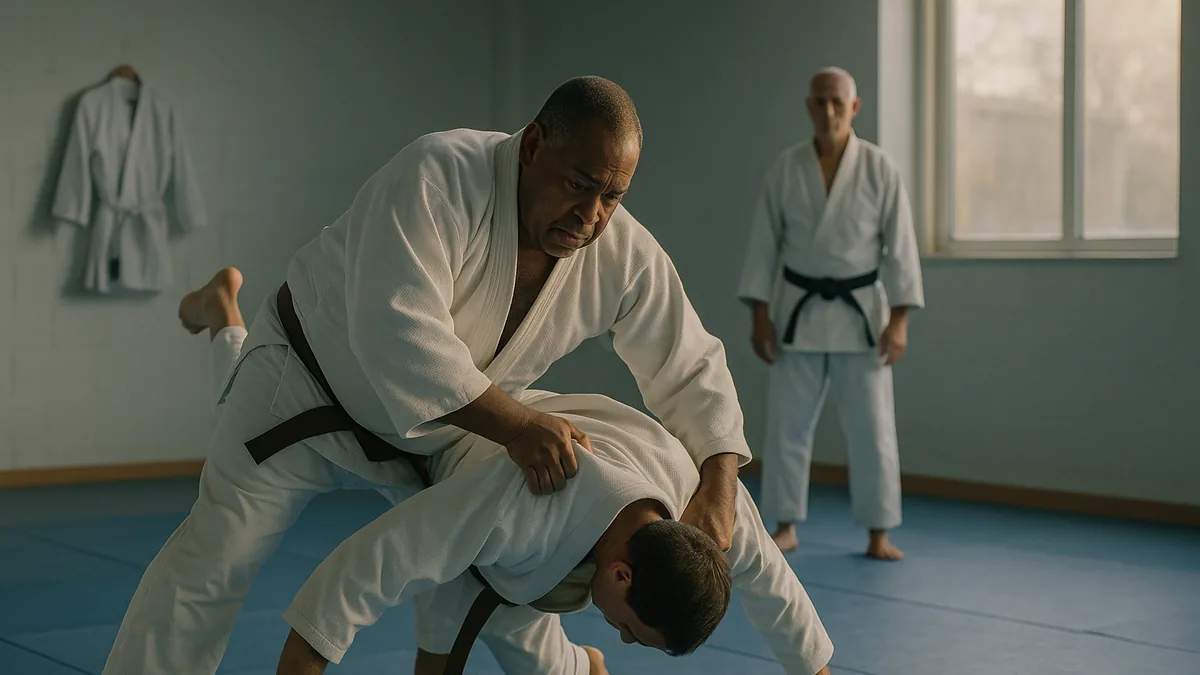
If I could tell every serious karateka to pick up one additional art, it would be judo. Not because it’s going to make you a better grappler in some abstract sense, but because it teaches you something about bodies and balance that you genuinely cannot get from striking practice alone.
The thing that changed my understanding was training judo for about eight months in my late twenties. I went in thinking I’d pick up some throws to add to my karate. What actually happened was that I started understanding off-balancing - kuzushi - in a completely different way. When someone grabs you, or when you make contact in close range, there’s this moment where their structure is compromised. Judo makes you feel that moment. You’ll feel it through your hands and your hips before your brain has time to process it. That sensitivity doesn’t go away when you’re back in karate sparring.
The other thing judo does is make you comfortable being grabbed, which most karateka are not. I’ve watched students completely freeze the first time someone gets a hold of their gi in kumite. They don’t know where their hands are, they don’t know where their weight is. A few months of judo randori fixes that permanently.
What to Watch Out For in Judo Training
The footwork is the main conflict. Judo stance is wider and lower, the weight distribution is different, and the way you move around an opponent is fundamentally different from karate footwork. I’d recommend being conscious of this from the first session. When you’re in the judo dojo, commit to judo movement. When you’re back in the karate dojo, commit to karate movement. Don’t try to blend them on the fly - that’s where the interference happens.
One mistake I see often is students bringing judo gripping habits into karate sparring - reaching for the lapel, grabbing sleeves. It looks wrong, it breaks your karate timing, and instructors will pull you up on it. Keep the sensitivity you’ve built, but leave the habit patterns in the judo dojo.
Taekwondo: More Useful Than Karateka Usually Want to Admit
There’s a snobbery in some karate circles about taekwondo that I think is mostly about politics and association tribalism rather than anything technical. I’ve trained with serious TKD practitioners and the kicking ability is genuinely impressive - not just the height and flexibility, but the speed and the variety of angles.
I prefer to think of taekwondo cross-training as targeted rather than wholesale. The spinning and jumping kicks aren’t going to become your go-to tools in karate competition or self-defence contexts. But the way TKD practitioners develop their chambering, their hip engagement for turning kicks, and especially their ability to throw fast, deceptive combinations with the legs - that’s worth studying.
I used to think my roundhouse kick was solid. Then I trained for a few months with a TKD coach who had me do nothing but slow-motion chambering drills for the first three sessions. The hip had to lead, the knee had to stay high and pointed at the target before the leg extended, the foot had to snap back after contact. It felt completely mechanical and wrong at first. Three months later my mawashi geri was faster and sharper than it had ever been, and I wasn’t even thinking about the mechanics anymore.
The Kicking Combination Problem
The one thing I’d caution against is absorbing TKD’s approach to combination kicking wholesale. In TKD sparring, you score with the kick, and the combinations are built around that. In karate, kicking combinations need to set up or follow hand techniques. The rhythm is different. I’ve noticed students who cross-train heavily in TKD start throwing kick-kick-kick combinations in jiyu-kumite that look impressive but leave them completely exposed because there’s no hand technique anchoring the sequence. Your karate instructor will probably tell you the same thing. Listen to them.
Arts That Dilute More Than They Add
I want to be honest here rather than diplomatic. Some cross-training choices are actively counterproductive for karateka, at least at certain stages of development.
Brazilian Jiu-Jitsu is the one that comes up most often, and I’ll get pushback for this, but hear me out. BJJ is a complete and sophisticated art. The problem is it takes years to develop any functional competence in it, and the body mechanics, the way you use your hips on the ground, the instinct to go to the floor - all of it runs counter to karate principles. If you’re a black belt with twenty years of deeply ingrained karate movement, you can probably add BJJ without it contaminating your striking. If you’re a mid-level kyu grade still building your karate foundation, you’re going to end up half-competent at two things instead of competent at one. This is especially worth considering if you’re also managing the physical demands of training as you get older - something I’ve written about in more depth over at training karate after 40.
Muay Thai has a similar issue, though for different reasons. The guard is completely different, the way you absorb and check kicks is different, and the clinch work will pull your close-range habits in a direction that doesn’t serve karate. I’ve seen students come back from Muay Thai gyms with great conditioning and terrible karate structure. The conditioning is real, but you can get conditioning without the structural conflict.
Aikido is one I’d avoid entirely for karateka looking to fill gaps, not because it’s a bad art, but because the time investment required to get anything functional out of it is enormous, and the returns for a karateka specifically are low. The principles are interesting philosophically. As a practical cross-training choice, I don’t think it justifies the hours.
Community Perspective
This is one of those topics where you’ll get genuinely different answers depending on who you ask, and the disagreement is real rather than just stylistic preference.
Traditional dojo instructors, particularly those from Japanese or Okinawan lineages, tend to be sceptical of cross-training at any level below black belt. The argument is that you need to develop a single coherent movement vocabulary before you start adding complexity. I have some sympathy for this view, especially for students who are still figuring out the basics - if you’re still working out what to expect from your training, understanding what you’re getting into matters before you start looking elsewhere.
Sport-focused karateka, especially those competing in open-format tournaments, tend to be much more pragmatic about it. If judo throws are legal and you can score with them, you learn judo throws. That’s a reasonable position too.
What I’ve noticed is that opinions on this shift with experience. Most senior practitioners I know who were dead against cross-training in their thirties have softened by their fifties. And most of the enthusiastic cross-trainers in their twenties have narrowed their focus considerably by the time they hit black belt. Both groups tend to end up in roughly the same place: selective cross-training, chosen deliberately, with a clear sense of what you’re trying to develop.
Key Takeaways
- Judo is the single best cross-training choice for most karateka. The sensitivity to balance and the comfort with physical contact transfers directly into your karate, and the movement conflicts are manageable if you’re conscious of them.
- Taekwondo kicking mechanics are worth studying, but take the kicking technique and leave the kicking-only rhythm. Your combinations need to include hands.
- Know what gap you’re trying to fill before you start. Cross-training without a specific purpose tends to dilute rather than develop.
- Timing matters as much as choice. The same art that would confuse a third-kyu can be genuinely useful for a first-dan. Be honest about where you are in your development.
- Watch for interference patterns. If your karate instructor is pointing out new problems that appeared after you started cross-training, take that seriously. It’s usually a sign the new patterns are leaking in.
- Your primary art needs to stay primary. Cross-training works when it feeds back into your karate. If you’re spending more time thinking about the other art, that’s worth examining - and if it’s pointing to deeper issues with your current training environment, navigating that honestly is a separate conversation worth having.
The weekly digest
New karate articles, once a week
One email every week with everything new on Karate Lifestyle. No spam; unsubscribe in one click.
We'll email you to confirm. See our privacy policy.