What Is Kihon? A Guide to Karate Basics
Most people treat kihon like a warm-up. That’s the mistake. And I’ve watched it cost students years of progress they’ll never get back.
You can spot it in any dojo - the class lines up, sensei calls the first technique, and half the room goes through the motions. Arms moving, legs stepping, eyes glazed. They’re waiting for the real training to start. The sparring, the kata, the partner work. The stuff that feels like karate.
Here’s what I’ve come to believe after fifteen years on the floor: kihon is the real training. Everything else is where you test whether it worked.
What Kihon Actually Is (And What It Isn’t)
The word translates roughly as “basics” or “fundamentals,” but that translation does more harm than good. It makes kihon sound like beginner content - the stuff you do until you know enough to move on. Every senior practitioner I’ve trained with would tell you the opposite is true.
Kihon is the deliberate, isolated practice of technique. No opponent, no reaction, no chaos to hide in. Just you, the movement, and nowhere to put a bad habit except on display. It covers punches, kicks, blocks, stances, and combinations - but the form of it matters more than the list of techniques. You’re not just rehearsing moves. You’re building the neuromuscular patterns that will fire under pressure.
What kihon isn’t: it isn’t drilling for its own sake. I’ve trained in dojos where kihon was essentially a cardio warm-up - high volume, low attention, sensei counting while students half-heartedly punched the air. That’s not kihon. That’s going through the motions, and it actively reinforces bad technique by repeating it hundreds of times.
The distinction matters. Kihon done right is slow enough to feel, fast enough to challenge, and deliberate enough to change something.
Why Beginners Get It Wrong (And Why It’s Not Their Fault)
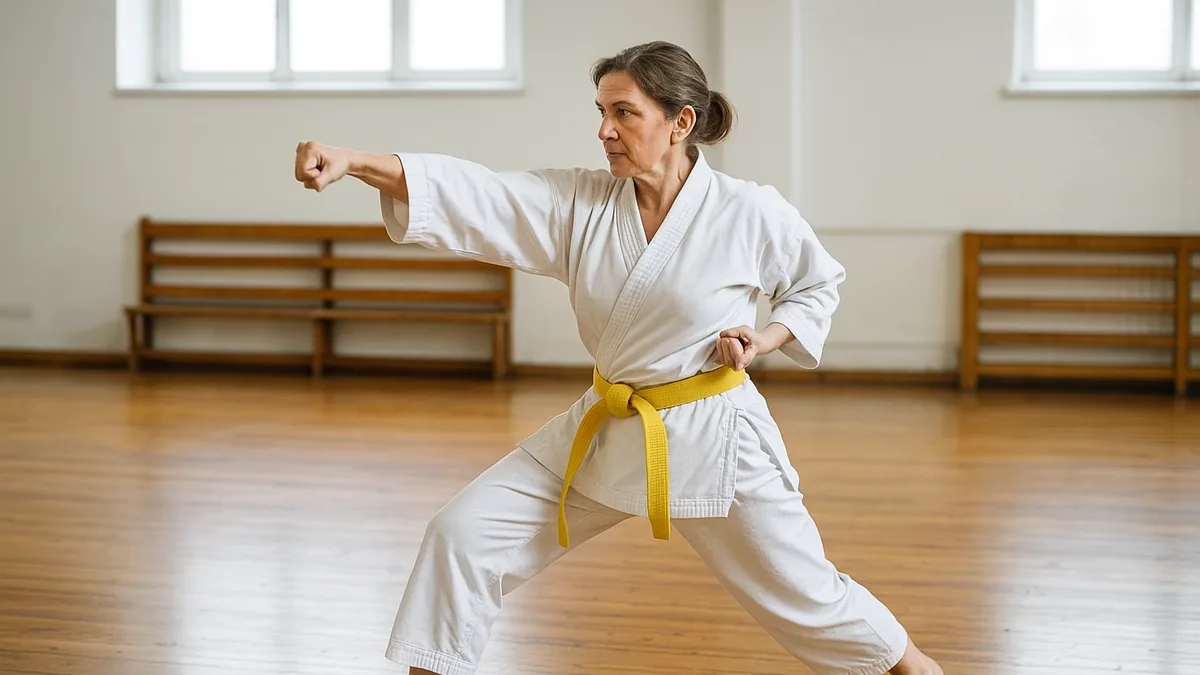
One mistake I see constantly with white and yellow belts: they focus on the end position. They’re trying to arrive at the right shape - arm extended, stance wide, hip square. So they rush through the movement to get there, check it looks right, and wait for the next count.
The technique isn’t the destination. It’s the path.
I used to think the same way. My first instructor would keep telling me to “feel the technique,” and I genuinely had no idea what that meant. I thought I was feeling it. My arm was doing the thing. What else was there?
The thing that actually changed my understanding was a correction I got at a grading preparation session, maybe three years into my training. A senior instructor watched me throw a gyaku-zuki and said, “You’re punching with your arm. Where’s the rest of you?” He made me do it in slow motion - and I mean genuinely slow, about five seconds for the full technique. And somewhere in that slowness, I felt my hip start to rotate before my arm was halfway extended, and the whole thing connected differently. The punch didn’t feel like an arm movement anymore. It felt like something that started in my back foot and arrived at my fist.
That’s what kihon is supposed to teach you. Not the shape. The connection.
The Mechanics Beneath the Mechanics
Stance and Foundation
Beginners obsess over stance width. I understand why - instructors talk about it constantly, and it’s visible and measurable. But stance width is almost irrelevant compared to what’s happening in the hips, the knees, and the weight distribution.
What I tell students when they’re struggling with zenkutsu-dachi: stop thinking about where your feet are and start thinking about whether you could move from where you’re standing. If you’re so wide and locked that a push would topple you, your stance is working against you. A fighting stance needs to be stable and mobile. Those aren’t opposites - they’re the same requirement.
The feeling you’re after in a good front stance is a kind of loaded readiness. There should be tension through the back leg, like a compressed spring. When that’s right, you’ll feel it in your glutes and hamstrings, not just your quads. Most beginners sit into their front leg and lose all of that. The correction that makes the biggest difference here isn’t telling them to adjust their back foot - it’s asking them to push the floor away with their back heel.
Hip Rotation
The hip rotation is the whole punch. Without it, you’re just throwing your arm.
I’ve said this to students hundreds of times, and I’ll keep saying it because it keeps being true. The challenge is that beginners can’t feel the difference yet. Their arm punch and their hip-driven punch look similar from the outside and feel similar from the inside - until they hit something. Then the difference is immediate and obvious.
One drill I come back to regularly: stand in yoi, no stance, and throw a chudan-zuki using only hip rotation. No step, no stance work, just the hip snapping through. Done correctly, you’ll feel a whipping sensation through your core - it almost feels like you might lose your balance forward. That’s the energy you’re trying to transfer through the arm. The arm is the delivery mechanism, not the source.
Hikite - The Pull That Nobody Takes Seriously
I’ve written more about this elsewhere, but hikite deserves mention here because it’s the most consistently neglected element of kihon I’ve ever seen. The withdrawing hand. The chamber.
Most students treat it as decorative. They pull it back loosely, park it somewhere near the hip, and forget about it. The problem is that hikite is half the technique. The tension created by driving one hand forward while pulling the other back is what generates the rotation, the snap, the kime. A lazy hikite doesn’t just look wrong - it mechanically prevents the technique from working properly.
If your punches feel weak and you can’t figure out why, check your hikite first. It’s almost always the answer. I’d recommend reading Why Most Karateka Never Fix Their Hikite - it goes deep on exactly why this habit is so hard to break and what actually corrects it.
Kime: The Part That Takes Years to Understand
Kime is the focus at the point of impact - the brief, total contraction that transfers power and then releases. It’s the most important concept in kihon and the hardest to teach.
As a white belt, I thought kime meant tensing up at the end of the technique. So I’d throw a punch and clench everything at full extension. It felt powerful. It looked tense and committed. My instructor kept telling me it was wrong, and I kept not understanding why.
By brown belt, I realised kime isn’t about holding tension - it’s about creating it and releasing it in the same instant. The contraction has to be fast enough to be explosive, and it has to relax immediately after or the next technique is compromised. What I’d been doing was bracing, not focusing. There’s a physical difference: bracing feels like armour, like you’re preparing to absorb something. Real kime feels like a crack - a sudden, sharp compression that’s gone almost before you notice it.
You’ll hear your instructor talk about kime from your first lesson. You won’t truly understand it until you’ve felt the difference between a technique with it and one without - and that usually happens by accident the first time, when something clicks in a combination and the technique sounds different when it lands on the pad.
Common Mistakes I’ve Seen (And the Corrections That Work)
Punching to the target instead of through it. The mental image matters here. I tell students to aim for a point six inches behind where they intend to land. It changes the trajectory and the commitment of the technique immediately.
Collapsing the front knee inward during kicks. Especially on mae-geri. The knee should track over the foot throughout the chamber and the kick. When it collapses inward, you lose stability and put unnecessary stress on the joint. The correction: slow the kick down to the point where you can feel the knee position at every stage. Most students have never actually felt their knee collapse because they’ve always moved too fast to notice.
Dropping the guard hand during combination work. In kihon combinations, the non-punching hand almost always drops as students focus on the active technique. I’ve seen this in students from white belt all the way up to first dan. The correction isn’t “keep your guard up” - that instruction doesn’t stick. What works better is having them feel the consequence: ask a training partner to lightly tap the dropped guard hand every time it falls. One session of that and the habit starts to change.
Rushing the count. Kihon is supposed to be performed to a rhythm set by the instructor. Students who rush are usually doing it because they want to get the technique done, not because they’re training the technique. Slowing down feels uncomfortable because it exposes what’s actually happening in the movement.
If you’re newer to structured kihon training and want specific drills to build on this, Kihon Training Drills for Beginners is worth working through systematically.
How Kihon Changes as You Progress
This is something I wish someone had explained to me early: what you’re trying to get out of kihon changes completely depending on where you are in your training.
As a beginner, you’re learning the shapes. The goal is to build a mental map of what the technique is supposed to look like and start training your body to approximate it. That’s legitimate work, and it takes longer than most people expect.
As an intermediate practitioner - green to brown belt, roughly - the shapes should be familiar enough that you can start working on the quality underneath them. This is where most people plateau. They’ve learned the techniques well enough to pass gradings, and they stop examining them. The students who improve fastest at this stage are the ones who treat every kihon session as a chance to find something wrong.
At senior level, kihon becomes something closer to meditation. The technique is ingrained enough that you can focus entirely on the sensation - where the energy is moving, what’s connecting, what’s still not quite right. Senior practitioners I’ve trained with will sometimes spend an entire session on a single technique, not because they can’t do it, but because they’ve found something subtle that they want to understand better.
Kihon in Sparring: Where It Either Works or It Doesn’t
The test of kihon is jiyu-kumite. Not kata, not partner drills - free sparring, where you can’t think about what you’re doing and the technique either fires correctly or it doesn’t.
The connection I’ve noticed most clearly: practitioners who put genuine attention into kihon have cleaner, faster counters. Not bigger or stronger - cleaner. The technique starts and finishes without wasted movement, which means it arrives sooner and recovers faster. In free sparring, that’s the difference between a counter that scores and one that gets blocked or avoided.
Specifically, a well-trained gyaku-zuki from kihon becomes your most reliable counter when your opponent overcommits to a jodan attack. Their weight is moving forward, you shift offline, and the reverse punch fires from a grounded stance with full hip rotation. If your kihon is solid, that combination happens almost without decision. If it isn’t, you’ll find yourself either hesitating or throwing a sloppy technique that your opponent walks through.
The same principle applies to kata - the mechanics you build in kihon are what make kata meaningful rather than decorative. If you’re interested in how kihon connects to the rest of your training, What Is Kata? explains the relationship from the other direction.
Community Perspective: How Much Kihon Is Enough?
This is genuinely debated, and I don’t think there’s a clean answer.
Some instructors - particularly in traditional Shotokan dojos - treat kihon as the foundation of every session. Thirty to forty minutes of basics before anything else, every class, regardless of grade. I’ve trained in those environments and I understand the logic. The volume builds physical memory, and the repetition forces you to confront your weaknesses.
Other dojos, particularly those with a more applied or competition focus, treat kihon as a smaller component - ten or fifteen minutes of targeted practice before moving to partner work. The argument is that isolated technique only transfers to real application if you’re constantly testing it against resistance.
I think both camps are partially right and partially missing something. Pure kihon without application becomes empty repetition. Application without kihon becomes sloppy habit. What I’ve found works best is deliberate kihon - shorter sessions, higher attention, with a clear focus on a specific element - followed quickly by partner drills that test whether the work transferred.
What I’d push back on is the idea that high-volume, low-attention kihon is better than nothing. I’ve seen students who’ve trained for years in high-volume dojo environments and have deeply ingrained bad habits because they’ve repeated them thousands of times. Volume without quality doesn’t build skill - it builds permanence.
If you’re managing training load and recovery around consistent kihon sessions, Recovery For Karate Practitioners has practical guidance on how to structure that without accumulating fatigue.
Key Takeaways
- Kihon is not warm-up and it’s not beginner content. It’s the deliberate practice of technique in isolation, and the quality of your attention during it determines whether it improves your karate or just fills time.
- The correction that makes the biggest difference in most punching techniques is the hikite, not the punching hand. Check the withdrawing hand before anything else when a technique feels weak.
- Slow your kihon down until you can feel what’s happening. If you can’t feel the hip rotation, the weight transfer, and the kime separately, you’re moving too fast to learn anything.
- What you’re training for changes with grade. Beginners are learning shapes. Intermediate students are refining mechanics. Senior practitioners are feeling for subtleties. Adjust your focus accordingly.
- Test your kihon in sparring regularly. If a technique doesn’t fire cleanly under pressure, the kihon version of it needs more work - not more sparring.
- Quality over volume. Twenty focused repetitions with full attention will do more for your technique than two hundred mechanical ones. This is the thing most dojo cultures get backwards.
The weekly digest
New karate articles, once a week
One email every week with everything new on Karate Lifestyle. No spam; unsubscribe in one click.
We'll email you to confirm. See our privacy policy.