Foam Rolling for Karate: Which Muscles Actually Need It and Which Don't
Most people grab a foam roller and just… start rolling. Wherever feels tight, wherever they saw someone else roll, wherever looks vaguely like a muscle. I’ve watched students spend ten minutes rolling their IT band with a grimace on their face like they’re earning a medal, then skip their quads entirely and wonder why their front kick feels like dragging a rusty hinge through sand two days after hard training.
Foam rolling isn’t complicated, but it is specific. And for karate, the muscles that actually need it are not always the ones that feel the worst.
Why Karate Demands a Different Recovery Approach
After a hard session - kihon, kata, kumite, bag work, whatever you’re doing - the muscles that took the most punishment aren’t always the ones screaming at you. The loudest complaints are often the secondary movers, the muscles compensating for something that’s already fatigued. That’s what makes recovery decisions tricky.
I’ve noticed this pattern repeatedly with students who train three or four times a week: they feel it in their lower back, so they try to roll their lower back. They feel it in their knees, so they try to do something around the knee. Both of those are usually the wrong move. The lower back is almost always tight because the hip flexors and quads are locked up. The knee discomfort is almost always coming from the quad or the calf, not the joint itself.
The thing that actually changed my understanding of this was a period when I was training six days a week building toward a grading and I kept developing this nagging ache behind my left knee. I tried everything around the knee itself - nothing helped. A senior student watched me train one evening and pointed out my left calf was visibly more developed and tighter than my right, probably from years of favouring that side in my fighting stance. Two weeks of proper calf rolling and the knee issue largely resolved. I hadn’t even considered the calf.
That’s the core lesson: the problem and the source of the problem are rarely in the same place.
The Muscles That Actually Need Rolling
Quads
If you do nothing else with a foam roller as a karateka, roll your quads. I’m not hedging on this - I think it’s the single most valuable thing you can do with a roller after training.
Think about what your quads are doing in a session. Every zanshin, every drop into shiko-dachi, every mae-geri chambered from a front stance, every time you push off the back leg in a combination - all of that loads the quads. By the end of a two-hour session they’re often shortened and fatigued in a way that doesn’t fully resolve overnight without some help.
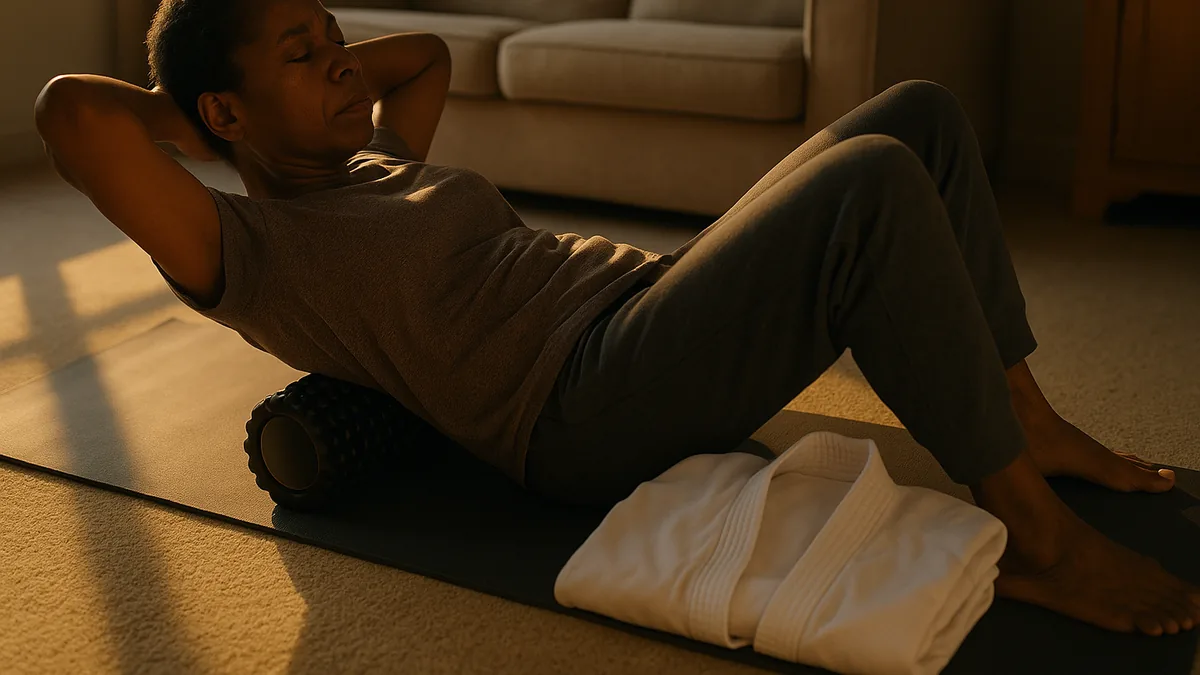
Rolling the quad correctly means lying face down, roller under the front of your thigh, and moving slowly - I mean genuinely slowly, not the fast rolling you see people do. You’re looking for the spots that make you want to stop. When you find one, you stop there. You breathe. You wait for it to release rather than rolling through it. It feels like pressure that builds and then slowly softens, like a knot loosening. If you’re rolling quickly and it just feels like friction, you’re not getting much out of it.
What I tell students is: if you’re rolling your quads and it doesn’t find anything uncomfortable, either you’re rolling too fast or you haven’t trained hard enough.
Hamstrings
The hamstrings are a different texture of problem. They’re not usually as acutely sore as the quads, but they accumulate tension in a way that compounds over weeks if you ignore them. For karate specifically, the hamstrings are constantly working as a brake - decelerating kicks, stabilising the knee in deep stances, controlling the descent in any lunge-based movement.
I’ve seen students develop chronically tight hamstrings that they attribute to “just not being flexible” when the actual issue is that the muscle tissue is loaded with accumulated tension that static stretching alone won’t address. Foam rolling before you stretch the hamstrings makes the stretching significantly more effective. If you’re putting time into flexibility work and not seeing progress, this might be why - you’re trying to lengthen a muscle that hasn’t released its baseline tension yet.
For more on why flexibility work alone often isn’t enough, Mobility vs Flexibility for Karate Recovery: Why the Difference Matters covers that gap in detail.
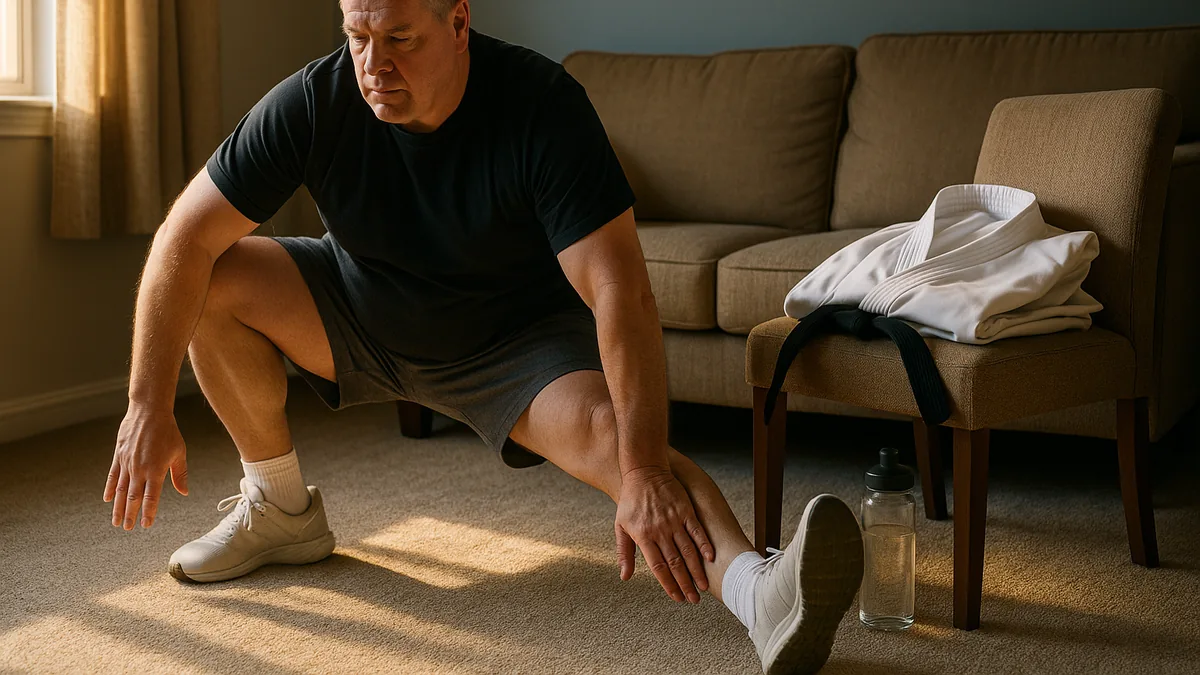
Sit on the roller with it under the back of one thigh, cross the other leg over to increase pressure, and again - go slowly. The hamstring is a long muscle, so work from just above the back of the knee up toward the glute. Most people only roll the middle section. The upper hamstring near the sit bone is often the tightest part and the most neglected.
Calves
The calf is underrated for karate recovery and I think it’s because people don’t associate it with the big dramatic movements. But your calves are working constantly - in your stance, in every push-off, in every pivot, in every time you rise onto the ball of your foot for a kick.
Tight calves affect your ankle mobility, which affects your stance depth, which affects your stability in virtually everything you do. I’ve corrected students’ stances for months before realising the root issue was calf tightness limiting how much they could dorsiflex at the ankle. Once that released, the stance corrected almost automatically.
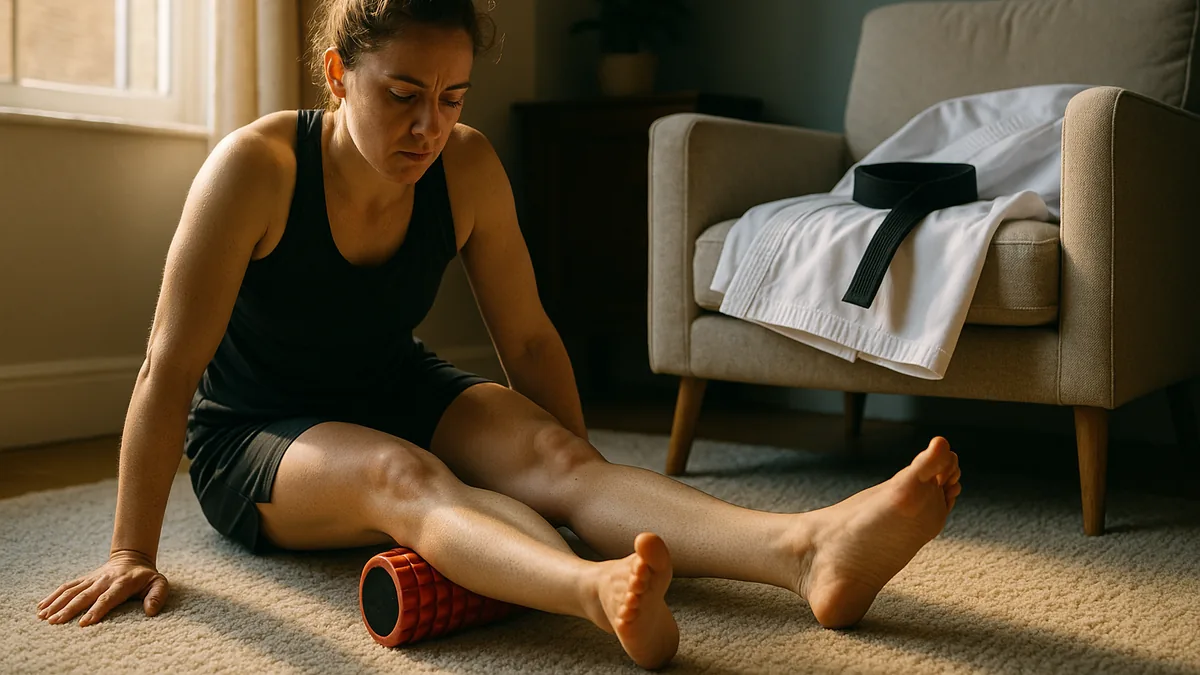
Rolling the calf is simple but most people do it passively. Sit on the floor, roller under the calf, and use your arms to lift your body weight onto it. Then flex and point your foot while you’re on the tight spot. That active movement while under pressure makes a real difference compared to just sitting there. You’ll feel it - there’s a distinct sensation of the tissue releasing when you move the ankle through its range while the roller holds pressure on the muscle belly.
Glutes and Hip Flexors
These aren’t always mentioned in basic foam rolling guides but they matter enormously for karate.
The glutes do a huge amount of work in hip extension, rotation, and stabilisation. After heavy kicking sessions, they accumulate tension that feeds directly into lower back tightness. Sitting on the roller, crossing one ankle over the opposite knee, and leaning into the glute on that side will find spots that you didn’t know existed. It can feel almost bruising at first if you’ve been neglecting this area.
The hip flexors are harder to address with a roller - you’re better off combining light rolling of the upper quad and TFL (the muscle on the outer front of your hip) with some dedicated hip flexor stretching. But ignoring this area entirely is a mistake, especially if you train in deep front stances regularly.
The Joints: Leave Them Alone
This is the mistake I see constantly, and it usually comes from a reasonable misunderstanding. Students feel soreness or stiffness in their knees, their ankles, or their lower back, and they try to roll directly on those areas because that’s where it hurts.
Joints are not muscles. There’s nothing for the roller to release there. Rolling directly on the knee joint, for example, puts compressive force on structures that don’t benefit from it - the joint capsule, the ligaments, the menisci. It doesn’t help and it can aggravate things that were just mildly irritated.
The correction that actually works is to find the muscle upstream or downstream of the joint that’s causing the restriction. Knee stiffness: roll the quad and the calf. Ankle stiffness: roll the calf and the peroneals (the muscles along the outer lower leg). Lower back tightness: roll the glutes, the TFL, and the upper hamstrings.
One mistake I see constantly is people rolling the IT band. I want to be careful here because this is an area where practitioners genuinely disagree. The IT band itself is a thick fibrous band, not a muscle, and you can’t really release it with a roller the way you can a muscle. What you’re actually affecting when you roll the outer thigh is the vastus lateralis (the outer quad) and the TFL. Rolling the outer quad is genuinely useful. Rolling directly on the IT band while it’s inflamed is often painful without being productive. I’d rather you spend that time on the quad and glute work that addresses the actual source of IT band tension.
For more on how to protect yourself from the injuries that make recovery necessary in the first place, Preventing Common Karate Injuries is worth reading alongside this.
When to Roll and How It Fits Into Recovery
I prefer rolling after training rather than before. Before training, if you roll extensively and release a lot of tension, you can temporarily reduce the muscle’s ability to generate force and respond quickly - the last thing you want before a sparring session. A brief, light roll before training on very specific areas is fine, but the real work should happen post-session.
After training, you have a window where the muscles are warm and more responsive to this kind of work. Ten to fifteen minutes is enough if you’re focused. Don’t try to roll everything. Pick the muscles that did the most work that session and address those.
Foam rolling is one tool in a broader recovery approach. It works best alongside good sleep, appropriate nutrition timing, and active recovery on lighter days. If you’re not sleeping well, no amount of foam rolling will compensate - Sleep and Karate Performance: What Serious Practitioners Get Wrong is worth reading if recovery is a consistent issue for you. And if you’re wondering what to do on the days between hard sessions, Active Recovery Days: What Karateka Should Actually Do Between Hard Sessions covers that in more detail.
Community Perspective
There’s a genuine split in how dojos approach this kind of recovery work. Traditional environments - and I’ve trained in a few - tend to view foam rolling and similar tools with some scepticism. The attitude is often that if you train correctly and progressively, your body adapts. You don’t need gadgets. I have some sympathy for that view. There’s a risk of becoming so focused on recovery tools that you spend more time managing training than actually training.
But I’ve also watched senior practitioners train through accumulated tightness for years and develop movement restrictions that could have been avoided. The body does adapt, but it also accumulates. By the time you’re in your thirties or forties and training seriously, you’re carrying the history of every hard session you’ve had. A bit of deliberate maintenance isn’t weakness - it’s how you keep training at a level that’s actually worth doing.
The practitioners I’ve seen sustain high training quality into their forties and beyond are almost universally the ones who take recovery seriously. Not obsessively - but seriously.
Key Takeaways
- Roll your quads after every hard session - slowly, stopping on tight spots rather than rolling through them. This single habit will do more for your training consistency than almost anything else in recovery.
- Work the calf actively: flex and point your foot while the roller holds pressure on the muscle belly. Passive rolling of the calf is much less effective.
- If you have knee discomfort, roll above and below the knee - not on it. The source is almost always the quad or calf, not the joint.
- Upper hamstring near the sit bone is the most neglected section - most people only roll the middle third. Start there.
- Roll after training, not before a hard session. Light pre-session rolling on specific areas is fine, but the real release work belongs post-session when the muscle is warm.
- Foam rolling works better as part of a system - pair it with genuine mobility work like what’s covered in Flexibility for Karate: What Actually Matters rather than treating it as a standalone fix.
The weekly digest
New karate articles, once a week
One email every week with everything new on Karate Lifestyle. No spam; unsubscribe in one click.
We'll email you to confirm. See our privacy policy.