Knee Pain in Karate: What Causes It, What Helps, and When to Stop Ignoring It
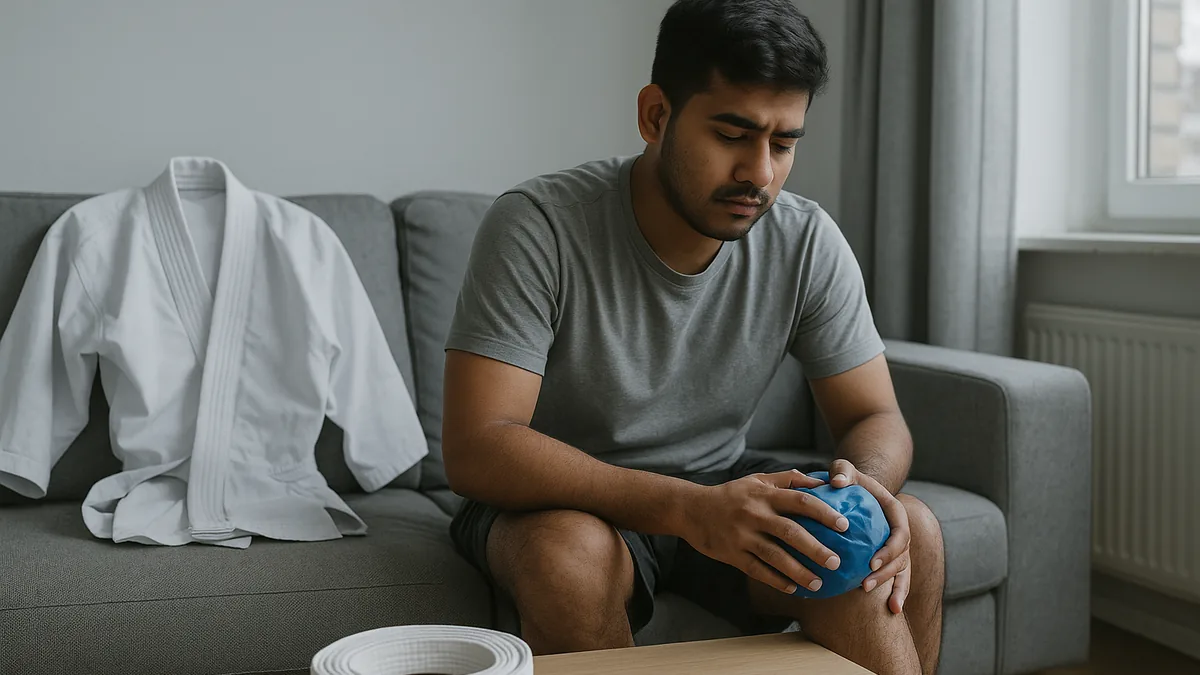
Knee pain is one of the most common complaints I hear in the dojo, and the honest answer is this: most of it is preventable, some of it is self-inflicted through bad habits, and almost none of it should be trained through without understanding what’s actually happening. The short answer is that your knees hurt because karate puts serious demands on joints that are often underprepared for those demands - but it’s more nuanced than that, and getting the nuance right is the difference between training for decades and grinding yourself down to nothing by your forties.
I’ve been training for over fifteen years, and I’ve had my share of knee problems. I’ve also watched students make the same mistakes I made, ignore the same warnings I ignored, and end up on the same physio table I ended up on. So let me give you the real picture.
Why Do Karateka Get Knee Pain in the First Place?
The two biggest culprits are technique problems and overuse - and they often work together.
On the technique side, the most common issue I see is misalignment in stances. In zenkutsu-dachi, your front knee should track over your second toe. When it collapses inward - and it does, constantly, especially in beginners - you’re loading the medial side of the knee with every single rep. Multiply that by a thousand repetitions of oi-zuki in a single training block, and you’ve got a recipe for pain that creeps up slowly and then hits you all at once.
I’ve noticed that students with tight hips are particularly prone to this. The hip can’t rotate properly, so the knee compensates. The correction that actually works isn’t just telling someone to straighten their knee - it’s addressing the hip restriction that’s causing the problem. Cueing someone to “push the knee out” in isolation rarely sticks. Getting them to open the hip first does.
The other technique issue is in kicking - specifically mawashi-geri and yoko-geri. The supporting leg takes enormous rotational stress during these techniques. If the supporting knee is locked or misaligned, that stress goes straight into the joint rather than being absorbed through the leg musculature. You’ll feel it as a sharp twist or ache on the outside of the knee, often after class rather than during it.
On the overuse side - especially if you’re also competing or cross-training - your knees simply accumulate load faster than they can recover. If you’re not sleeping well, not eating well, and training six days a week, something will break down. The knee is often first. We have a full article on Overtraining in Karate: How to Recognise It, Admit It, and Actually Fix It that covers this in more depth, but the knee is often the early warning sign that you’re doing too much.
What Muscles Should You Be Strengthening to Protect Your Knees?
The quadriceps and hamstrings get all the attention, and they matter - but in my experience, the vastus medialis oblique (the teardrop muscle on the inner quad) and the hip abductors are the ones most karateka neglect. The VMO stabilises the kneecap. Weak hip abductors mean your femur drops inward under load, which drags the knee out of alignment.
What I tell students is this: if your knees hurt, start with single-leg work. Wall sits, split squats, step-downs. Not because they’re exciting, but because bilateral exercises let you compensate. Single-leg work forces the stabilisers to do their job, and you’ll quickly find out exactly where your weakness is.
Calf strength also matters more than people realise. The gastrocnemius crosses the knee joint. If it’s weak or tight, it affects how load is distributed through the joint during dynamic movements like landing from a jump kick or dropping into a low stance quickly.
I’d also recommend looking at your warm-up. If you’re going straight into kihon with cold joints, you’re asking for trouble. We cover the specific risks of poor warm-up practice in Why Karateka Get Injured in the Warm-Up (And How to Stop It Happening) - the short version is that joint prep needs to come before muscular warm-up, not after it.
Does Stretching Help or Make It Worse?
This is where I’ve changed my view significantly over the years. When I started training, I thought stretching was the answer to everything. Tight? Stretch it. Sore? Stretch it. My instructor used to push us into deep stretches at the end of class, and I accepted it without question. It wasn’t until I developed medial knee pain during a particularly heavy training block that I started paying attention to what stretching was actually doing.
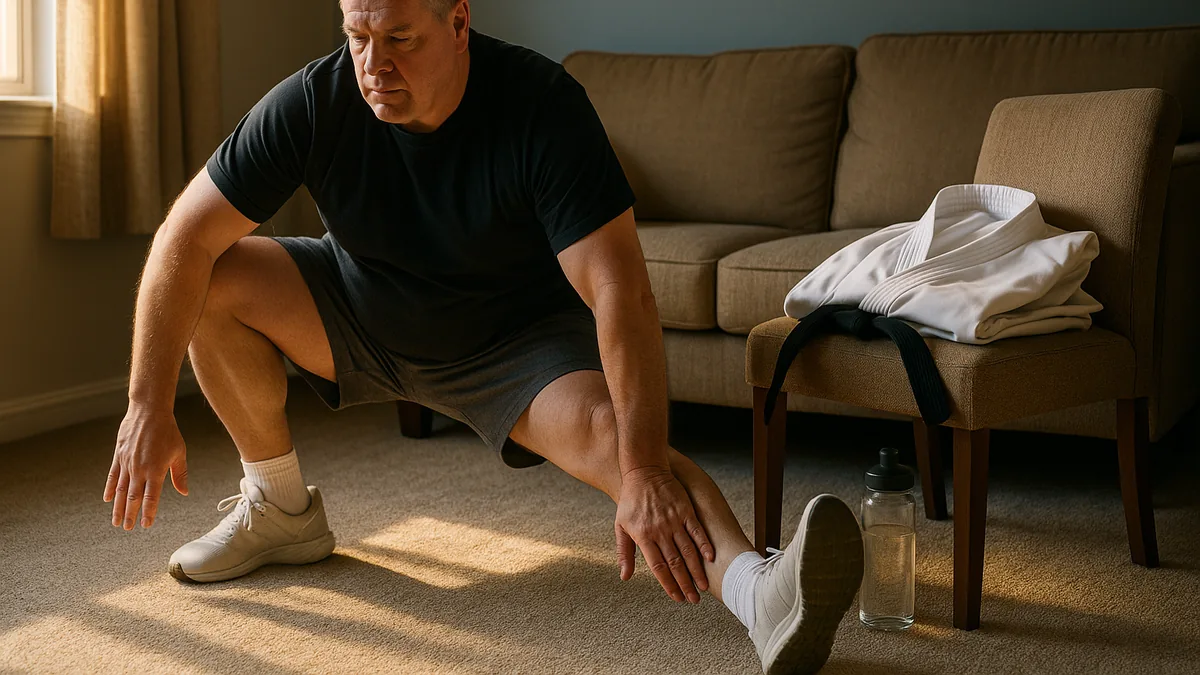
The honest answer is that static stretching a painful knee often makes it worse, not better. If the pain is coming from inflammation or a structural issue, you’re pulling on already-stressed tissue. What tends to help more is mobility work - controlled movement through a range, not passive lengthening. Hip circles, leg swings, slow knee circles with load - these improve joint health without adding stress.
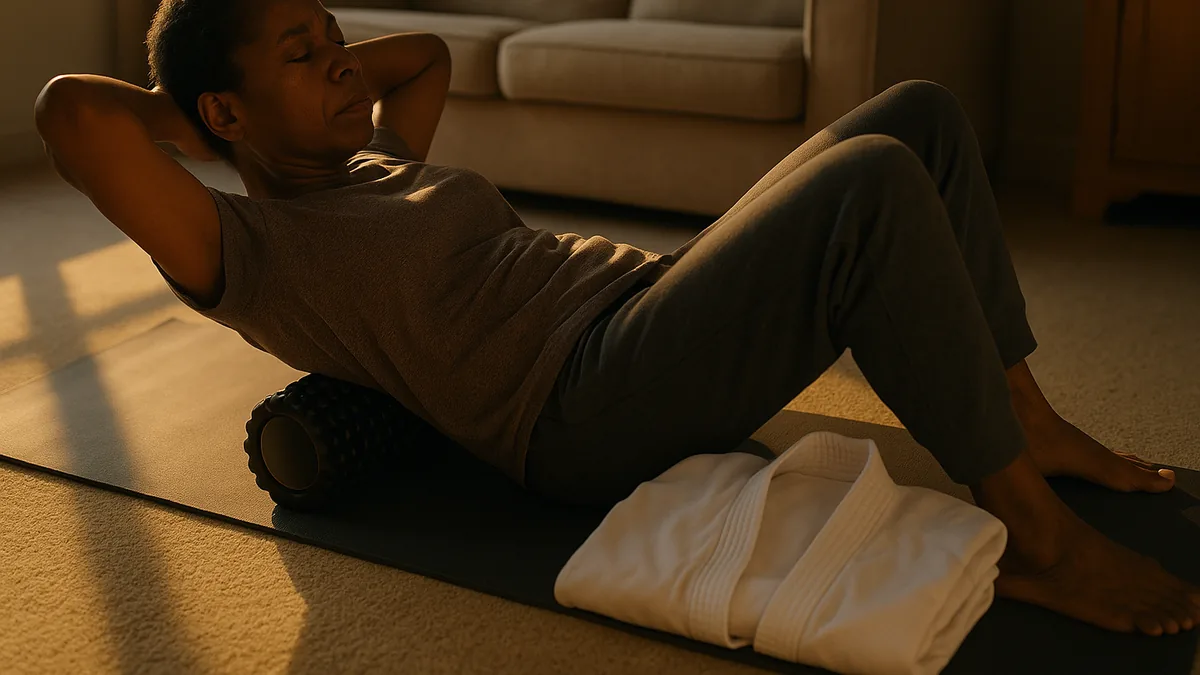
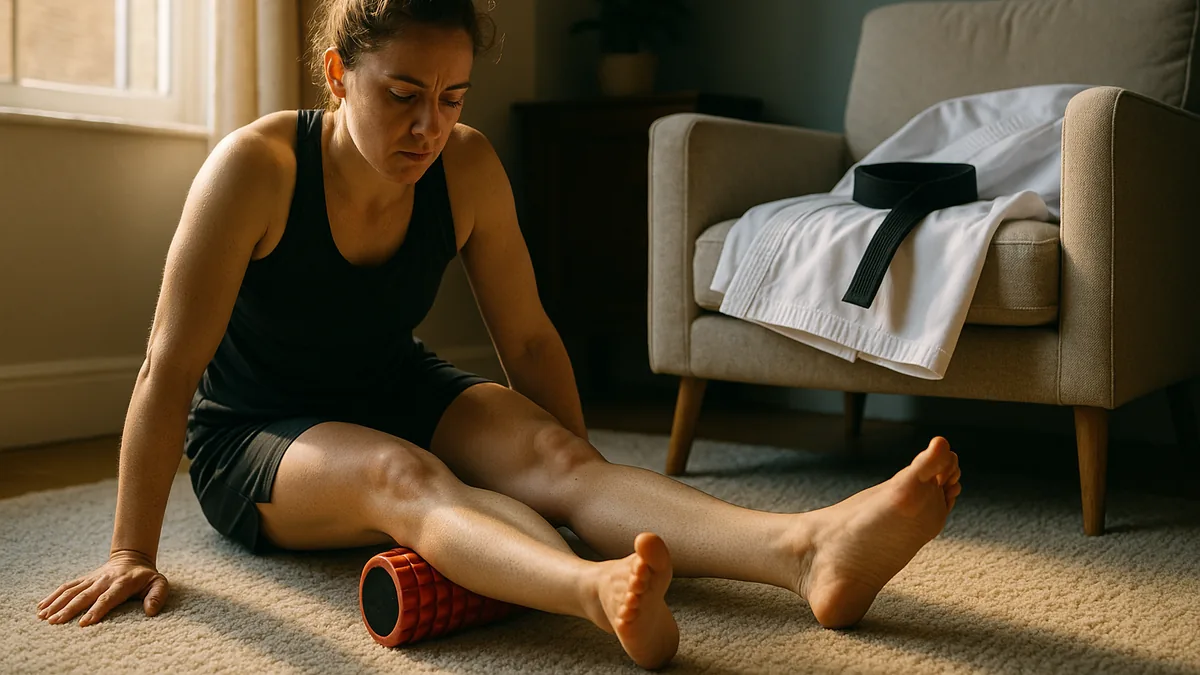
Foam rolling the IT band and quads before training can make a real difference to how the knee tracks during practice. We’ve got a detailed breakdown of what’s actually worth rolling in Foam Rolling for Karate: Which Muscles Actually Need It and Which Don’t.
When Is Knee Pain a Sign You Should Stop Training?
Most people get this wrong. They either train through everything and make it worse, or they stop at the first sign of discomfort and lose months of progress unnecessarily. The reality is somewhere in between, and the key is learning to distinguish between discomfort and damage.
Discomfort is the dull ache you feel in a deep stance when you’re not used to it. It fades with movement, it doesn’t get worse as training progresses, and it’s gone by the next morning. That’s adaptation. Train through it carefully.
Pain that gets worse during training, pain that’s sharp or localised to a specific point, swelling, locking, or any sensation of instability - those are signals to stop. Not reduce. Stop. I’ve seen students train through swelling because they had a grading coming up, and the result was a much longer layoff than if they’d rested for a week in the first place.
Anything that persists beyond two weeks without improvement needs a professional assessment. I’m not a physio, and neither are most instructors. The dojo is full of well-meaning advice about knee pain, and some of it is genuinely harmful. Get it looked at.
For recovery between sessions when you’re managing mild soreness, it’s worth knowing which tools actually help. Epsom Salts, Contrast Showers, and Compression: Which Recovery Tools Are Actually Worth It for Karateka? gives an honest breakdown. I also think Active Recovery Days: What Karateka Should Actually Do Between Hard Sessions is worth reading if you’re currently managing a knee issue - keeping movement going without loading the joint is often better than complete rest.
Community Perspective
There’s a genuine split in the karate community on how to handle training through pain, and it tends to fall along generational and stylistic lines. Older instructors, particularly those trained in more traditional environments, often have a “push through it” mentality that comes from their own experience of training under similar expectations. I understand where it comes from, and I don’t think it’s always wrong - but applied uncritically to knee injuries, it causes real damage.
Younger practitioners, especially those who’ve engaged with sports science or modern physiotherapy, tend to be more conservative. I think that’s the right direction, but it can tip into excessive caution that interrupts progress unnecessarily.
The most useful framing I’ve found is this: train around the injury where you can, rest the specific structure that’s damaged, and keep the rest of your training going. A knee that can’t handle deep stances might still be fine for kata that doesn’t require them, or for pad work focused on hand techniques. You don’t have to stop training - you have to train smarter.
Key Takeaways
- Knee pain in karate is usually caused by technique faults, overuse, or both - address the cause, not just the symptom.
- Stance misalignment, particularly knee collapse in zenkutsu-dachi, is the single most common technique problem I see leading to knee pain.
- Strengthen the VMO and hip abductors specifically - bilateral squats alone won’t fix the stability issues that karate exposes.
- Distinguish between adaptation discomfort and actual injury signals. Swelling, sharp pain, instability, and pain that worsens during training all mean stop.
- Persistent pain beyond two weeks needs professional assessment - dojo advice is not a substitute.
- Warm-up quality matters enormously. Joint prep before muscular warm-up, not after.
- Recovery tools like contrast showers and compression can support healing between sessions, but they don’t replace addressing the root cause.
- Training through a knee injury to make a grading deadline is almost always a decision you’ll regret.
The weekly digest
New karate articles, once a week
One email every week with everything new on Karate Lifestyle. No spam; unsubscribe in one click.
We'll email you to confirm. See our privacy policy.