Shoulder Pain in Karate: What's Actually Causing It and How to Train Around It
Why Karate Actually Stresses the Shoulder
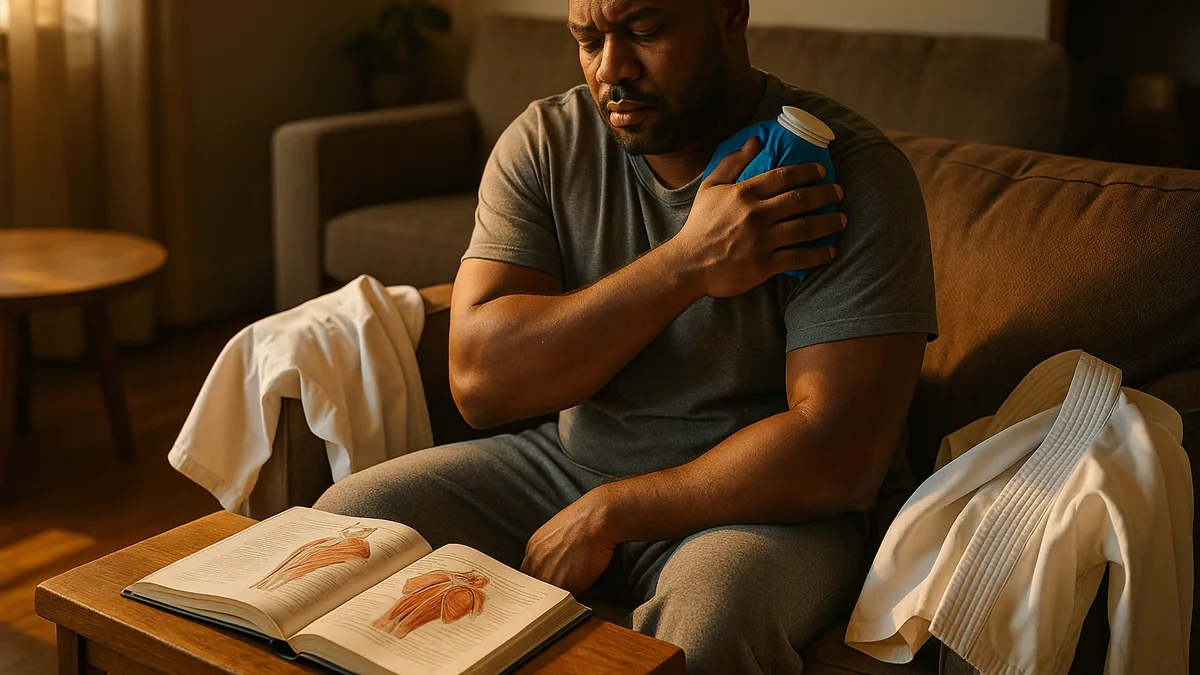
The shoulder is a ball-and-socket joint: the ball-shaped upper end of the humerus fits into a socket in the scapula. That design gives it extraordinary range of motion, but relatively little bony stability. The rotator cuff - the supraspinatus, infraspinatus, subscapularis, and teres minor - is crucial for shoulder stability, movement, and force generation, particularly in overhead sports. These muscles and their attachments contribute to the dynamic stability of the shoulder by holding the humeral head against the glenoid, allowing the joint to act efficiently while limiting secondary injury. When those muscles are weak, tight, or poorly coordinated, the joint takes stress it shouldn’t.1, 2
Karate loads the shoulder in ways most people don’t think about clearly. Punching isn’t just about the arm going forward - it’s about the arm snapping back just as hard. The hikite, the withdrawing hand, creates as much rotator cuff demand as the striking hand. A common pattern among practitioners who develop anterior shoulder pain is a weak or lazy hikite - they throw the punch but do not pull the other arm back with equal intent. That imbalance accumulates.
Blocking is the other major culprit. Age-uke, soto-uke, uchi-uke - these all involve rapid deceleration of the arm against resistance. In partner work and on the makiwara, that deceleration load is real. If you are not bracing properly through the shoulder girdle when you make contact, the rotator cuff absorbs the force badly. The combination of extrinsic mechanical compression and tendon overuse from repetitive overhead activities has been identified as one of the main mechanisms underlying rotator cuff pathology.3
The Overhead Problem
Jodan work is where the most acute issues tend to arise. Age-uke in particular places the shoulder at the end of its range under load. The classic sign of subacromial impingement is a painful arc on abduction, typically between 60 and 120 degrees, when the tendon presses against the acromion - outside of this range, movement is generally painless.4 The article previously cited 80 to 90 degrees as the onset point; the clinical evidence is clear that the arc typically begins earlier, around 60 degrees. If you feel that catch at the top of age-uke, you may be moving into the upper part of this arc. Either way, it is not something to push through - that is something to fix.
Weakness and stiffness may also develop as the condition progresses, and night pain is common in more advanced cases. If the ache is now present at rest or keeping you awake, that is a different problem altogether, and it needs clinical assessment, not a training modification.
Kihon at the jodan level combined with high repetition is a reliable way to develop subacromial impingement if your mechanics are off. If you feel a catch or a click at the top of age-uke, that is not something to push through. That is something to fix.
The Warm-Up That Actually Matters
Many practitioners treat the shoulder warm-up as arm circles and a few swings across the body. The problem is that arm circles move the joint through range without activating the stabilising muscles that need to be ready before you start loading the shoulder. There is a difference between range-of-motion preparation and muscle activation, and only one of them is doing the work.
What actually works is a short sequence that gets blood into the stabilising muscles before you load them:
- Banded or bodyweight external rotation - stand with your elbow at 90 degrees, forearm across your stomach, and rotate outward against light resistance. Ten reps each side, slow and deliberate. External rotation of the shoulder works the infraspinatus, teres minor, and posterior deltoid. You should feel this in the back of the shoulder. If you don’t, you are not engaging the right muscles. Low-intensity training is more effective in selectively activating the rotator cuff than high-intensity exercises, which tend to recruit larger muscles such as the upper or posterior deltoid.5 Keep the load light and the movement slow.
- Wall slides - stand with your back flat against a wall, arms in a goalpost position, and slide them overhead while keeping contact with the wall. This is harder than it sounds if your thoracic mobility is limited. Many karateka have tight upper backs from years of forward-loaded posture, and this exposes it immediately.
- Scapular retractions - pull the shoulder blades together and hold for two seconds. Simple, but it activates the mid-traps and rhomboids that stabilise the shoulder blade during punching. Many practitioners have these chronically underactivated.
Do this before you touch the pads or start kihon. It takes four minutes. It is not optional if you have had shoulder trouble.
For the cool-down, the priority is restoring length to the muscles that shortened during training. The pectorals and anterior deltoid tighten up from sustained punching. A doorframe pec stretch held for 45 seconds each side, combined with a cross-body shoulder stretch, covers most of what you need. For the posterior capsule, the sleeper stretch is widely used: stretching techniques that focus on increasing posterior shoulder soft tissue flexibility are commonly incorporated into prevention and treatment programmes, and the cross-body and sleeper stretch exercises have been described as techniques to improve posterior shoulder soft tissue flexibility and to increase glenohumeral internal rotation range of motion.6 That said, based on the potential for subacromial impingement with the standard sleeper stretch, clinicians recommend modifications to ensure the scapula is stabilised during the stretch.6 If you have active impingement symptoms, check the technique carefully before adding it. If you want to go further with general muscle recovery, the article on foam rolling for karate covers which areas are actually worth targeting versus which ones are a waste of time.
Modifying Technique to Reduce Strain
If your shoulder hurts, training through it at full intensity is not demonstrating dedication. It is making the problem worse and building compensatory movement patterns that will take longer to unlearn than the original issue took to develop.
The good news is that most shoulder issues do not require you to stop training. They require you to train differently.
Punching Modifications
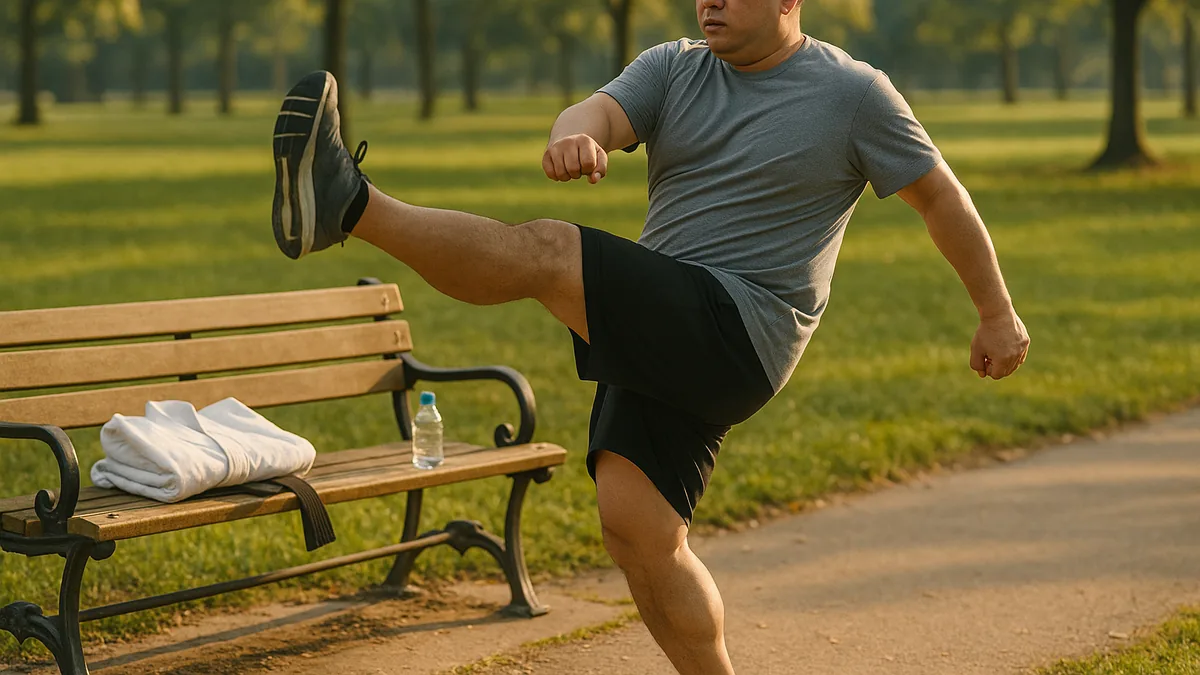
The biggest modification that actually helps is reducing the snap at full extension. The rotator cuff works hardest at the end range of the punch - that final phase where you are rotating the fist and locking out. If you are experiencing pain there, drill the punch to 90% extension for a period. You will still build the mechanics. You will not keep aggravating the tissue.
The correction that makes the biggest difference for most practitioners with anterior shoulder pain is fixing the hikite. Pull that withdrawing hand back hard, into the hip, with the elbow driving back rather than the hand pulling. When you do this properly, you will feel the load distribute across both shoulders more evenly rather than accumulating in the punching shoulder. It also improves your punch speed, which is a useful side effect.
Blocking Modifications
For jodan blocks, temporarily reducing the height of your age-uke is worth trying if you have impingement symptoms. The painful arc on abduction occurs between 60 and 120 degrees; abduction with the arm in full external rotation is usually without pain throughout the entire range of movement.4 Blocking to approximately forehead height rather than fully overhead keeps the arm below the upper end of the painful arc while still drilling the mechanics. It is not ideal technically, but it is far better than drilling impingement into a chronic injury.
Uchi-uke and soto-uke can be drilled in the air without partner resistance while the shoulder is settling down. The pattern and speed are still trained. The deceleration load against a partner’s arm is removed temporarily.
Sparring Considerations
In jiyu-kumite, shoulder pain tends to expose itself worst when you are caught defending a jodan attack with your arm already extended. The forced, uncontrolled elevation under impact is exactly the mechanism that aggravates impingement. If you are sparring with a shoulder issue, communicate it to your partner and focus on combinations that keep your guard tighter rather than reaching to intercept.
Shoulder pain during sparring sometimes signals a problem that is actually coming from somewhere else - overtraining being a common culprit. If your shoulders are aching during training that used to feel fine, it is worth reading about overtraining in karate before assuming the shoulder itself is the issue.
Mistakes That Appear Constantly
A common mistake is treating the shoulder as a single structure. Practitioners stretch the front of it, or ice it, and assume they have addressed the problem. The shoulder is a system. The rotator cuff, the scapular stabilisers, the thoracic spine mobility, and pectoral tightness all interact. Persistent anterior shoulder pain with no rotator cuff weakness at all is frequently traced back to a stiff thoracic spine that forces the shoulder blade to sit in a poor position. Fixing the mid-back can resolve the shoulder presentation entirely.
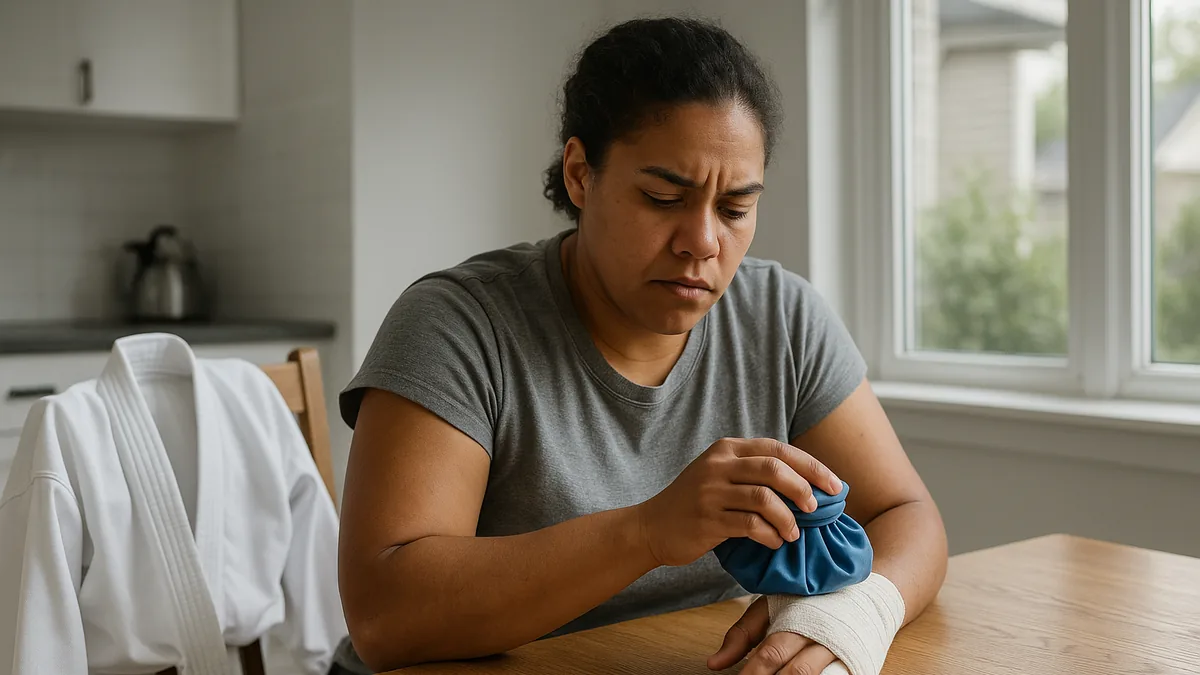
The other mistake is ignoring symptoms until they become significant. A dull ache present for three weeks and only apparent at the end of training is a very different problem from the same ache that is now present at rest or waking you at night. Shoulder pain that does not improve after two weeks might be caused by something that needs treatment.7 The NHS advises you to see a GP if you are worried and not to self-diagnose. Red flags warranting same-day or urgent clinical assessment include sudden onset of weakness, suspected fracture or dislocation, and escalating pain that does not respond to conservative management.8 Pain and weakness leaving you unable to lift your arm, or pain that is getting worse despite taking painkillers and doing recommended exercises, also require prompt clinical attention rather than further self-management.9 The first is manageable with the modifications above. Anything fitting the second description needs a physiotherapist, not a training partner. It can take six months or longer to recover from shoulder pain, which is reason enough to address it early rather than late.7 The same principle applies to knee issues, which we have covered in more depth at knee pain in karate.
Community Perspective
There is a genuine split in how different dojos approach this. Traditional instructors - and we say this with respect for the tradition - often push through pain as a matter of course. The attitude is that discomfort is part of training and that stopping is weakness.
The position here is that this approach produces practitioners who train for ten years and then stop because their bodies are worn out, rather than practitioners who train for forty years and are still functional. The ones who are still training hard into their fifties and sixties are almost universally the ones who learned to distinguish productive discomfort from injury signal. That distinction takes time to develop, but it is worth developing deliberately rather than learning it the hard way.
Some instructors will tell you that modifying technique is compromising the kata. Drilling a broken movement pattern under pain to preserve the appearance of correct technique is not preserving the kata. It is hurting yourself while looking like you are not.
Key Takeaways
- Anterior shoulder pain in karate is usually a rotator cuff load issue, not a single injury - fix the hikite and the impingement mechanics before you assume you need rest
- A proper shoulder warm-up activates the stabilising muscles, not just the joint range - banded external rotations and wall slides before kihon, not just arm circles
- The subacromial painful arc typically runs from 60 to 120 degrees of elevation: if you feel a catch or click during age-uke, reduce the height of your jodan blocks temporarily and address thoracic mobility
- Modify training rather than stop training - 90% extension punches and air-drilled blocks keep you progressing without loading the injury
- Cool down with pec and posterior capsule stretching after every session - the muscles that shorten during punching need consistent attention to stay balanced
- Distinguish between productive discomfort and injury signal - pain at rest, pain waking you at night, or pain accompanied by sudden weakness means you see a physiotherapist, not a training partner
If your shoulder is part of a broader pattern of fatigue and soreness, it is worth thinking about what your active recovery days actually look like. Many shoulder issues that do not resolve with technique correction resolve when the practitioner starts recovering properly between sessions.
References
Checked by the KarateLifestyle editorial team against NHS patient guidance, NHS Scotland MSK referral pathways, peer-reviewed orthopaedic and sports physiotherapy literature (PubMed/PMC, JOSPT), and clinical anatomy references (Cleveland Clinic, AAOS OrthoInfo) in September 2026. The sleeper stretch is supported by peer-reviewed evidence for overhead athletes but clinicians note that scapular stabilisation technique matters; practitioners with active impingement should seek professional guidance on technique.
- Rotator Cuff: Muscles, Tendons, Function & Anatomy. Cleveland Clinic (non-profit academic medical centre), reviewed 2026
- Subregions of the Rotator Cuff Muscles Present Distinct Anatomy, Biomechanics, and Function. PMC / National Library of Medicine, peer-reviewed, 2024
- Subacromial Pain Syndrome – Rotator Cuff Related Shoulder Pain (background, kinetic chain). ClinicalTrials.gov registered study protocol (NCT07744165), citing peer-reviewed literature on subacromial pathology mechanisms, 2025
- Painful arc – Primary Care Notebook (GPNotebook). GPNotebook / Primary Care Notebook, clinical reference, updated August 2025
- Proximal Effects of Blood Flow Restriction on Shoulder Muscle Function and Discomfort During Low-Intensity Exercise. PMC / National Library of Medicine, peer-reviewed randomised study, 2025
- The Modified Sleeper Stretch and Modified Cross-body Stretch to Increase Shoulder Internal Rotation Range of Motion in the Overhead Throwing Athlete. Wilk KE, Hooks TR, Macrina LC. Journal of Orthopaedic & Sports Physical Therapy, 2013
- Shoulder pain – NHS. NHS England, official patient information, reviewed October 2024
- Shoulder – Right Decisions (NHS Scotland / NHS Dumfries and Galloway MSK referral guidance). NHS Scotland / NHS Dumfries and Galloway, MSK clinical referral pathway, updated July 2026
- Painful shoulder – Newcastle upon Tyne Hospitals NHS Foundation Trust. Newcastle Hospitals NHS Foundation Trust, occupational health physiotherapy self-help leaflet, reviewed 2025
The weekly digest
New karate articles, once a week
One email every week with everything new on Karate Lifestyle. No spam; unsubscribe in one click.
We'll email you to confirm. See our privacy policy.