Who Was Chōki Motobu? The Fighter Whose Methods Rivalled Funakoshi's and Why His Legacy Is Underrepresented in Modern Karate
Who Was Chōki Motobu?
Most karate practitioners can name Gichin Funakoshi without hesitation. Ask them about Chōki Motobu and you often get a pause, maybe a vague answer about “that other Okinawan fighter.” That gap says everything about how modern karate chose to develop - and what it left behind.
Motobu was not a footnote. He was, by most historical accounts, one of the most capable fighters Okinawa produced in his era. The fact that his approach sits at the margins of mainstream karate is not an accident of history. It is the result of deliberate choices made about what karate should look like, who it should appeal to, and how it should be taught. Understanding those choices - and what was traded away - matters if you take the applied side of karate seriously.
Who Was Chōki Motobu?
Chōki Motobu was born in 1870 in Akahira village in the Shuri region of Okinawa.1 His birth year appears as either 1870 or 1871 in different sources; the official Motobu-ryu organisation gives 1870, which we follow here. He came from an aristocratic family of Okinawan nobility, one of the cadet branches of the Ryūkyūan royal family.1 As the third son, he was not entitled to an education in his family’s martial arts tradition, which by custom passed to the eldest - his brother Chōyu.1 That exclusion reportedly drove him to seek out training wherever he could find it.
He trained under several of Okinawa’s most prominent teachers: Ankō Itosu, the leading master of Shuri-te, and later Kōsaku Matsumora of Tomari-te, as well as Sakuma Pechin. His relationship with each was not without friction - his aggressive reputation and habit of testing himself in street fights in the Tsuji district of Naha made him an uncomfortable student, and some teachers accepted him only reluctantly. The street fighting background is not a colourful detail to gloss over. It shaped everything about how Motobu understood karate. He was not theorising about application. He was testing it, repeatedly, against resisting opponents who were trying to hurt him. That context produced a practitioner whose understanding of what actually works under pressure was unusually hard-earned.
His most famous moment of public recognition came in November 1922, when he defeated a Western boxer at a public event in Kyoto.2 The fight was reported in the September 1925 issue of the Japanese magazine Kingu (King), three years after the fact, and the account spread widely.2 The historical record here is not entirely clean, and it is worth saying so plainly: Kingu’s version has been described by researchers as “a piece of imaginative, popular journalism rather than an accurate blow-by-blow report.” The article named Motobu as the victor, but the illustrations showed Funakoshi - an editorial blunder that sharpened the rivalry between the two men.2 Motobu himself, in a later interview, placed the fight in 1923 rather than 1922, though as the magazine was published only three years after the event, most researchers treat the 1922 date as more reliable. What is documented is that the coverage made Motobu’s name across mainland Japan and created a surge of public interest in karate.
What is also well documented is that Motobu moved to Osaka in 1921, later relocated to Tokyo in 1929, taught karate there, and built a reputation among practitioners who valued fighting effectiveness above ceremony.1
The Method: What Motobu Actually Emphasised
Motobu’s approach centred on a few principles that, stated plainly, most modern karate has moved away from.
Kata as a source of fighting technique, not performance. Motobu believed that Naihanchi (called Tekki in Shotokan lineages) contained all the principles of karate. His view was that a practitioner who understood Naihanchi deeply - not as a sequence of movements but as a collection of applicable techniques - had what they needed. This is not quite the same as claiming Naihanchi was the only kata he knew or taught; he also practised and taught Passai, Seisan and others.1 But Naihanchi was the curriculum’s centre of gravity in a way that most modern syllabuses would find hard to accommodate. Most modern karate treats kata as one component among many, with competition kata performance pulling it further from fighting application every decade.
Close-range fighting. Motobu’s fighting model was built around close distance. He emphasised the ability to strike, clinch, and control at ranges where most karate practitioners today feel uncomfortable. The standard kumite distance - where both practitioners can just reach each other with a lunge - is not where Motobu’s techniques were designed to operate.
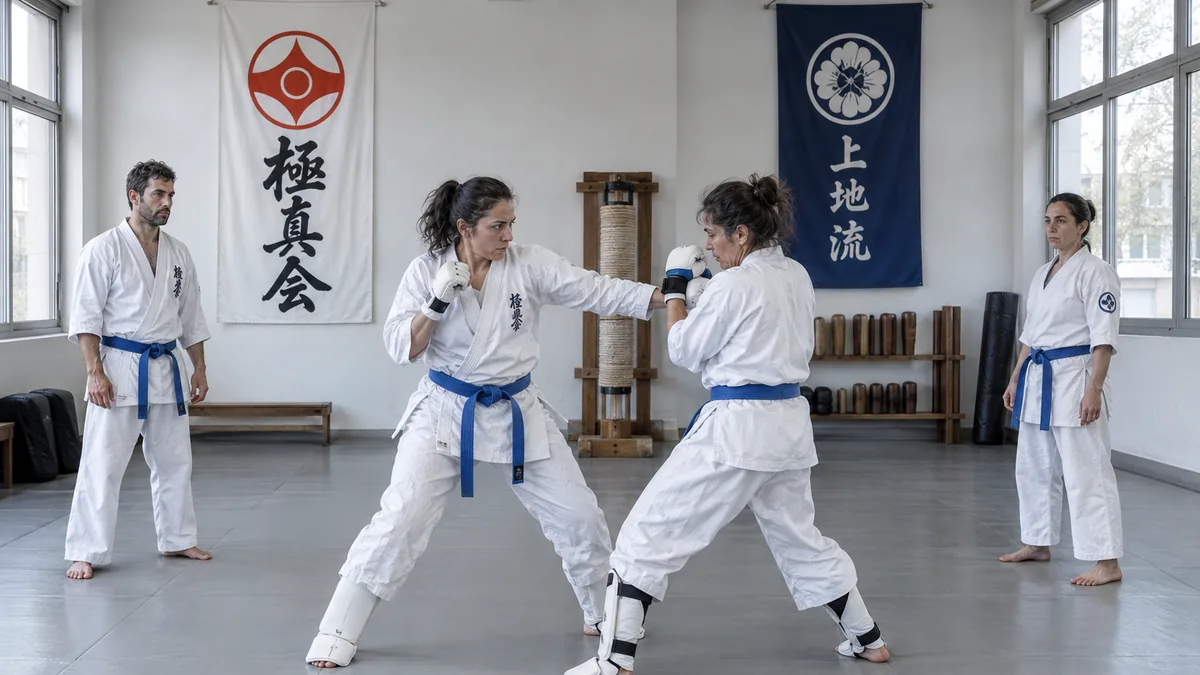
Continuous pressure. Rather than the single-technique, return-to-kamae model that dominates kihon training, Motobu favoured combinations and the ability to keep attacking once you had closed distance. This is closer to what you see in Kyokushin’s approach to contact fighting than to traditional Shotokan kumite - though the lineages are separate.
Reading the opponent. Motobu wrote about the importance of watching the opponent’s eyes and body for signals before they move. This is not mysticism; it is the practical observation that anticipating a strike is faster than reacting to it. A common correction at this stage of training is to stop watching the attacking limb and start watching the centre of the body - the shoulders and hips telegraph intent before the hands do.
Where Motobu and Funakoshi Diverged
To understand Motobu’s legacy, you have to understand what Funakoshi was doing at the same time - and why the two approaches were genuinely incompatible, not just stylistically different.
Funakoshi’s project was explicitly one of cultural transmission. He was introducing Okinawan karate to mainland Japan, and later to a wider world, and he made conscious decisions to present it in a form that would be accepted by Japanese educational institutions and the Japanese public. That meant emphasising discipline, character development, and structured progression. It meant de-emphasising the fighting application and downplaying the street-level origins.
Motobu had no such project. He was not interested in making karate palatable to Japanese universities. He was interested in whether it worked when someone was trying to hit you.
This is not a criticism of Funakoshi. His approach succeeded on its own terms - karate spread globally, and Shotokan remains the world’s most widely practised style. But the trade-off was real. The version of karate that spread was the one designed for mass adoption, not the one optimised for fighting effectiveness. We think it is worth being direct about that, because many practitioners spend years in the mainstream before they realise the gap exists.
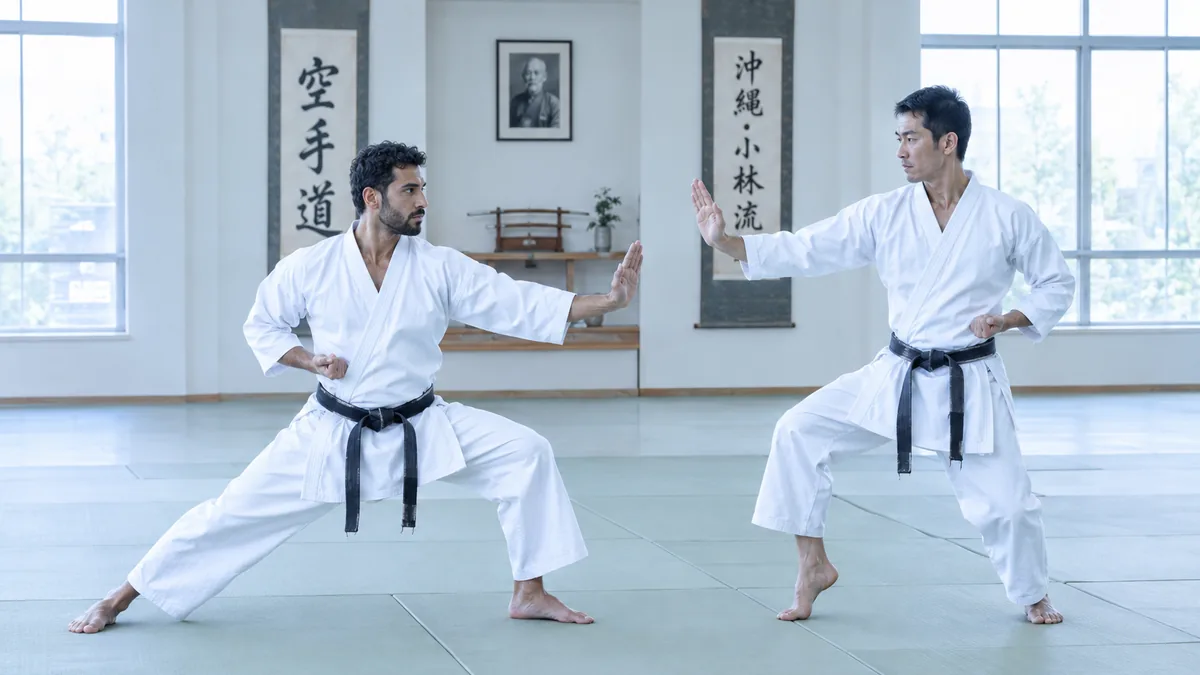
For a sense of how different the resulting styles became, the comparison between Shotokan and Shitō-ryū shows how much variation developed even among styles that share common Okinawan roots.
The Practical Techniques Motobu Left Behind
Motobu published two books during his lifetime: “Okinawa Kenpo Karate-jutsu Kumite-hen” in 1926 and “Watashi no Karate-jutsu” in 1932.1 Both are significant because they document his approach in his own words and through his own demonstrations - not through the interpretations of later students.
Several principles from those texts remain directly applicable:
-
Striking to the face is primary. Motobu consistently emphasised jodan attacks to the face as the most effective targets. WKF competition rules do permit light controlled face contact for senior competitors, but require techniques to stop within 2 centimetres of the target for hand techniques - a constraint that trains practitioners away from committed facial striking as Motobu understood it.
-
The block and counter are one movement. Many instructors repeat this, but Motobu’s application was more aggressive than the standard interpretation. The block was not a defensive pause before the counter - it was the entry point for simultaneous or near-simultaneous striking. Try it: the standard block-then-counter has a gap in it that a fast opponent can exploit. The combined movement feels different - tighter, more committed, and harder to interrupt.
-
Position matters more than power. Motobu wrote about getting to a position where the opponent cannot effectively strike back while you can continue to strike. This is closer to a grappling concept than the standard striking-only karate model, and it connects to why his close-range emphasis made sense as a system.
Common Misconceptions About Motobu’s Legacy
Misconception: Motobu was just a street brawler with no real system.
This comes up regularly and it misreads the evidence. Motobu had formal instruction from respected Okinawan teachers. His emphasis on practical application was a deliberate methodological choice, not a lack of training. The mistake is confusing “less formal” with “less sophisticated.” His approach to Naihanchi kata alone - treating it as a central vehicle for fighting principles rather than a preliminary exercise - reflects a depth of understanding that most modern practitioners never develop.
Misconception: His approach has nothing to offer sport karate practitioners.
The correction that actually helps sport karate practitioners is often exactly the kind of close-range awareness Motobu emphasised. In jiyu-kumite, the moment after a failed attack - when both practitioners are inside the standard fighting distance - is where most points are won and lost at higher levels. Knowing what to do there, how to read the opponent’s recovery, and how to apply pressure rather than retreat is precisely what Motobu’s model trains. It does not fit neatly into WKF rules, but the underlying skills transfer.
Misconception: Motobu’s karate died with him.
Motobu died in April 1944. His third son, Chōsei Motobu (born 1925), inherited the headship of the school and began teaching around 1948.1 In 1977, Chōsei formed the Nihon Karatedō Motobu-kai by uniting dojos with direct connections to his father, and he remains head of the organisation today as the second sōke of Motobu-ryu and custodian of the family’s broader martial heritage.1 The lineage is thin but documented and active.
Why His Legacy Remains Underrepresented
The honest answer is institutional momentum. Funakoshi’s approach produced organisations, syllabuses, gradings, and competition frameworks. Those structures self-perpetuate. The style that can be taught in a school curriculum, examined at grading, and competed at international level will always outgrow the style that resists systematisation.
Motobu’s approach resists systematisation almost by design. You cannot easily reduce “understand this kata deeply enough that you can apply any of it under pressure” to a ten-point grading syllabus. You cannot run a WKF-compliant tournament around close-range simultaneous striking to the face. The approach does not fit the infrastructure that modern karate built.
This is the same tension that runs through the history of other styles. Chojun Miyagi’s Goju-ryu retained more of the close-range grappling-adjacent techniques than Shotokan did, partly because of Miyagi’s own research in China. Hironori Otsuka’s Wado-ryu brought in jujutsu principles that kept some of the close-range application alive. Both sit outside the mainstream for similar structural reasons.
Community Perspective
There is a genuine split in how karate practitioners respond to Motobu’s story. One view is that the mainstream styles simply evolved to serve a different purpose - sport, fitness, discipline, character development - and that criticising them for not being Motobu’s karate is like criticising swimming for not being diving. The purpose changed; the method followed.
The other view is that something was lost that cannot easily be recovered, and that most modern practitioners do not even know it is missing. This realisation tends to arrive somewhere around shodan or nidan - after enough sparring to notice that the standard kihon model does not fully explain what is happening in real exchanges.
Both views contain something true. The disagreement is really about what karate is for - and that question does not have a single answer that applies to every practitioner or every dojo.
What we would say is this: if you train karate primarily for the applied self-defence dimension, Motobu’s principles deserve serious attention. They are not a replacement for your current training. They are a lens that makes certain things visible - particularly at close range - that standard kihon and kumite training tends to obscure.
Key Takeaways
- When training kata, prioritise understanding how each sequence applies under pressure rather than how it looks from the outside. Naihanchi/Tekki is worth spending far more time on than most syllabuses suggest.
- In jiyu-kumite, train specifically for the close-range moment after a failed attack - yours or your opponent’s. This is where Motobu’s principles become immediately practical.
- Watch your opponent’s centre - shoulders and hips - rather than their hands. The correction that makes the biggest difference in reaction time is usually this one, and most beginners resist it for months before it clicks.
- The block-and-counter as a single movement is worth drilling in isolation until the gap disappears. When it is right, it feels like one action rather than two.
- The trade-off between systematisation and fighting effectiveness is real. Knowing which side of that trade your training sits on helps you make informed decisions about what to supplement.
- Motobu’s two published books are primary sources worth reading directly, not just through secondary summaries. They are available in translation and give you his reasoning in his own terms.
References
Checked by the KarateLifestyle editorial team against the official Motobu-ryu organisation website (primary source), Graham Noble's peer-reviewed martial arts history article in the Journal of Combative Sport, and the WKF's 2026 official competition rules in November 2026. Historical dates around Motobu's birth year and the boxer fight remain genuinely disputed across sources; we have adopted the figures supported by the official organisation and the most contemporaneous account respectively, and flagged uncertainty in the text.
- About Nihon Denryu Heiho Motobu Kenpo (official Motobu-ryu organisation history). Motobu-ryu official organisation website, n.d. (primary source for the school's history and Chōsei's succession)
- WKF Kumite Competition Rules 2026 (Version 13 Final). World Karate Federation, 2026. Official rules governing scoring and face-contact distance for senior competitors.
The weekly digest
New karate articles, once a week
One email every week with everything new on Karate Lifestyle. No spam; unsubscribe in one click.
We'll email you to confirm. See our privacy policy.