Gyaku-Hanmi vs Shomen in Kihon: What the Hip Position Is Actually Doing and Why Instructors Disagree on How Much Rotation Is Correct
The hip position debate in kihon is one of those arguments that looks like a disagreement about tradition but is actually a disagreement about mechanics. The honest answer is that both gyaku-hanmi and shomen are correct - but correct for different things, at different moments, in different techniques. The real problem is that many instructors teach one as though it applies universally, and students pay the price in either weak technique or chronic lower back tension.
Here is what the argument is actually about, why it matters, and what we think you should prioritise at each stage of your training.
What do gyaku-hanmi and shomen actually mean in practice?
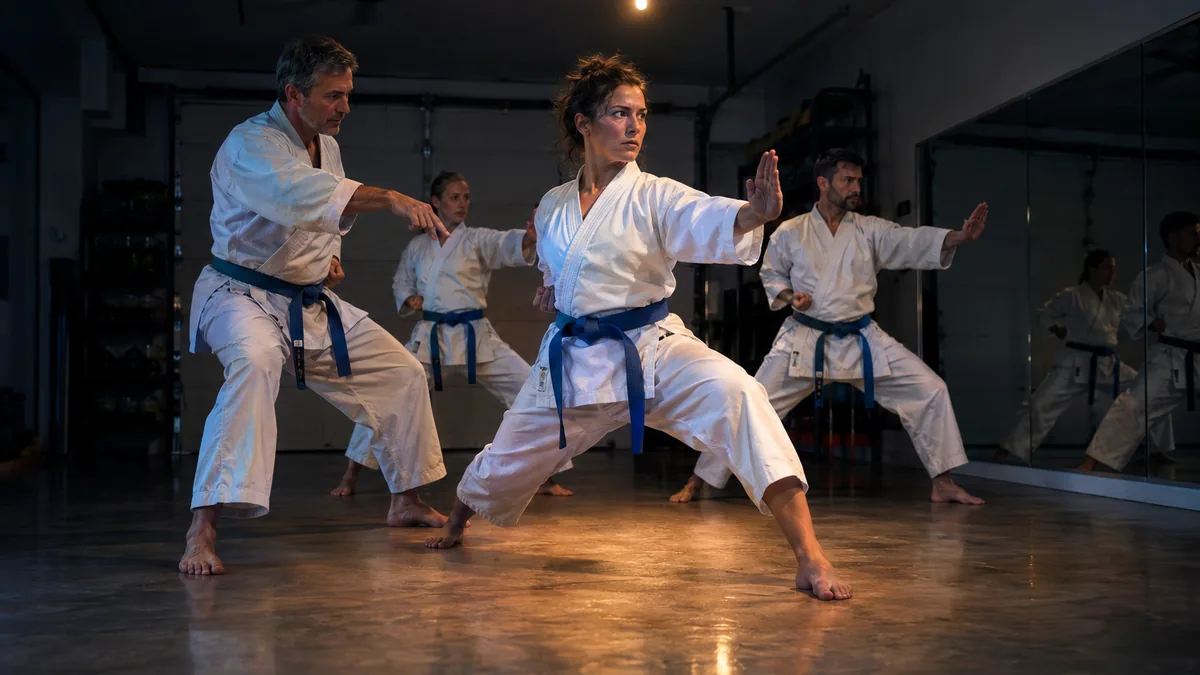
Gyaku-hanmi means the hips are rotated away from the direction of the technique - so in a right-hand reverse punch, the left hip is forward. Shomen means the hips face squarely to the front. Hanmi sits between these two, with the hips at roughly 45 degrees but in the opposite direction to gyaku-hanmi. The Japan Karate Association’s own technical documentation defines hanmi as a 45-degree hip rotation and gyaku-hanmi as the reverse of that position, with the hip on the punching side drawn back.1
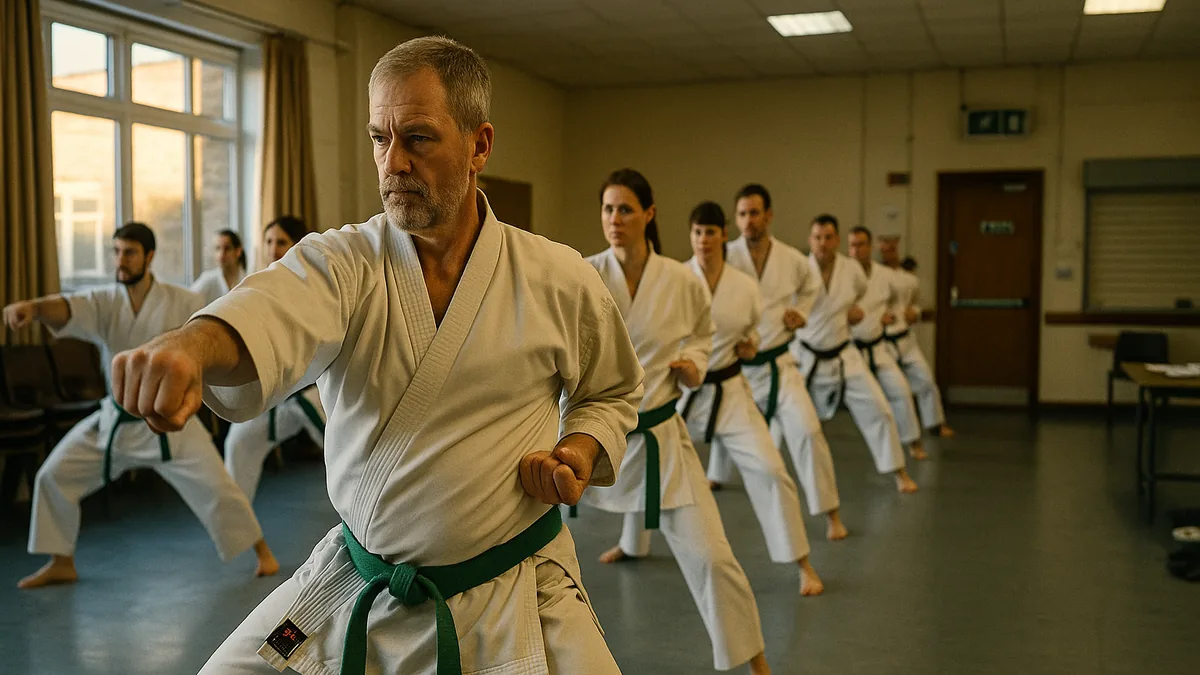
What most people get wrong about this is treating these as fixed positions rather than phases of movement. In a well-executed gyaku-zuki, you are not holding gyaku-hanmi and punching from it - you are driving through it, using the rotation from gyaku-hanmi toward shomen to load and then release power. The hip position at the moment of kime is the end point of a movement, not a static stance you punch from.
This is why power generation in karate is so often misunderstood at the kyu grades. Students see the finished position and try to replicate it without understanding the rotational path that created it.
Why do instructors disagree so strongly on how much rotation is correct?
Because they are often watching different things and prioritising different outcomes. An instructor focused on competition kumite wants fast, repeatable hip snap with clean recovery - they will often cue toward a controlled gyaku-hanmi start and a quick shomen finish, minimising over-rotation. An instructor focused on traditional kihon or kata may insist on a deep, committed shomen at the point of kime, with the hips fully squared and locked.
Both positions have a coherent rationale. The competition-oriented approach prioritises speed and the ability to chain techniques. The traditional approach prioritises maximum force transfer at a single point of impact.
The disagreement becomes a problem when an instructor presents their preference as the only technically valid option. A common mistake is assuming that more rotation always means more power. It does not. Past a certain point, over-rotation pulls the shoulder out of alignment and actually reduces the structural integrity of the punch at the moment of impact. You will feel this as a looseness at the end of the technique - the punch lands but there is nothing behind it.
How does hip position change between oi-zuki and gyaku-zuki?
This is where the mechanics get genuinely interesting and where most students have a gap in their understanding.
In oi-zuki, the hip on the punching side drives forward with the stepping leg. The rotation is different in character - it is more of a forward drive than a lateral snap. Many instructors cue this as “push the hip forward with the punch” rather than “rotate.” Over-rotating into shomen on oi-zuki is a very common error; it tends to collapse the structure of zenkutsu-dachi and makes the punch look and feel like a lunge rather than a committed strike.
Training oi-zuki correctly requires understanding that the hip action here is different from gyaku-zuki - and if your oi-zuki and gyaku-zuki look the same speed, that is often a sign the hip mechanics are not differentiated enough. See also: why your oi-zuki and gyaku-zuki look the same speed.
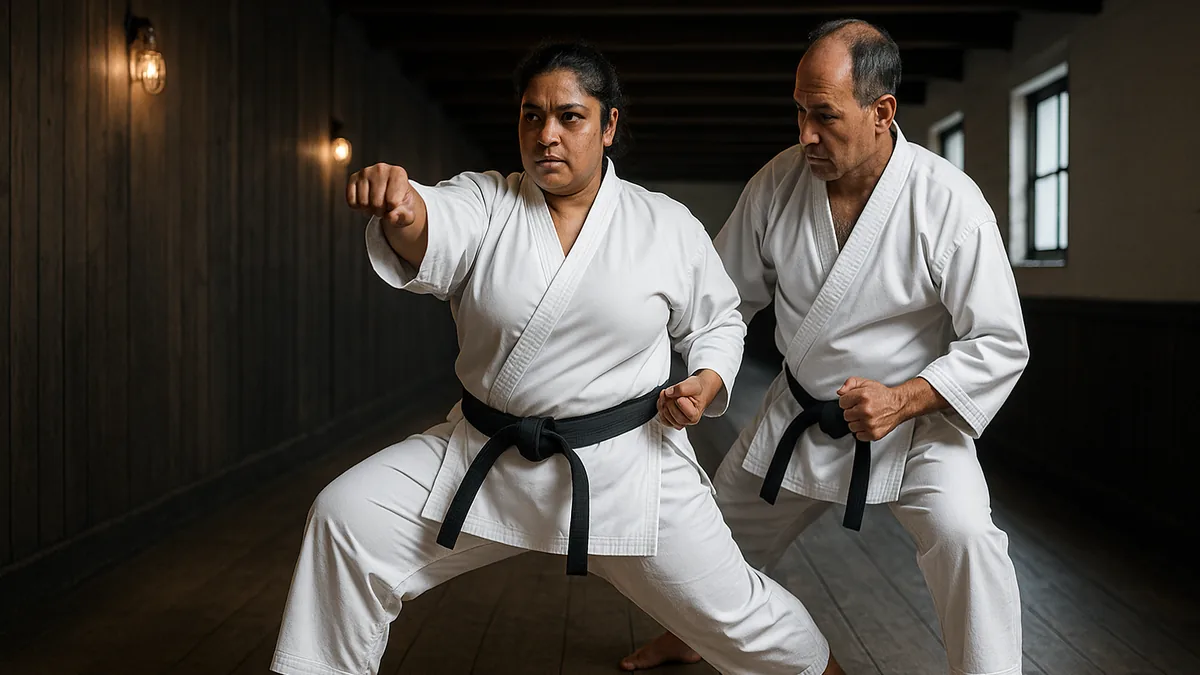
In gyaku-zuki, the rotation is lateral and more obvious. Research using electromyography on the gyaku-tsuki specifically confirms that the punch is initiated by pelvic rotation, which transmits momentum through the trunk, shoulder, arm and fist in sequence.2 The back hip snaps forward, and the correct amount of rotation is enough to drive the shoulder through without over-committing the spine. The correction that works for most students who under-rotate is not “rotate your hips more” but “pull the hikite back harder” - the returning hand creates the rotational force that drives the punching side through. This is exactly why hikite is so frequently neglected and why fixing it changes the punch more than any amount of hip coaching on its own.
What does correct hip rotation actually feel like?
When the hip rotation is working correctly in gyaku-zuki, you will feel the power arrive in the fist rather than feeling like you are pushing the fist to the target. There is a distinct sensation of the body catching up with itself - the legs and hips have driven, the shoulder follows, and the arm is almost a passenger at the end of the chain. The punch feels compact and heavy rather than long and effortful. Kinematic analysis of straight punching confirms this proximal-to-distal sequencing: power originates at the ankle, travels through the knee and hip, crosses to the upper body via the trunk, and reaches the fist last.3
When the hips are under-rotating, the arm does most of the work and the punch feels like an extension of the shoulder. When the hips over-rotate, you will feel instability at the point of kime - the body wants to keep moving past the target, and the punch loses its solidity. Correct rotation feels like a door slamming shut rather than a door swinging open.
At brown and black belt level, the sensation becomes more about timing than range of motion. The question shifts from “how much do I rotate?” to “when does the rotation arrive?” - and the answer is: at exactly the same moment the fist reaches its target. That synchronisation is what kime actually is.
How should you approach this in grading and competition?
For grading in most traditional associations in the UK - the KUGB, SKIGB (affiliated to SKIF), and JKA-affiliated groups - the expectation in kihon lines is clear hip engagement with visible rotation in gyaku-zuki and controlled forward drive in oi-zuki. Examiners are looking for evidence that the hips are powering the technique, not just accompanying it. A punch with no visible hip contribution will be marked down regardless of how fast or accurate it is.
In jiyu-kumite and competition, the calculus changes. A fully committed shomen at the point of kime is fine for a finishing technique, but it leaves you momentarily exposed and slows recovery. The biggest difference between a mid-grade competitor and a senior competitor is often not the power of their techniques but the speed at which the hips reset. Senior practitioners use just enough rotation to generate effective force without sacrificing the ability to immediately counter or defend.
In jiyu-kumite, gyaku-zuki off a failed opponent attack becomes your fastest counter precisely because the hip has less distance to travel if you are already in a slightly bladed stance. That is a practical reason to understand both positions - not just to satisfy your instructor, but because each serves a specific tactical purpose.
Community Perspective
This topic generates genuine disagreement that runs along style lines, generational lines, and increasingly, along the line between traditional and sport-oriented training.
Shotokan practitioners trained in the 1970s and 1980s often insist on deep, full shomen at kime - this reflects the emphasis of that era’s teaching, particularly the JKA’s focus on powerful, committed single techniques. The JKA was sending its most accomplished professional instructors overseas from as early as 1958, and by the 1970s and 1980s that teaching - built around ippon-shobu, the idea of finishing with a single blow - was the dominant influence on Shotokan dojos in the UK.4 Practitioners who came up through sport karate or who have cross-trained in other styles often argue for a more moderate rotation that prioritises speed and combination potential.
There is also a body-type dimension that does not get discussed enough. A practitioner with a naturally mobile lower back can achieve full shomen without strain; someone with a stiffer lumbar spine forcing the same position is creating a structural problem, not a powerful technique. The range of rotation that is mechanically correct varies between individuals, and the honest position is that a fixed angular target - “hips must reach exactly 45 degrees” - is a teaching simplification, not a biomechanical law.
Opinions on this also shift with experience. Many practitioners who were taught to maximise rotation at lower grades find themselves moderating it significantly as they progress, not because they are cutting corners but because they have developed enough sensitivity to feel what is actually generating force versus what is just visible movement. That shift in understanding is part of why copying your instructor has a ceiling - at some point you have to understand the principle, not just the shape.
Key Takeaways
- Gyaku-hanmi and shomen are phases of movement, not static positions. Train the rotation, not the end point.
- The correct amount of hip rotation is the amount that maximises force at the point of kime without destabilising your structure or slowing your recovery. That amount varies by technique, context, and individual.
- If your gyaku-zuki lacks power, fix the hikite before adding more hip rotation. The returning hand drives the rotation more than most students realise.
- For grading in traditional associations, visible hip engagement is non-negotiable. For kumite, hip economy and reset speed matter more than maximum rotation.
- Over-rotation is as much of a problem as under-rotation. You will feel it as looseness at kime - the technique lands without solidity.
- The disagreement between instructors on this topic is real and legitimate. Understanding why they disagree - and what each approach is optimising for - is more useful than picking one and ignoring the other.
- For deeper work on how this connects to overall power generation, see how to generate power in karate and drilling vs sparring ratios.
References
Checked by the KarateLifestyle editorial team against official governing body publications (JKA, KUGB, SKIF), peer-reviewed biomechanics literature (PubMed/PMC, EJPES), and primary association records in November 2026. The biomechanics evidence base for karate-specific hip rotation and kime is growing but most studies focus on overall punch mechanics rather than the hanmi/shomen distinction specifically.
- JKA Technical Instructor Manual (Spanish-language edition, official JKA publication). Japan Karate Association (JKA), technical division. Defines hanmi as 45-degree hip rotation, gyaku-hanmi as its reverse, and specifies that hip rotation from hanmi to shomen must be rapid, fluid and parallel to the floor.
- A Novel, Sport-Specific EMG-Based Method to Evaluate Movement Efficiency in Karate Punching. Peer-reviewed study, Sports (MDPI), DOI: 10.3390/sports13070218. Focuses specifically on gyaku-tsuki; confirms pelvic rotation initiates the punch and transmits power through trunk, shoulder, arm and fist.
- Kinematic and kinetic analysis of throwing a straight punch: the role of trunk rotation in delivering a powerful straight punch. Journal article, European Journal of Physical Education and Sport Science (EJPES), 2017. Confirms proximal-to-distal power sequencing from ankle through knee, hip, trunk, to fist; trunk rotation identified as critical to punch force.
- A Brief History of the Japan Karate Association. Official JKA website. Confirms JKA founded November 1948; documents the JKA's overseas instructor deployment programme from 1958 onwards and its emphasis on ippon-shobu.
The weekly digest
New karate articles, once a week
One email every week with everything new on Karate Lifestyle. No spam; unsubscribe in one click.
We'll email you to confirm. See our privacy policy.