Returning to Full Training After a Knee Injury: A Realistic Timeline and What to Expect at Each Stage
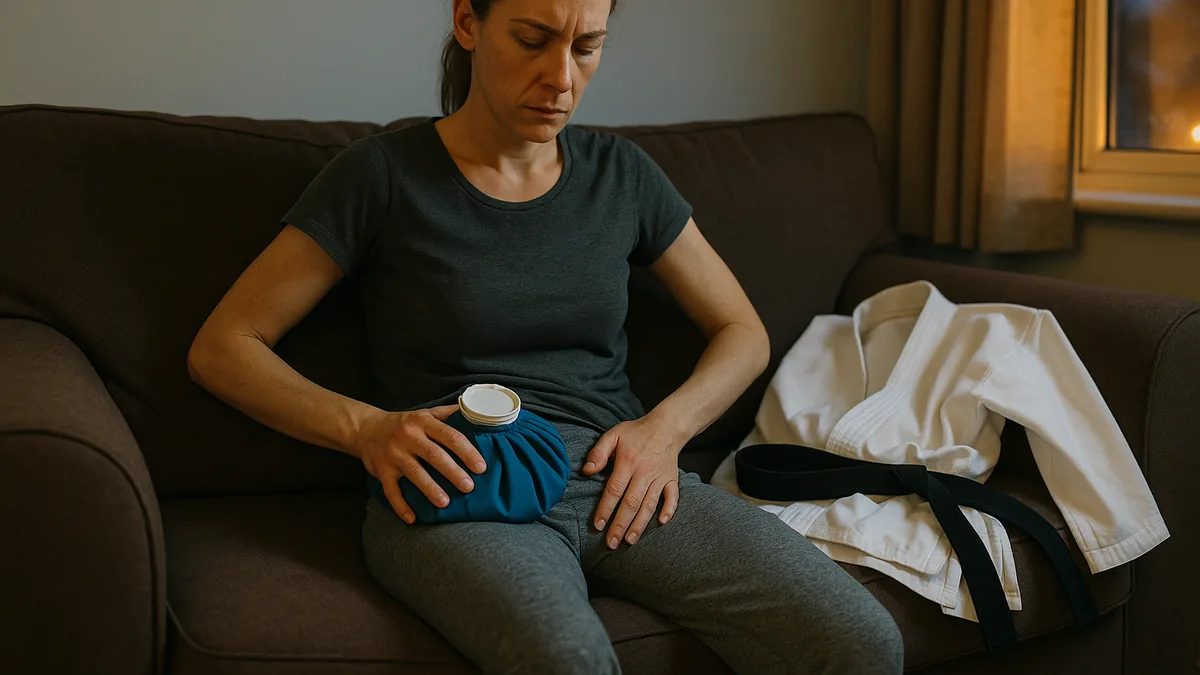
Most people coming back from a knee injury make the same mistake: they wait until the knee feels normal, then try to train like nothing happened. I’ve seen this pattern more times than I can count, and it almost always leads to a setback somewhere between weeks three and six of returning. The knee felt fine in daily life, felt fine in the warm-up, then one deep zanshin stance or a single round of light kumite and it swells up overnight.
The problem isn’t impatience, exactly. It’s that “feeling fine” and “being ready” are two completely different things, and nobody explains what that gap actually looks like in practice.
Here’s what I’ve learned from going through my own knee injury - a partial MCL tear from a badly timed sweep - and from coaching students through everything from minor sprains to post-surgical recovery. The return to full training isn’t a straight line. It’s a series of honest checkpoints, and the practitioners who get back fastest are the ones who take each checkpoint seriously rather than treating it as a box to tick.
Why Phased Return Matters More Than You Think
When the knee is injured, the body doesn’t just damage the tissue - it disrupts the proprioceptive feedback system in the joint. That’s the system that tells your brain where your knee is in space, how much load it’s under, and when to fire the surrounding muscles to protect it. You can have full range of motion and zero pain and still have compromised proprioception, which is exactly why so many practitioners re-injure themselves on a “simple” technique they’ve done ten thousand times.
I used to think rehabilitation was about rebuilding strength. My instructor corrected me on this years ago: “Strength without control is just a faster way to get hurt again.” I didn’t fully understand that until I watched a strong, fit student blow out his knee six weeks after returning from a meniscus injury - doing a basic mawashi geri at half speed. His muscles were strong. His joint control wasn’t there yet.
A phased approach isn’t about being cautious. It’s about rebuilding the right things in the right order so the knee can actually handle what you’re asking of it.
For a deeper understanding of what’s happening in the joint itself, Knee Pain in Karate: What Causes It, What Helps, and When to Stop Ignoring It is worth reading before you start this process.
Phase One: The Foundation Stage (Weeks 1-4 Post-Clearance)
This is the stage most people rush, and it’s the most important one to get right. Your goal here is not to train karate. Your goal is to rebuild the basic movement quality that makes karate training safe.
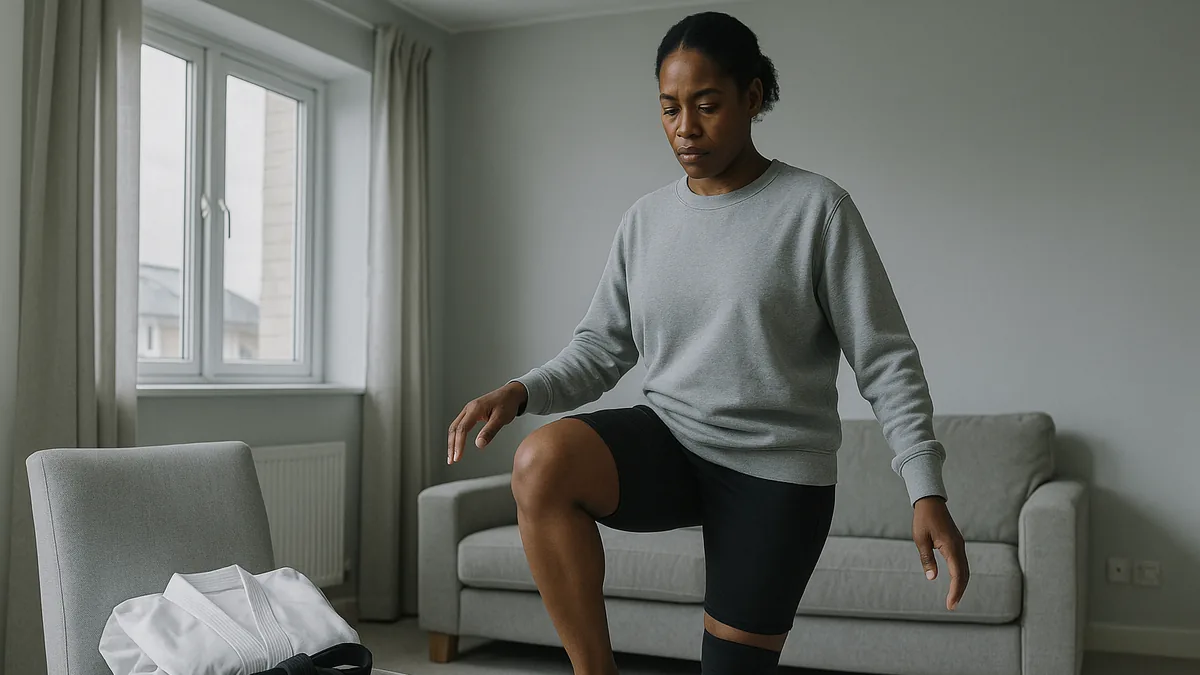
Controlled Single-Leg Balance Work
This is the drill I prioritise above everything else in early recovery, and I’ll be direct: it looks embarrassingly simple, which is why people skip it. Don’t.
Why it matters: Single-leg balance under load is the foundation of every weight-shifting movement in karate - stepping, turning, kicking, transitioning between stances. If you can’t control the knee when it’s the only thing between you and the floor, you have no business putting it under the stress of a gyaku-zuki combination.
Setup: Stand near a wall or chair for safety. Bare feet on a flat surface.
Execution:
- Shift your weight onto the recovering leg and lift the other foot just off the ground.
- Hold for 30 seconds. Don’t let the knee drift inward - keep it tracking over the second toe.
- Rest. Repeat three times.
- Progress to small perturbations - shift your weight slightly forward, back, side to side while maintaining balance.
- Once solid, progress to doing this with eyes closed.
What to feel for: When this is working correctly, you’ll feel the muscles around the knee firing constantly in small adjustments - it almost feels like the joint is “breathing.” If the knee feels locked and rigid, you’re compensating with the hip or ankle. That’s a sign the proprioceptive system isn’t online yet.
The mistake I see most often: Students hold their breath and stiffen everything to stay still. That’s not balance - that’s bracing. Real balance is dynamic, and you’ll feel the difference once you stop trying to freeze.
Terminal Knee Extensions
I’d rate this as the single most undervalued drill for karate-specific knee recovery. It directly strengthens the VMO (the teardrop-shaped muscle just above the inner knee) which is critical for stance stability.
Setup: A resistance band looped around something fixed at knee height, with the band behind the knee.
Execution:
- Face away from the anchor point with the band behind the recovering knee.
- Step forward slightly so there’s tension in the band pulling the knee forward.
- From a slight bend, straighten the knee fully, squeezing the quad hard at the end.
- Control the return - don’t let the band snap you back.
- Three sets of 15.
What to feel for: You’ll feel a focused contraction just above and inside the kneecap. That’s exactly where you want it. If you feel nothing specific, you’re not getting full extension.
Phase Two: Rebuilding Karate-Specific Movement (Weeks 4-8)
By this point you should have solid single-leg control, minimal swelling, and full or near-full range of motion. Now you start reintroducing karate movement patterns - but in isolation, with control, and without power.
Stance Transitions with Deliberate Loading
Why it matters: Zenkutsu-dachi and kiba-dachi aren’t just positions - they’re loaded positions. The knee has to accept and distribute force through every transition. Most practitioners jump straight back into kata without ever testing whether their knee can actually handle stance transitions under load.
Execution:
- Start in shizentai. Step slowly into zenkutsu-dachi, pausing halfway through the transition.
- Hold the halfway point for two seconds. Feel whether the knee is stable or wobbling.
- Complete the stance. Check alignment - knee over second toe, not caving inward.
- Return to shizentai with the same control.
- Ten repetitions each side, no rushing.
What to feel for: The knee should feel like it’s being guided into position by the surrounding muscles. If it feels like it’s “falling” into the stance - like the muscles aren’t engaging until you’re already there - slow down even more. The control has to come before the speed.
The biggest difference I see between students who recover well and those who don’t is willingness to do this drill slowly enough that it’s almost uncomfortable to watch. Slow is where the neuromuscular reprogramming happens.
Low-Impact Kicking Reintroduction
I’d recommend starting with mae geri before any rotational kicks. The straight-line movement is more predictable for the knee than the hip rotation required for mawashi geri or ushiro geri.
Execution:
- From a natural stance, chamber the knee slowly - no snap, no speed.
- Extend the kick to about 60% of your normal height.
- Return to chamber. Return to floor. Control every phase.
- No kiai. No power. Pure movement quality.
When this feels completely stable - and I mean completely, not “probably fine” - you can begin adding height and eventually rotation-based kicks. I’d wait a full two weeks of pain-free mae geri before touching mawashi geri.
Phase Three: Return to Full Training (Weeks 8-16)
This phase is longer than most people expect, and the timeline varies significantly depending on the severity of the original injury. For a minor sprain, eight weeks might be enough. For anything involving surgery or significant ligament damage, sixteen weeks is a realistic minimum before full contact kumite.
Kumite Reintroduction Protocol
The mistake I see most often here is returning to full sparring in a single session. What I tell students is: treat kumite like a separate skill you’re relearning. Your brain has protective patterns built up from the injury - you’ll unconsciously avoid pivoting on that leg, you’ll pull kicks, you’ll hesitate on combinations that require weight transfer. That’s normal. But it means you need to reintroduce sparring contact gradually.
Start with controlled partner drills - one attack, one defence, agreed in advance. No free movement. Then progress to jiyu-ippon kumite where the attacks are called but the response is free. Only then move to full jiyu-kumite, and start with a partner who knows about your recovery and will work with you, not against you.
What to feel for in sparring: When the knee is genuinely ready, you stop thinking about it. You’ll know you’re not there yet if you find yourself checking in on it mid-exchange - “is it okay? Did that feel wrong?” When it’s ready, it just works.
On the question of training frequency during this phase, How Long Should You Rest Between Karate Training Sessions? A Practitioner’s Guide has practical guidance that applies directly to managing load during return to training.
Managing Recovery Between Sessions
Recovery isn’t passive. What you do between training sessions matters as much as the sessions themselves.
I’d recommend reading Active Recovery Days: What Karateka Should Actually Do Between Hard Sessions for specifics, but the principle is this: in the early phases, your off days should include gentle movement, not rest. Walking, cycling, swimming - anything that keeps blood moving through the joint without loading it.
On the mobility versus flexibility question - which matters more for knee recovery - I have a strong opinion: mobility wins every time. Passive flexibility doesn’t translate to joint control under load. Mobility vs Flexibility for Karate Recovery: Why the Difference Matters explains the distinction clearly, and it’s worth understanding before you commit to a stretching routine.
For managing inflammation and soreness between sessions, Epsom Salts, Contrast Showers, and Compression: Which Recovery Tools Are Actually Worth It for Karateka? gives an honest assessment of what actually makes a difference versus what’s just ritual.
Community Perspective
There’s a genuine split in the karate community about how much rest versus active rehabilitation is appropriate after knee injury, and it breaks roughly along generational lines.
Older instructors - and I’ve trained under several who came up in the 1970s and 80s - tend toward “rest it until it’s healed, then get back on the mat.” That approach made sense when the alternative was training on it too soon and making it worse. But it also produced a generation of practitioners with chronic knee problems because they returned without rebuilding the supporting structures.
The modern rehabilitation approach, which is what I use and what I’d recommend, emphasises early controlled movement, proprioceptive training, and a structured return. The evidence for this is strong, and I’ve seen better outcomes with students who follow it.
Where I think the traditional view has something worth keeping: the emphasis on listening to your body rather than following a rigid schedule. A timeline is a guide, not a contract. If you’re at week ten and something still doesn’t feel right, that matters more than the calendar.
Key Takeaways
- Proprioceptive retraining comes before strength work. If the joint can’t tell your brain what it’s doing, more muscle won’t protect it.
- Single-leg balance and terminal knee extensions are the two drills I’d keep even if I had to cut everything else. Do them every day in Phase One.
- Slow stance transitions are not beginner work - they’re the most honest test of whether the knee is actually ready for the next phase.
- “No pain” is not the same as “ready to train.” The absence of symptoms is just the starting point.
- Return to kumite in stages. One full sparring session too early can set you back further than the original injury.
- The practitioners I’ve watched recover fastest are the ones who treated the rehabilitation as seriously as their regular training - not as something to get through, but as something to get right.
The weekly digest
New karate articles, once a week
One email every week with everything new on Karate Lifestyle. No spam; unsubscribe in one click.
We'll email you to confirm. See our privacy policy.