Kumite Conditioning: What Physical Qualities Actually Win Fights and How to Train Them Without Becoming a Gym Athlete
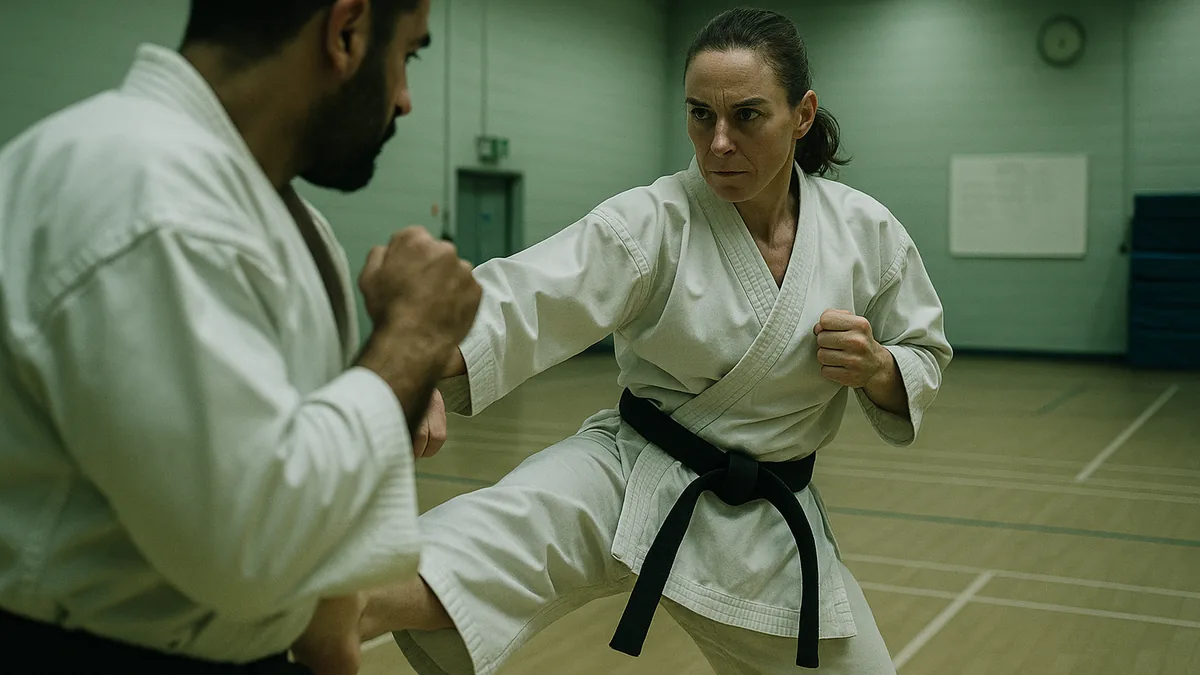
Most people training for kumite spend too much time in the gym doing the wrong things. I’ve watched students come back from an off-season with bigger arms, more muscle, and slower combinations. They’ve been training hard - just not training smart. The physical qualities that actually win fights in kumite are not the ones a standard fitness programme develops, and the gap between “gym fit” and “kumite fit” is wider than most people realise.
This is what I’ve learned works, what I’ve stopped doing, and what I’d tell any motivated competitor who wants to get faster, sharper, and harder to hit without losing their karate in the process.
What Kumite Actually Demands Physically
Before any drill makes sense, you need an honest picture of what you’re training for.
Kumite is not an endurance sport. It’s not a strength sport. It’s a sport built on explosive bursts, recovery between those bursts, and the ability to stay sharp under pressure for the duration of a match. The physical qualities that matter most are: reactive speed, hip-driven power, anaerobic capacity, and postural stability under movement.
Notice what’s not on that list. Raw strength is not on that list. Sustained aerobic endurance is not on that list. Both are useful as a base - but neither is what separates good kumite fighters from great ones. I’ve seen students who could run a 5k without breathing hard get gassed in a 90-second match because they had no anaerobic capacity. I’ve seen strong guys throw weak gyaku-zuki because they had no hip connection.
If you want to understand how your physical style interacts with your fighting approach, this breakdown of passive vs aggressive kumite styles is worth reading alongside this - because the conditioning you prioritise should match the game you’re trying to play.
The Drills That Actually Move the Needle
Interval Sparring Rounds
I rate this above everything else. Not because it’s clever, but because it’s the most honest simulation of what a match actually demands.
Why it matters: A kumite match is not a steady-state effort. It’s 10-second bursts of maximum intensity with passive movement in between. If you don’t train that pattern, your conditioning is for a different sport.
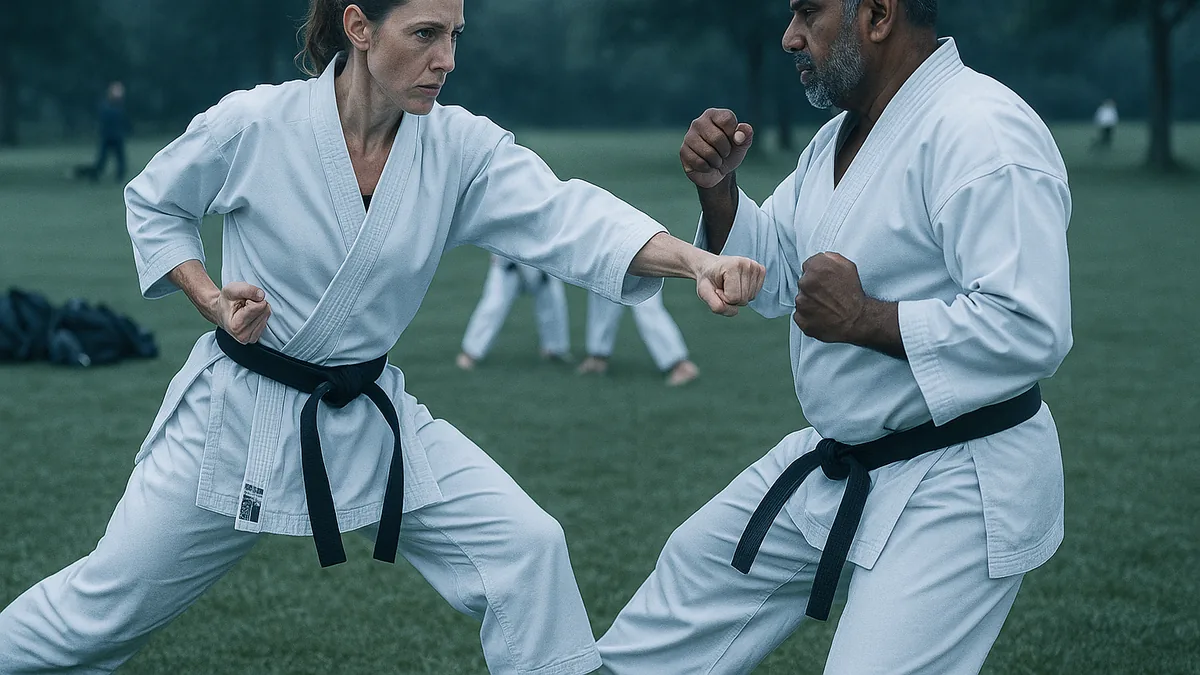
Setup: Two people. One pad or one partner. Timer set for 8-second work, 12-second active rest. Six to eight rounds per set. Two to three sets with two-minute rest between sets.
Execution:
- On the work signal, attack at absolute maximum intensity - combinations, pressure, movement, everything.
- On the rest signal, keep moving. Don’t stop. Stay on your toes, stay in guard, just drop the output.
- On the next work signal, go again at maximum.
What to feel for: By round four, the rest period should feel barely long enough to recover. If you’re recovering easily, the work intervals are not hard enough. When you’re doing this right, you’ll feel the lactic acid building in your legs, not your arms - that tells you you’re staying mobile through the rest periods instead of standing flat-footed.
The mistake I see most often: People pace themselves through the work intervals. They’re thinking about surviving the set. What I tell students is that the whole point is to train your system to recover fast from maximum output - if you’re not hitting maximum, you’re not training the right quality. Go harder for less time, not easier for longer.
Hip Isolation Punching Drill
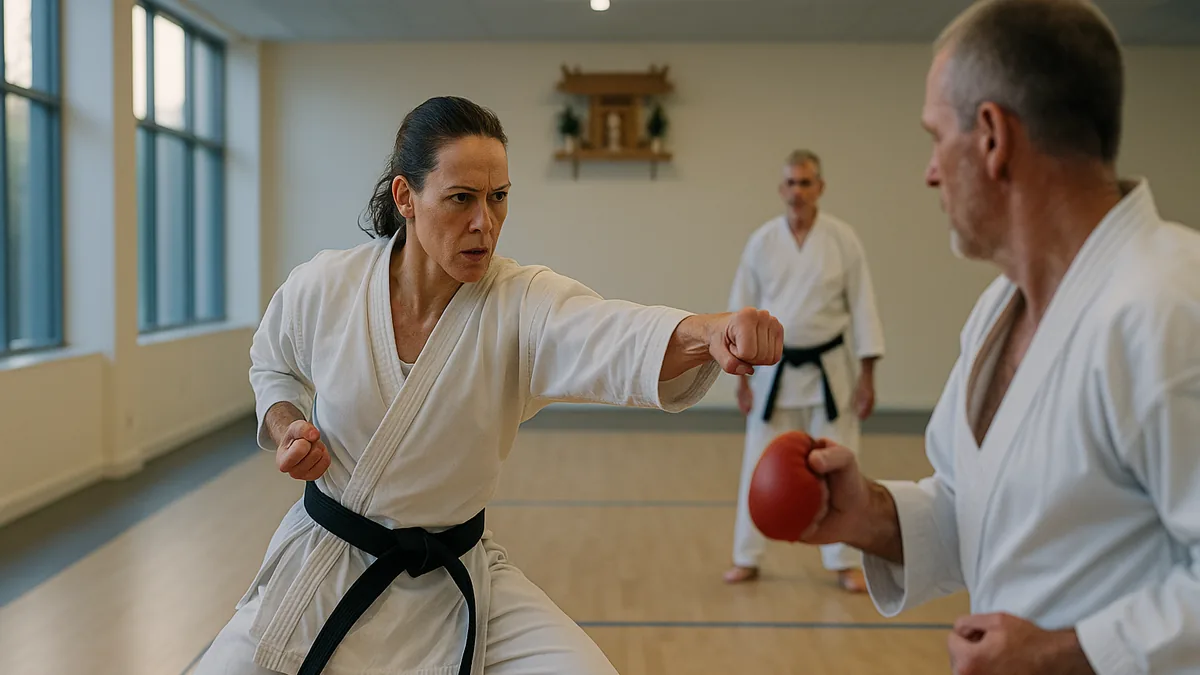
I used to think powerful gyaku-zuki was about shoulder drive. My instructor kept telling me “the hip is the punch” and I nodded along without really getting it. Then in a club training session, he held a pad and told me to punch it with only my arm - then with my hip. The difference in impact was embarrassing. That was the moment it clicked.
Why it matters: Hip rotation is not a style preference. It’s the mechanical source of power in every straight punch. Without it, you’re throwing your arm. With it, you’re throwing your body weight.
Setup: Stand in a fighting stance facing a wall pad or a partner holding a focus pad. Feet shoulder-width, front foot pointing forward, back foot at roughly 45 degrees.
Execution:
- Start with your back hip pulled back - feel the tension in your obliques.
- Initiate the punch by driving the back hip forward and through.
- Let the shoulder follow the hip, not the other way around.
- The fist arrives last.
What to feel for: When the timing is right, the impact travels through your whole body, not just your arm. You’ll feel it in your back foot, through your core, into the target. It almost feels like you’re falling into the punch rather than throwing it. When it’s wrong, you feel the impact only in your arm and shoulder - that’s your signal the hip is late.
The mistake I see most often: Students fire the shoulder first and try to bring the hip along for the ride. This happens because the arm is what they can see and control consciously. The correction that works for me is telling them to think of the punch starting below the belt. Forget the arm exists for the first half of the movement.
For more on how this applies specifically to competition scoring, the breakdown of gyaku-zuki vs kizami-zuki in competition gets into the practical tradeoffs.
Reaction Pad Work
Not standard pad work. Reaction pad work. The difference is who initiates.
Why it matters: In kumite, you rarely attack into a static target. You attack into an opening. That opening appears and disappears in fractions of a second. Training your hands to respond to a visual cue is a different skill to training them to throw combinations on command.
Setup: Pad holder stands in front of you. No pre-agreed combinations. Pad holder presents the pad at random - different heights, different angles, sometimes fake presentations.
Execution:
- Stay in guard. Stay moving.
- When the pad appears, attack it immediately - no preparation, no wind-up.
- Return to guard and reset.
- If the pad disappears before you hit it, stop. Don’t chase it.
What to feel for: A clean reaction hit feels different to a prepared one. There’s less tension in it. Your body moves before your brain has finished processing. When you’re reacting well, the technique feels almost automatic - the sensation is of catching something rather than throwing something.
Progression: Once this is working, add a penalty for hitting a fake. Pad holder occasionally presents a pad and pulls it away - if you swing and miss, you do five push-ups. This builds the discipline to not fire on incomplete information, which is one of the most valuable skills in kumite.
Defensive Footwork Ladder
I’ll be honest - footwork drills with an agility ladder are mostly overrated for kumite. The patterns are too fixed and the speed is too linear. What I use instead is directional reaction footwork.
Setup: Mark four points around you - front, back, left, right - with cones or tape. Stand in the centre.
Execution:
- Partner calls or points a direction.
- You move to that point with a defensive step - not a jump, not a shuffle, a proper weight-transferred step that leaves you in a balanced stance.
- Return to centre.
- Increase the speed of calls until you’re moving on reaction rather than decision.
What to feel for: Good defensive movement feels grounded. Your weight transfers, your stance closes, and you feel ready to counter. Bad defensive movement feels floaty - you’ve moved your feet but not your balance. If you feel like you’re tipping when you arrive at the point, you moved too fast for your balance to follow.
This directly feeds into the kind of footwork you need when managing close range - something covered well in how to use the clinch range in kumite without getting penalised.
What Changes With Experience
Most beginners train conditioning as a separate thing from kumite. They run, they do circuits, they do pad work, and then they spar. Senior practitioners don’t separate them. The conditioning becomes the sparring. Every round is also a conditioning session because the intensity and duration are managed deliberately.
I’ve noticed that the biggest shift between intermediate and advanced competitors is not physical capacity - it’s efficiency. Advanced fighters use less energy to do the same work. Their movement is more economical. Their attacks are sharper because they’re not wasting tension in their shoulders. The conditioning work that supports this is not more - it’s more specific.
If you’re competing at masters level, the physical demands shift again. Kumite after 40 covers this honestly - recovery time changes, and the way you train needs to account for that without abandoning intensity.
Community Perspective
There’s a genuine split in how dojos approach kumite conditioning, and I don’t think either side is completely right.
One camp says kumite conditioning should happen on the dojo floor - more sparring, more pressure training, more rounds. The other camp says dedicated physical conditioning outside the dojo is necessary for serious competitors, and that sparring alone doesn’t develop the specific physical qualities fast enough.
I’ve trained both ways. My honest take: sparring alone is enough to maintain fitness, but not enough to develop it quickly. If you want to move up a level in a reasonable timeframe, you need some dedicated conditioning work outside the dojo. But that work has to be kumite-specific - not generic fitness. The mistake is doing gym work that makes you feel fitter without making you fight better.
The other debate worth naming is about strength training. I think a lot of karateka avoid it because they’re worried about becoming slow or stiff. In my experience, sensible strength work - focused on hip extension, core stability, and leg drive - makes you faster, not slower. The key word is sensible. Heavy bench press three times a week is not sensible for a kumite competitor.
For practitioners thinking about how build affects conditioning demands, this guide for heavier or shorter karateka is worth reading alongside this one.
Key Takeaways
- Train the work-to-rest ratio of an actual match - 8 to 10 seconds maximum effort, short active recovery, repeated. Generic cardio does not prepare you for this.
- The hip rotation is the whole punch. If you’re not feeling impact through your back foot, the hip is not driving the technique.
- Reaction work is a separate skill to combination work. Train both, but don’t confuse them.
- Defensive footwork should leave you in a balanced, ready position - if you feel unstable when you arrive, the movement was wrong regardless of how fast it was.
- Conditioning and kumite skill are not separate tracks. The most efficient path is conditioning work that is structurally identical to competition demands.
- If you’re managing intensity and aggression in competition, physical conditioning is part of that picture - a gassed fighter is an undisciplined fighter.
The weekly digest
New karate articles, once a week
One email every week with everything new on Karate Lifestyle. No spam; unsubscribe in one click.
We'll email you to confirm. See our privacy policy.