How to Practise Karate at Home
Most people’s home training is worse than they think it is. Not because they’re lazy - because they’re practising the wrong things in the wrong way, and the dojo never quite fixes it because class time is limited and instructors can’t watch everyone at once. I’ve been in that position myself, and I’ve watched students do it for years.
Home training can genuinely accelerate your development. I’ve seen students who trained consistently at home overtake people who only trained in class, even when the class-only students had better natural ability. But I’ve also seen home training cement bad habits that took months to unlearn. The difference is almost always the same thing: whether the student understood what home training is actually for.
What Home Training Is Actually For
Here’s the honest version: home training is for drilling what you already understand. It is not for learning new things.
I know that sounds limiting. It isn’t. Most of us have more than enough material we understand conceptually but haven’t drilled into our bodies. That gap - between knowing and doing - is exactly what home training closes.
When you’re in class, you’re learning. You’re receiving correction, watching others, processing new information. Your brain is busy. At home, the learning phase is over. Now you’re building the physical memory that makes technique automatic. That’s a different kind of work, and it requires a different mindset.
What I tell students is this: if you can’t do it cleanly in the dojo, don’t drill it at home. You’ll just ingrain the mistake. Wait until your instructor has corrected it and you’ve felt the right version a few times. Then take it home and drill it until it stops requiring conscious thought.
If you want to understand what kihon training is actually trying to build, What Is Kihon? A Guide to Karate Basics is worth reading before you set up your home routine.
Space Requirements - The Honest Picture
You need less space than you think for most things, and more than you have for a few specific things.
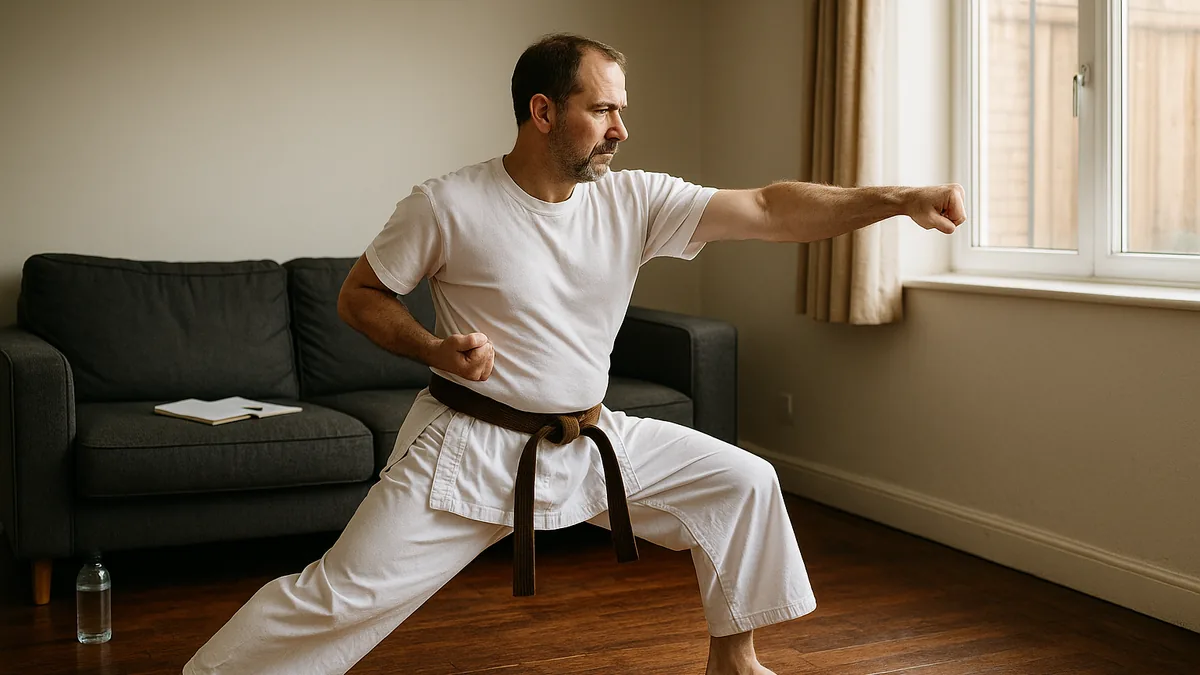
For stationary basics - punches, blocks, strikes practised on the spot - you need roughly two arm-lengths in every direction. That’s it. A cleared living room corner works. I trained for a full year in a student flat where my elbow would have hit the wardrobe if I’d turned the wrong way. You adapt.
For moving basics - stepping punches, combinations with footwork, any kind of ido-geiko - you need a straight run of at least four to six steps. A hallway often works better than a living room for this. I’ve done stepping punches down a long hallway more times than I can count. It’s not ideal, but it’s enough.
What genuinely doesn’t work at home:
- Full kata that require large space and diagonal movements
- Kumite practice of any real value (you need a partner)
- Anything requiring a makiwara or bag if you don’t have one
Don’t try to compress kata into a smaller space by adjusting your steps. You’ll learn a version of the kata that doesn’t match what you’re supposed to be doing, and unpicking that is genuinely difficult. Either find the space or skip the kata and focus on kihon instead.
What Actually Transfers From Home Training
Stance work transfers extremely well. This is probably the single most underused aspect of home training, and it’s where I’d put the majority of my own time if I was starting again.
I’ve noticed that most students treat stances as something that happens while they’re doing something else - the punch is the main event, the stance is just where you happen to be standing. That’s backwards. The stance is the foundation that makes everything else possible. Karate Stances Explained goes into the detail, but the short version is: if your zenkutsu-dachi is wrong, your oi-zuki is wrong, and no amount of punching practice will fix it.
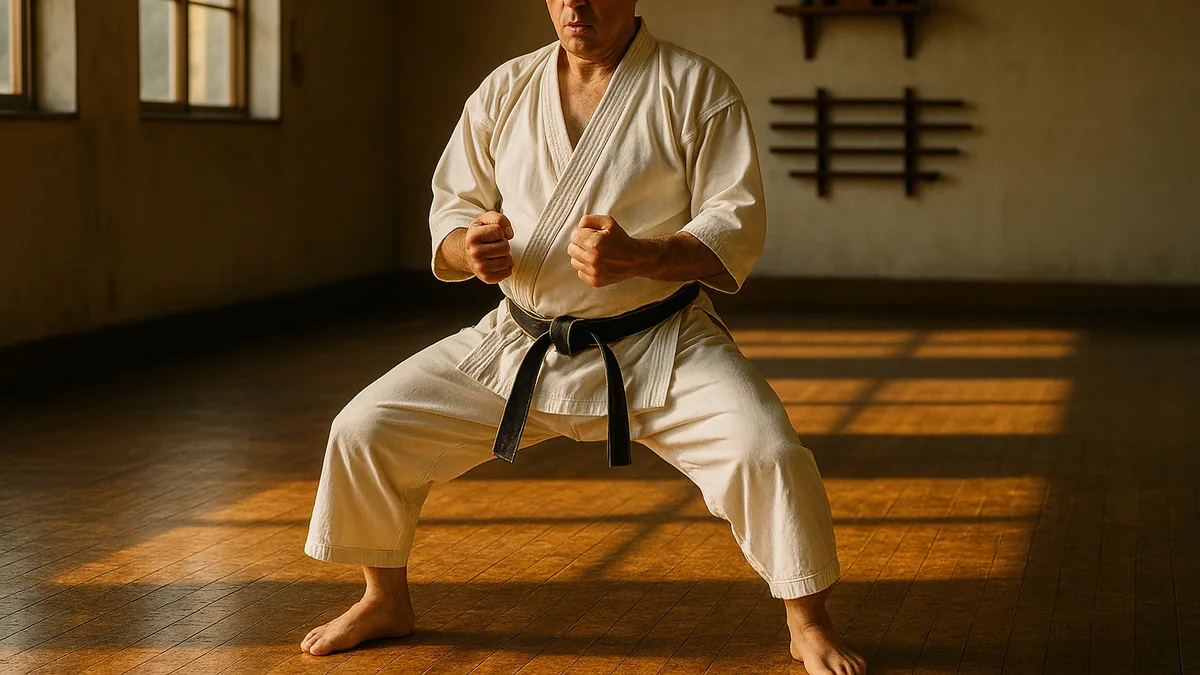
Spend time just holding stances. Not moving, not punching - just being in the stance, feeling where the weight sits, whether your back knee is tracking correctly, whether your hips are level. It feels wrong at first because it feels like nothing is happening. Something is happening. You’re building the physical reference point that your body will return to automatically under pressure.
Timing and rhythm transfer well too. Practising combinations at home - even without a partner or target - builds the internal rhythm of technique. The pause between techniques, the compression before the kime, the recovery after. These things are hard to drill in class because class has its own rhythm. At home, you set the pace.
What transfers poorly:
- Distance judgment - You cannot develop ma-ai without a partner. Full stop.
- Reaction - Drilling your own combinations doesn’t train you to respond to anything. It trains you to execute in a vacuum.
- Pressure testing - Technique that works in your living room may collapse completely under stress. That’s not a reason not to train at home. It’s just a reason to be honest about what home training is and isn’t doing.
The Mistakes I See Constantly
Training too fast. This is the most common one. Students go home and drill at full speed because it feels productive. It isn’t - not at that stage. Speed without structure just burns in the errors faster. What I tell students is to find the speed at which you can feel every part of the technique, then work at that speed until it becomes automatic. The speed comes later, and it comes naturally once the mechanics are right.
Losing kime because there’s no target. In the dojo, you’re punching toward a partner or at least imagining one. At home, the mind drifts. The punch loses its endpoint, the focus disappears, and you’re basically just moving your arm. I’ve noticed this in my own training - after ten or fifteen minutes of solo work, the quality of kime quietly degrades unless I’m actively maintaining it. Set a visual target. A mark on the wall, a piece of tape at head height, anything. Your technique needs somewhere to go.
Neglecting the non-dominant side. In class, the instructor calls the combination and everyone does it together. At home, you choose. And almost everyone, left to their own devices, drills their strong side more. I did it for years. By the time I noticed, my left gyaku-zuki was noticeably weaker than my right in grading situations. Force yourself to do equal repetitions on both sides, and if anything, spend extra time on the weaker side.
Drilling kata without understanding what the kata is for. This one is harder to correct because it requires a conversation with your instructor, not just a technical fix. But I’ve seen students spend hours drilling kata at home and come back to the dojo having learned to perform a sequence of movements with no understanding of what any of them mean. If you don’t know the application of at least the basic techniques in a kata, drilling it at home is mostly aesthetic practice. That has some value, but it’s limited.
How to Structure a Home Session
I prefer shorter, more frequent sessions over long occasional ones. Twenty minutes four times a week will do more for you than ninety minutes once a week. The neural pathways you’re trying to build respond to frequency, not volume.
A structure that works:
-
Five minutes of kihon on the spot - Pick two or three techniques from your current grading syllabus. Drill them slowly, feeling each part. Not for speed, not for power - for accuracy.
-
Five to ten minutes of moving basics - Stepping combinations if you have the space. Focus on the transition between techniques, not the techniques themselves. The connection is where most people lose quality.
-
Five minutes of stance work - Hold each stance for thirty seconds. Feel where you’re compensating. This is uncomfortable and boring and genuinely useful.
-
Five minutes of a single kata or kata section - Only if you have the space and understand the material. Otherwise, replace this with more kihon.
That’s twenty to twenty-five minutes. You can do that in a cleared living room. You don’t need equipment, you don’t need a partner, and you don’t need to warm up extensively for this kind of controlled drilling.
For more structured drill ideas, Kihon Training Drills for Beginners has material that works well in a home context.
The Power Question
A lot of students try to work on power generation at home and end up reinforcing the wrong mechanics. The reason is that power in karate doesn’t come from what it looks like it comes from. As a white belt I thought it was about arm speed. By brown belt I realised the arm is almost irrelevant - the power comes from the hip, the stance, the weight transfer, and the connection between all three. How to Generate Power in Karate covers this properly.
The problem with drilling power at home is that without a target that gives you feedback, you can’t tell whether your mechanics are actually generating force or whether you’re just moving quickly. The punch feels powerful because your arm is moving fast. Hit a makiwara and you find out the truth very quickly.
If you don’t have a bag or makiwara, I’d honestly recommend not focusing on power at home. Focus on mechanics. The power follows from correct mechanics, and you’ll develop it faster by getting the mechanics right than by trying to force it in a feedback vacuum. If you’re thinking about investing in equipment, the karate training equipment for home guide covers what’s genuinely worth buying and what isn’t.
Community Perspective
There’s a genuine split in how different dojos approach home training, and it’s worth being honest about it.
Traditional instructors - and I’ve trained under several - often discourage unsupervised practice, particularly for lower grades. The argument is that you’ll ingrain mistakes and that technique needs to be developed under a watchful eye. I understand that position. I’ve seen it happen.
But I’ve also seen students who trained at home consistently develop a level of physical automaticity that class-only students couldn’t match. The difference was always whether the home training was disciplined and focused on correctly understood material.
My position is that home training is worth doing, but only once you’re past the very early stages where you’re still forming your basic understanding of technique. White belts probably shouldn’t drill heavily at home unless their instructor has specifically given them material to work on. Once you’re past that stage, home training is one of the most efficient things you can do.
The other disagreement is about kata at home. Some instructors actively encourage it. Others think kata practised without correction becomes performance rather than training. I lean toward the sceptical view - I’d rather a student drilled kihon at home and saved kata for the dojo, where it can be seen and corrected.
Key Takeaways
- Only drill at home what you already understand and have had corrected in class - home training builds physical memory, not new understanding
- Stance work is the most underused home training tool available; spend more time on it than feels necessary
- Train slowly enough to feel every part of the technique - speed without structure just ingrains errors faster. The article on why practising slowly builds speed explains the neuroscience behind this
- Set a visual target for every technique; kime disappears without something to aim at
- Keep sessions short and frequent rather than long and occasional - twenty minutes four times a week beats ninety minutes once
- Be honest about what home training can’t do: distance judgment, reaction, and pressure-testing all require a partner and a dojo
Why Kihon Still Matters at Every Belt Level is worth reading alongside this if you’re thinking about how your home training fits into your broader development. And if you’re working on your blocking mechanics in your home sessions, Blocking in Karate: Why Most Blocks Fail will give you things to focus on that most students miss entirely.
The weekly digest
New karate articles, once a week
One email every week with everything new on Karate Lifestyle. No spam; unsubscribe in one click.
We'll email you to confirm. See our privacy policy.